RBI Remittance Cap and Rupee Stability
Source:The Hindu ↗
Why It Matters
It addresses crucial macroeconomic policy tools used by the central bank to manage exchange rate volatility, capital account convertibility, and external sector stability amid heavy foreign exchange outflows.
Summary
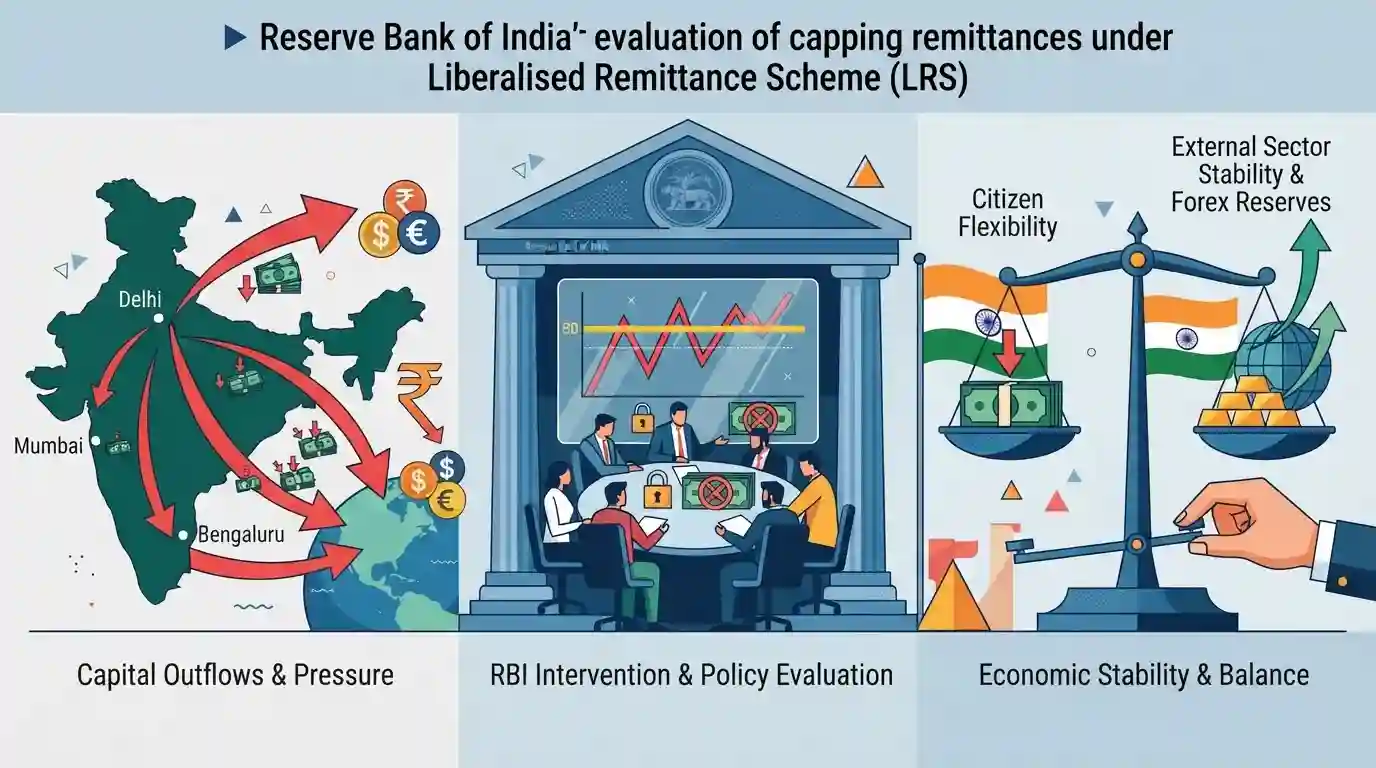
The Reserve Bank of India is evaluating proposals to cap select overseas remittances at 50 lakh rupees under the Liberalised Remittance Scheme. The measure is aimed at arresting massive capital outflows that weaken the Indian rupee and deplete foreign exchange reserves, balancing external sector stability with citizen flexibility.
Key Points
- The Reserve Bank of India is considering capping select overseas remittances under the Liberalised Remittance Scheme (LRS) at 50 lakh rupees to curb heavy capital outflows and protect the depreciating Indian rupee.
- Large-scale outward remittances put downward pressure on the domestic currency, forcing the central bank to intervene in the foreign exchange market and deplete its forex reserves.
- Such regulatory adjustments highlight the balance central banks must maintain between providing capital account freedom and safeguarding macroeconomic stability.
Important Terms
Liberalised Remittance Scheme

An RBI mechanism under FEMA 1999 that permits resident individuals to freely remit up to USD 250,000 per financial year for overseas current and capital account transactions.
UPSC context
UPSC Prelims/Mains (GS Paper III): Important for questions on foreign exchange management, capital account convertibility, and external sector stability.
Reserve Bank of India
India's central banking institution established under the RBI Act 1934, responsible for regulating currency, monetary policy, and foreign exchange reserves to ensure financial stability.
UPSC context
UPSC Prelims/Mains (GS Paper III): Essential for Indian Economy, monetary policy, banking sector reforms, and regulation of financial markets.
Prelims Trap
resident individuals can remit unlimited funds under the Liberalised Remittance Scheme for any purpose without regulatory caps.
Aspirants often confuse LRS with current account transactions or assume India has full capital account convertibility, whereas LRS is only a calibrated relaxation for resident individuals.
Static Concepts Connected
What is the difference between current account convertibility and capital account convertibility in India?
- Current Account:: Current account convertibility allows free conversion of currency for international trade in goods and services, which India achieved under IMF Article VIII in 1994.
- Capital Account:: Capital account convertibility permits free movement of financial assets and capital flows, which India maintains only partially through mechanisms like LRS and FPI caps.
- Tarapore Committee:: The Tarapore Committee (1997 and 2006) laid down a roadmap and crucial prerequisites for full capital account convertibility in India.
Cross-Topic Patterns
Capital Outflows + Exchange Rate Management
Large LRS outflows connect foreign exchange management directly with capital account convertibility debates in the Union Budget and fiscal deficit management.
Forex Reserves + External Sector Stability
Central bank interventions to protect the rupee directly deplete foreign exchange reserves, impacting import cover and external sector vulnerability.

RBI's LRS caps and capital account convertibility will likely be tested via a statement-based question linking forex reserves to rupee depreciation.
Linked PYQs · 3
Linked PYQs · 3
- 2022PrelimsGS1
Consider the following statements: 1. Tight monetary policy of US Federal Reserve could lead to capital flight. 2. Capital flight may increase the interest cost of firms with existing External Commercial Borrowings (ECBs). 3. Devaluation of domestic currency decreases the currency risk associated with ECBs. Which of the statements given above are correct?
- 2019PrelimsGS1
Which one of the following is not the most likely measure the Government/RBI takes to stop the slide of Indian rupee?
- 2022PrelimsGS1
With reference to the Indian economy, consider the following statements: 1. If the inflation is too high, Reserve Bank of India (RBI) is likely to buy government securities. 2. If the rupee is rapidly depreciating, RBI is likely to sell dollars in the market. 3. If interest rates in the USA or European Union were to fall, that is likely to induce RBI to buy dollars. Which of the statements given above are correct?
