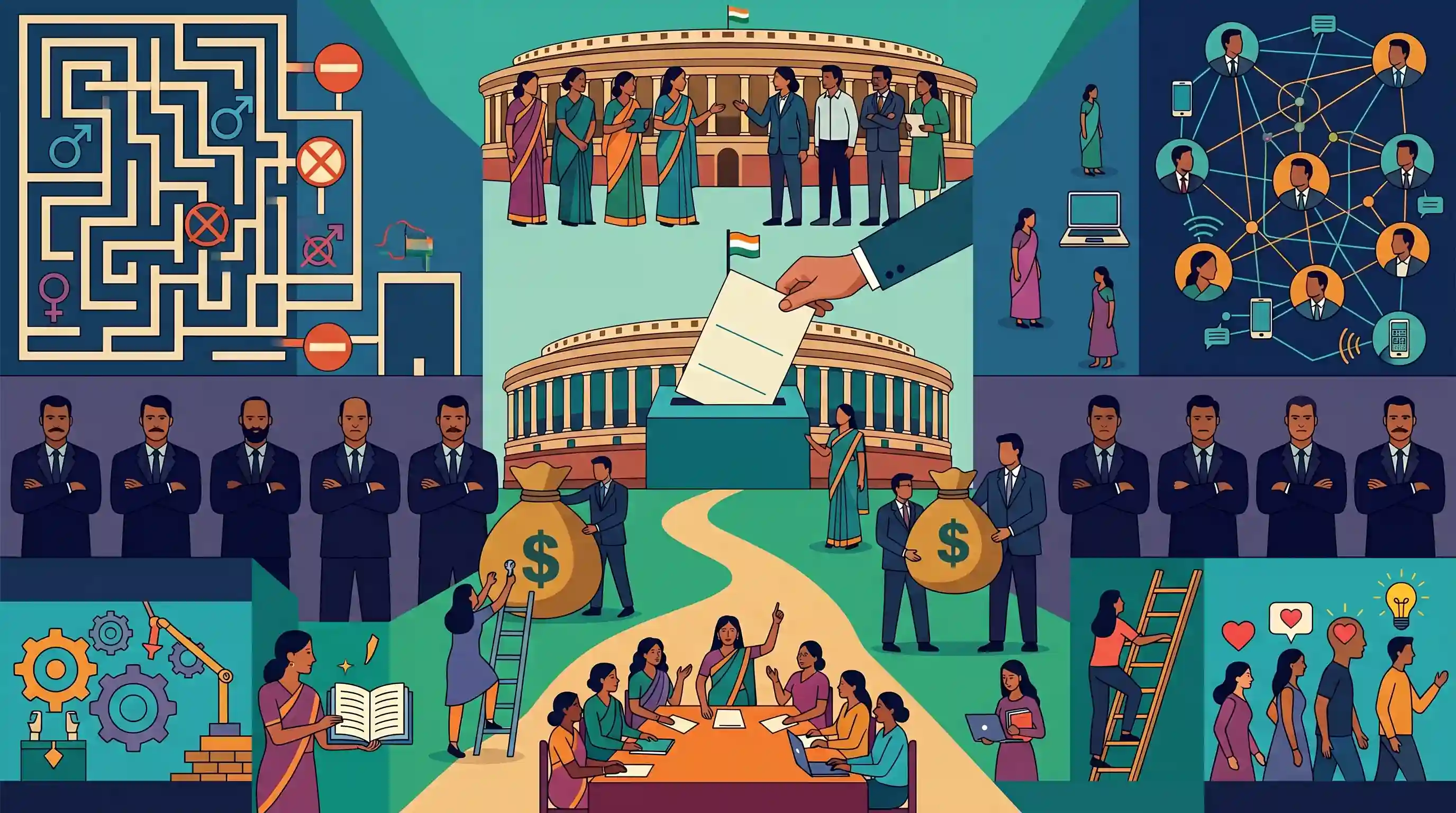
Structural barriers limiting women political representation in India
Source:The Hindu ↗
Why It Matters
Understanding the nuances of women's political representation is crucial for GS-2 (Social Justice and Governance). The Nari Shakti Vandan Adhiniyam is a landmark legislation, and candidates must critically evaluate its potential impact and limitations, connecting it to broader themes of patriarchy, structural inequality, and the functioning of democratic institutions.
Summary
The article critically analyzes the limitations of relying solely on legislative quotas, such as the Nari Shakti Vandan Adhiniyam, to enhance women's political representation in India. It argues that while reservations guarantee a numerical presence in legislatures, substantive political empowerment is heavily hindered by entrenched structural barriers. These include a patriarchal political culture, severe financial constraints, biases within political parties regarding ticket distribution, and a lack of social capital. Drawing parallels from the experience of local bodies, the piece emphasizes that achieving genuine gender parity requires systemic reforms, capacity building, and a shift in societal attitudes alongside quota implementation.
Key Points
- Legislative quotas like the Nari Shakti Vandan Adhiniyam are necessary for numerical representation but insufficient on their own to guarantee substantive political empowerment for women.
- Women face significant structural barriers in politics, including a deeply patriarchal political culture, lack of financial autonomy, and limited access to social capital and networks.
- Political parties often display bias by prioritizing 'winnability' over gender parity in ticket distribution and relegating women to 'soft' portfolios.
- The experience of women in local self-government (Panchayats) highlights challenges such as proxy representation ('sarpanch pati' syndrome), demonstrating that quotas must be complemented by capacity building and structural reforms.
- True representation requires a multi-pronged approach involving civil society engagement, inner-party democracy, and systematic dismantling of gendered political norms.
Important Terms
Nari Shakti Vandan Adhiniyam

The 106th Constitutional Amendment Act (2023) mandating 33% seat reservation for women in Lok Sabha and State Legislative Assemblies. Its implementation is contingent upon a post-enactment Census and subsequent Delimitation exercise.
UPSC context
GS Paper II (Polity/Social Justice); tests understanding of gender-based legislative reforms and technical implementation hurdles like delimitation.
73rd and 74th Constitutional Amendment Acts
The 1992 laws that constitutionalized rural and urban local bodies, respectively. They mandated a minimum 33% reservation for women in elected seats and chairperson positions to ensure grassroots political participation.
UPSC context
GS Paper II (Local Self-Government); essential for analyzing decentralization and the historical precedent for women's political quotas in India.
Substantive Representation
The concept that representation should go beyond demographic mirroring (descriptive) to include the active advocacy and implementation of policies that specifically address the needs and interests of the represented group.
UPSC context
GS Paper II (Governance); tests the ability to distinguish between numerical presence and actual policy influence in democratic institutions.
Sarpanch-Pati (Proxy Representation)
A phenomenon in local governance where male relatives of elected women representatives exercise actual decision-making power. This 'proxy' leadership undermines the constitutional objective of independent female political empowerment.
UPSC context
GS Paper II (Social Justice/Governance); highlights structural and patriarchal barriers that hinder the spirit of women's reservation.
Internal Party Democracy
The degree to which political parties follow democratic norms in their organization, specifically in candidate selection. A lack of transparency often results in biases against women due to perceived 'winnability'.
UPSC context
GS Paper II (Political Parties/Electoral Reforms); critical for discussing systemic barriers to women's entry into politics beyond legislative mandates.
Prelims Trap
"The 106th Constitutional Amendment reserves 33% seats for women in both houses of Parliament."
The Nari Shakti Vandan Adhiniyam applies only to the Lok Sabha and State Legislative Assemblies. It does NOT extend to the Rajya Sabha or State Legislative Councils.
Static Concepts Connected
What are the key provisions of the 106th Constitutional Amendment Act?
- Scope: Adds Articles 330A and 332A to reserve one-third of seats in the Lok Sabha and State Legislative Assemblies for women.
- Delimitation dependency: Implementation is explicitly tied to a delimitation exercise conducted after the first relevant census figures are published post-enactment.
- Sunset clause: The reservation will operate for 15 years initially, subject to extension by Parliament via law.
How does the Constitution mandate women's representation in local self-government?
- Rural bodies: Article 243D mandates that not less than one-third of total seats and chairperson offices in Panchayats be reserved for women.
- Urban bodies: Article 243T mirrors this, mandating one-third reservation for women in Municipalities.
- State variations: While the Constitution mandates 33%, over 20 states (including Bihar and Kerala) have legislatively increased this reservation to 50%.
Cross-Topic Patterns
Electoral funding & gender viability
Severe financial constraints and patriarchal control over property make women highly reliant on centralized party funding, linking political finance reforms directly to gender justice.
Inner-party democracy deficit
Without statutory enforcement for internal party elections under the RPA 1951, opaque ticket distribution relies on 'winnability' matrices that inherently favor established male networks.

Expect a 2026 Mains question asking to critically evaluate the 106th CAA by extrapolating 'Sarpanch Pati' lessons from the 73rd CAA.
Linked PYQs · 4
Linked PYQs · 4
- 2019MainsGS2
“The reservation of seats for women in the institutions of local self-government has had a limited impact on the patriarchal character of the Indian Political Process.” Comment.
- 2023MainsGS2
Discuss the contribution of civil society groups for women's effective and meaningful participation and representation in state legislatures in India.
- 2024PrelimsGS1
Consider the following statements regarding 'Nari Shakti Vandan Adhiniyam' : 1. Provisions will come into effect from the 18th Lok Sabha. 2. This will be in force for 15 years after becoming an Act. 3. There are provisions for the reservation of seats for Scheduled Castes Women within the quota reserved for the Scheduled Castes. Which of the statements given above are correct?
- 2025MainsGS2
Women's social capital complements in advancing empowerment and gender equity. Explain.
