Ecological Importance of Grasslands in Rhinoceros Conservation
Source:Indian Express ↗
આ શા માટે મહત્વનું છે
Grasslands are critical yet neglected ecosystems in India. Understanding their role in megaherbivore conservation (such as rhinos) is vital for GS3 Environment and Biodiversity questions.
સારાંશ
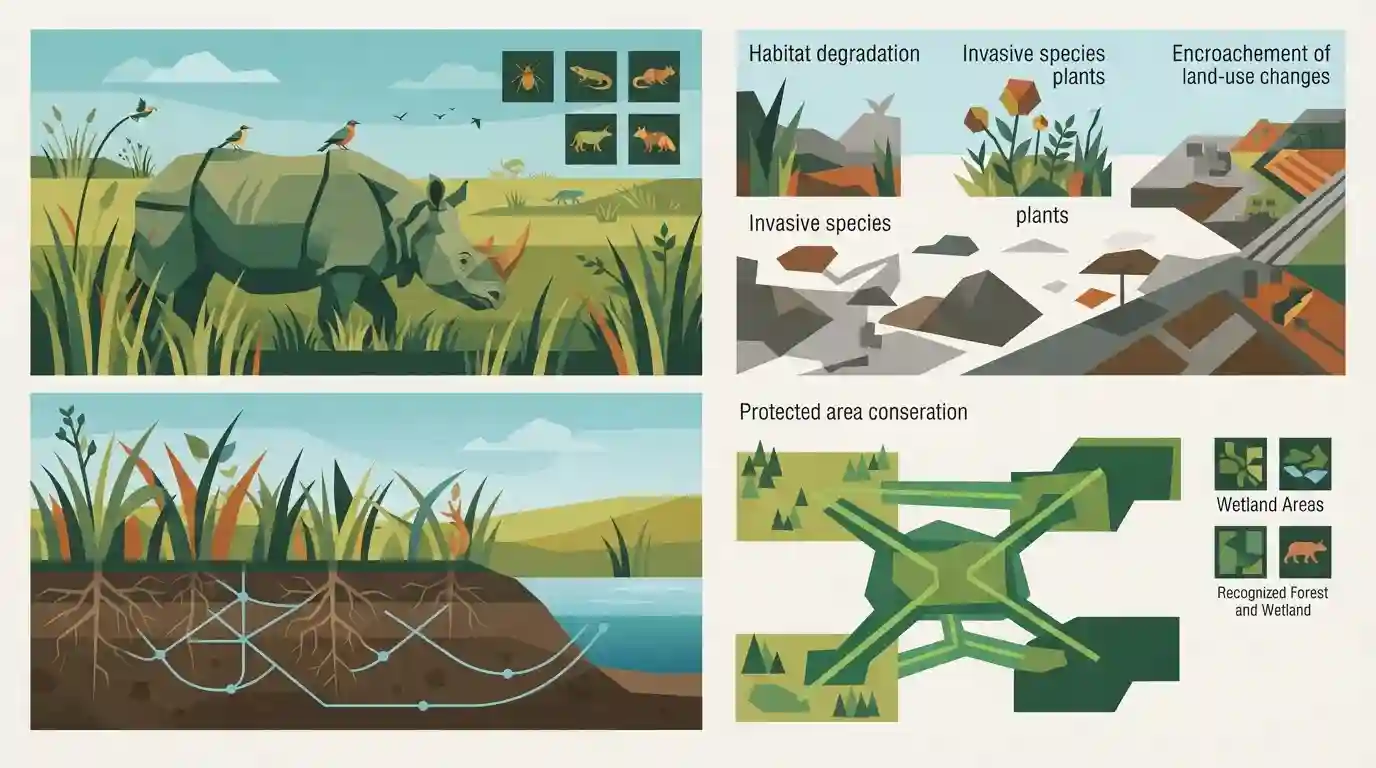
The article highlights the ecological significance of grasslands, arguing that protecting grassland habitats is central to conserving species like the greater one-horned rhinoceros. It underscores that grasslands are vital biodiversity hotspots that require distinct conservation focus, much like forests and wetlands, to counter threats such as habitat degradation, invasive species, and land-use changes.
મુખ્ય મુદ્દા
- Grassland ecosystems are foundational for the survival and conservation of the greater one-horned rhinoceros.
- Protection of grasslands goes beyond single-species conservation, supporting wider biodiversity, soil health, and hydrological cycles.
- Grasslands are often undervalued compared to forests, facing threats from agricultural encroachment, invasive species, and climate change.
- Integrating grassland management into national conservation strategies is essential for sustainable wildlife preservation and ecosystem resilience.
પ્રિલિમ્સ ટ્રેપ
Grassland ecosystems are legally categorized and managed as a sub-category of forest lands in India.
Aspirants often assume all high-biodiversity ecosystems in India are legally classified or managed under forest departments as 'degraded forests', missing that grasslands are ecologically distinct.
સંલગ્ન સ્થિર ખ્યાલો
What is the conservation status and ecological distribution of the Greater One-Horned Rhinoceros in India?
- IUCN Status: IUCN Status: Listed as Vulnerable on the IUCN Red List, having recovered from brink of extinction through intensive conservation.
- Natural Habitat: Key Habitat: Found primarily in alluvial tall grasslands and riverine forests of the Brahmaputra valley (e.g., Kaziranga, Orang, Pobitora).
- Geographic Range: Indian Range: Confined mostly to Assam, parts of West Bengal (Jaldapara), and Uttar Pradesh (Dudhwa National Park).
આંતર-વિષય પેટર્ન
Grasslands vs Forest Bias in Land Records
India's Open Natural Ecosystems are often misclassified as wastelands in land records, mirroring the systemic undervaluation seen in wetland conversions and coastal CRZ notification relaxations.
Species Recovery Plans and Habitat Legal Frameworks
While Project Tiger receives dedicated statutory backing via the Wildlife Protection Act, grassland-dependent species lack parallel habitat-specific statutory frameworks.

IUCN Red List status changes combined with the 'forest bias' in India's land classification are high-yield for Prelims and Mains.
સંલગ્ન PYQ · 2
સંલગ્ન PYQ · 2
- 2026PrelimsGS1
With respect to the Western Hoolock Gibbons, which of the following statements is/are correct? 1. A Sanctuary in North-east India is home to this ape species listed as Endangered in the International Union for Conservation of Nature (IUCN) Red List. 2. They have specialized brachiation and can easily swing between trees. 3. They possess a strong and heavy build like gorillas, yet are remarkably agile tree climbers. Select the answer using the code given below :
- 2018MainsGS3
What is wetland? Explain the Ramsar concept of 'wise use' in the context of wetland conservation. Cite two examples of Ramsar sites from India.
