International Court of Justice Proceedings on Genocide Convention
Source:The Hindu ↗
ఇది ఎందుకు ముఖ్యం
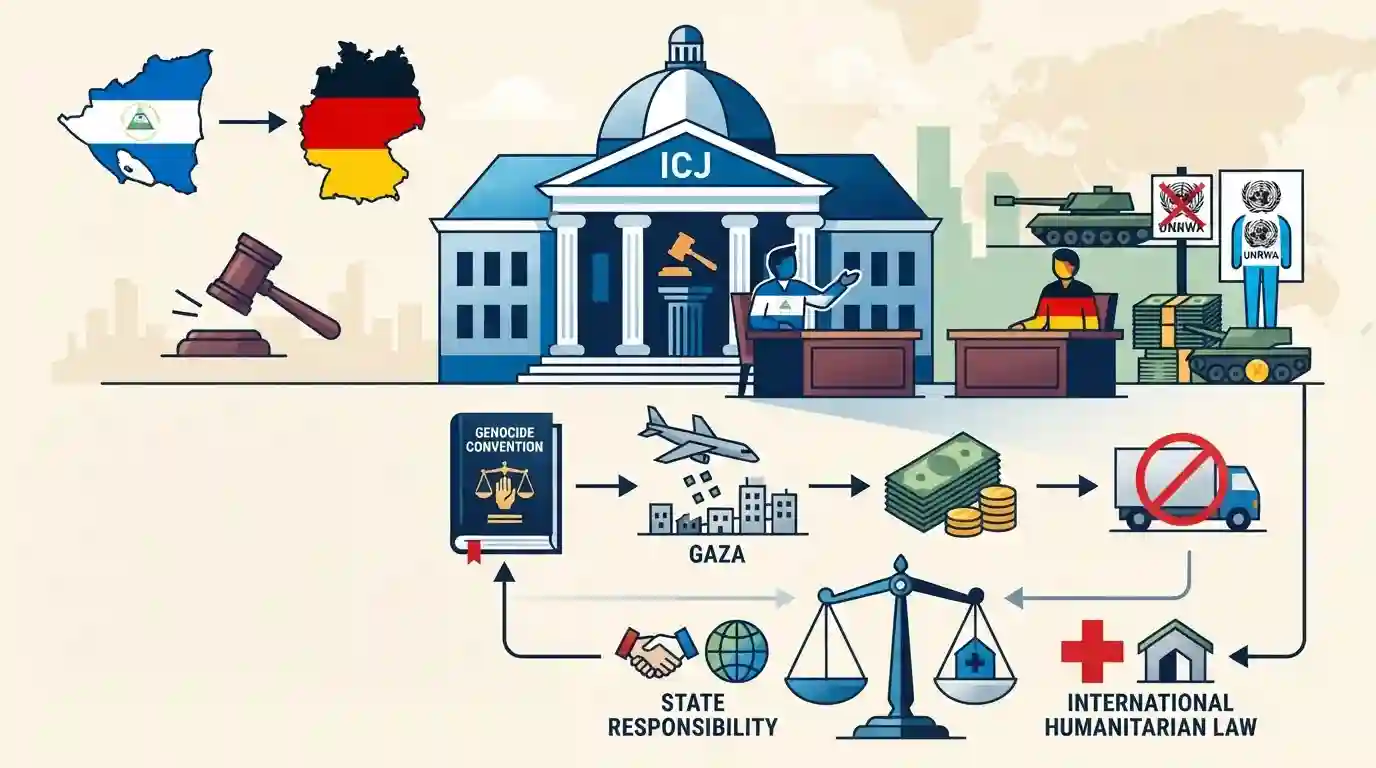
This case is significant for understanding the scope of state responsibility, international legal obligations under the Genocide Convention, and the role of the International Court of Justice in adjudicating disputes concerning third-state complicity in conflict zones.
సారాంశం
Nicaragua filed a case against Germany at the International Court of Justice (ICJ) under the Genocide Convention, alleging that Germany is complicit in genocide and human rights violations in Gaza through its military and financial support of Israel, as well as the suspension of funding to UNRWA. The case brings to light critical issues of state responsibility, international humanitarian law, and the enforcement mechanisms of the World Court.
ముఖ్య అంశాలు
- Nicaragua instituted legal proceedings against Germany at the International Court of Justice (ICJ), accusing it of violating the 1948 Genocide Convention by providing military and political support to Israel and defunding UNRWA in Gaza.
- Nicaragua requested provisional measures demanding Germany to immediately suspend its aid, especially military supplies to Israel, and resume funding to UNRWA.
- The case highlights state responsibility under international law, particularly regarding complicity or failure to prevent genocide and obligations under international humanitarian law.
- Germany defended its position, stating its deep commitment to Israel's security while also providing extensive humanitarian aid to Palestinians, arguing that the case is legally and factually unfounded.
ముఖ్యమైన పదాలు
International Court of Justice

A principal judicial organ of the United Nations that settles legal disputes between states and gives advisory opinions on international legal questions.
UPSC context
GS Paper II (International Relations): Tests knowledge of UN principal organs, global governance mechanisms, and international dispute resolution.
Genocide Convention
An international treaty adopted in 1948 that criminalises genocide and obligates ratifying states to prevent and punish acts of genocide.
UPSC context
GS Paper II (International Relations / Governance): Tests understanding of international humanitarian law, international treaties, and state obligations under UN frameworks.
అనుసంధానమైన స్థిర భావనలు
What is the jurisdiction and binding nature of judgments under the International Court of Justice (ICJ)?
- Standing: Only states can be parties in contentious cases before the ICJ; individuals or NGOs have no standing.
- Binding Nature: ICJ judgments are binding between the parties, and under Article 94 of the UN Charter, non-compliance can be referred to the UNSC.
- Interim Orders: Provisional measures indicated by the ICJ are legally binding on the states concerned.
అంతర-అంశ నమూనాలు
Genocide Convention & Erga Omnes Obligations
The Genocide Convention creates obligations erga omnes partes, meaning any state party can bring a claim against another without a direct bilateral injury, similar to environmental law doctrines.
ICJ Enforcement Mechanisms & UNSC Veto
ICJ provisional measures lack direct enforcement mechanisms and depend entirely on UN Security Council compliance, raising questions about great-power vetoes and institutional efficacy.

ICJ provisional measures + Genocide Convention jurisdiction test likely to feature in Prelims as a multi-statement assertion question.
