Youth-led protests and political turmoil unfold in neighboring country
Source:The Hindu ↗
Why It Matters
Political instability in a crucial neighboring country like Nepal directly impacts India's border security and regional diplomacy under the 'Neighbourhood First' policy. Furthermore, it serves as an excellent case study for GS2 and GS3 on how the regulation of social media and the failure to utilize the demographic dividend can lead to sudden, severe socio-political unrest.
Summary
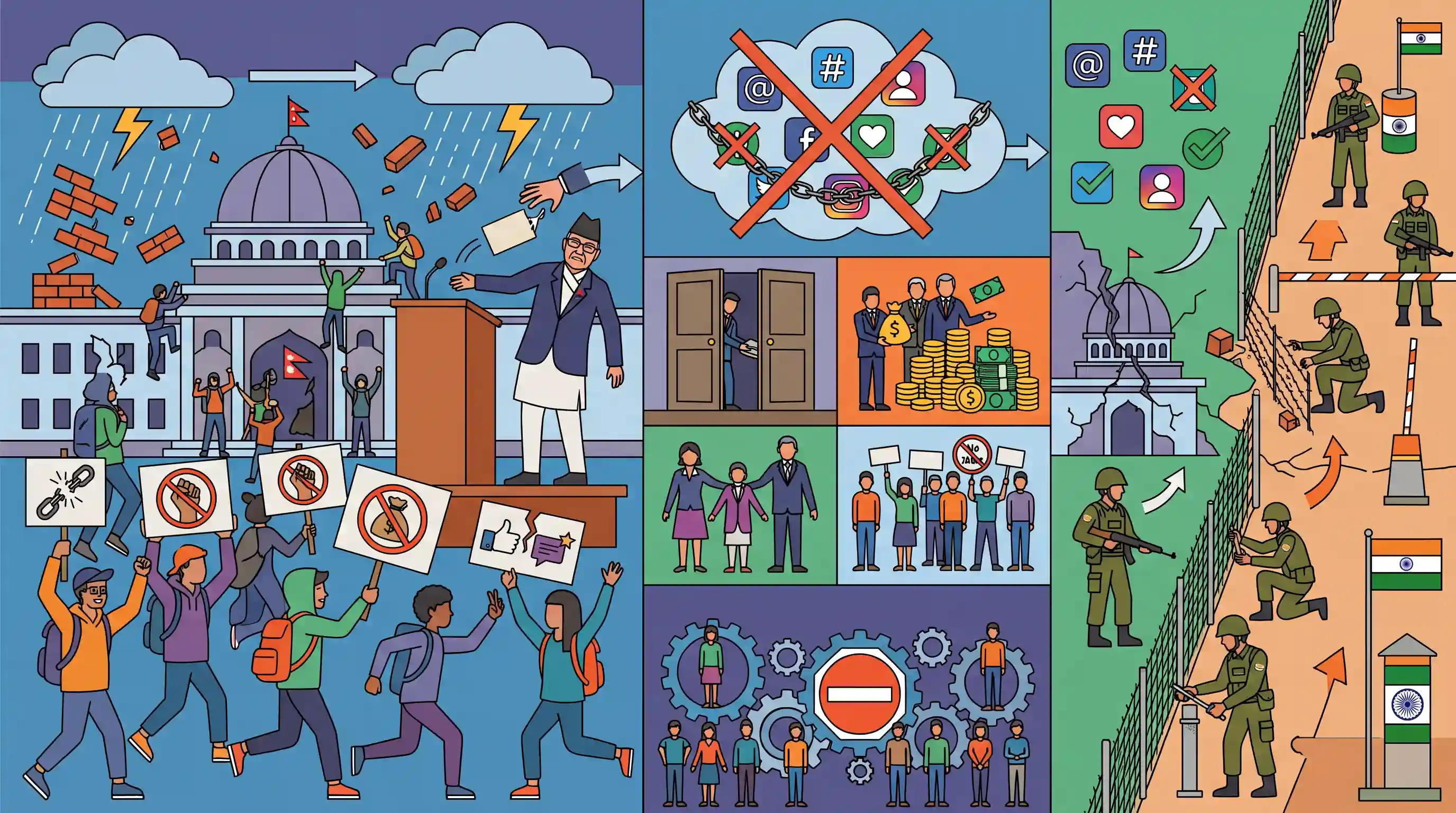
Massive Gen Z-led protests in Nepal have culminated in severe political upheaval, including the storming of the Parliament and the resignation of Prime Minister K.P. Sharma Oli. The unrest was initially triggered by a sudden government ban on 26 social media platforms for failing to register locally and adhere to content regulations. However, the protests quickly evolved into a broader uprising against chronic corruption, nepotism, wealth inequality, and rampant youth unemployment. While the government subsequently revoked the social media ban, the political crisis highlights the explosive combination of internet censorship and unaddressed demographic challenges. In response to the instability in its neighborhood, India has tightened security along the porous India-Nepal border.
Key Points
- The Nepal government instituted a sweeping ban on 26 social media platforms (including WhatsApp, Facebook, and X) citing their failure to register locally and comply with content removal requests.
- The ban triggered widespread protests led primarily by Gen Z and millennials, which quickly escalated into a movement against systemic corruption, nepotism, and lack of accountability.
- Underlying economic frustrations, such as high youth unemployment, inequality, and over-reliance on foreign remittances, significantly fueled the unrest.
- The protests turned violent, resulting in 19 deaths, the storming of the Parliament, and the resignation of Prime Minister K.P. Sharma Oli and several ministers.
- In response, India issued travel advisories and heightened security along the porous India-Nepal border in Uttar Pradesh and Bihar through the Sashastra Seema Bal (SSB).
Important Terms
Sashastra Seema Bal (SSB)

One of India's Central Armed Police Forces (CAPF) under the Ministry of Home Affairs, mandated to guard the 1,751 km India-Nepal and 699 km India-Bhutan borders.
UPSC context
GS Paper 3: Internal Security. Crucial for understanding border management, trans-border crimes, and the 'lead intelligence agency' role on porous frontiers.
Pratinidhi Sabha
The 275-member lower house of Nepal’s Federal Parliament. It plays a central role in forming the government and was the site of significant unrest during the 2025-26 protests.
UPSC context
GS Paper 2: International Relations. Relevant for understanding Nepal’s constitutional structure and the political stability of India's neighbors.
Treaty of Peace and Friendship (1950)
A 1950 agreement between India and Nepal that established an 'open border' and granted reciprocal rights to citizens regarding residence, employment, and property.
UPSC context
GS Paper 2: Bilateral Relations. A fundamental topic for India-Nepal ties, frequently tested regarding security challenges and diplomatic friction.
Demographic Dividend
The potential for economic growth when a country's working-age population (15–64) is larger than the non-working-age population. In Nepal, failure to harness this has fueled youth unrest.
UPSC context
GS Paper 3: Indian Economy and Employment. Tests the link between population age structures, job creation, and social stability.
Open Border Policy
A unique bilateral arrangement allowing free movement of citizens between India and Nepal without visas or passports, facilitating deep cultural and economic ties ('Roti-Beti' relations).
UPSC context
GS Paper 2 & 3: Security and IR. Focuses on the trade-off between people-to-people ties and security risks like smuggling or illegal migration.
Digital Censorship
State-led restrictions on internet platforms. In Nepal, the ban on 26 platforms triggered a political crisis, highlighting the tension between digital sovereignty and constitutional rights.
UPSC context
GS Paper 2: Governance and Fundamental Rights. Tests the balance between national security/regulation and the right to freedom of speech.
Prelims Trap
"The 1,751 km open border between India and Nepal is primarily secured by the Border Security Force (BSF)."
Aspirants often default to BSF for all international land borders. However, the open borders with Nepal and Bhutan are guarded by the SSB.
Static Concepts Connected
What are the administrative frameworks governing the India-Nepal open border?
- 1950 Treaty: The Treaty of Peace and Friendship establishes the open border, allowing free movement of citizens and goods without visas.
- SSB Jurisdiction: The Sashastra Seema Bal (SSB) is the Central Armed Police Force specifically mandated to guard this porous border.
- Bordering States: The border spans 1,751 km across five Indian states: Uttarakhand, Uttar Pradesh, Bihar, West Bengal, and Sikkim.
How does India mandate local accountability for social media platforms?
- IT Rules 2021: Under IT Rules 2021, platforms with over 50 lakh users must appoint a Resident Grievance Officer and Chief Compliance Officer based in India.
- Loss of Safe Harbour: Failure to comply with local regulations strips platforms of their 'safe harbour' immunity under Section 79 of the Information Technology Act.
Cross-Topic Patterns
Demographic bulge fueling South Asian regime changes
Nepal’s crisis mirrors recent unrest in Bangladesh and Sri Lanka, illustrating how jobless youth bulges combined with inflation rapidly escalate into uncontrollable anti-incumbency movements across South Asia.
Digital censorship vs. VPN mobilization
The failure of Nepal’s social media ban demonstrates the limits of state internet censorship, as tech-savvy demographics increasingly bypass blocks using VPNs, complicating traditional internal security doctrines.

Expect a GS3 Mains question linking youth unemployment in South Asia to internal security and cross-border spillover effects for India.
Linked PYQs · 4
Linked PYQs · 4
- 2024MainsGS3
Social media and encrypting messaging services pose a serious security challenge. What measures have been adopted at various levels to address the security implications of social media? Also suggest any other remedies to address the problem.
- 2016MainsGS3
Use of Internet and social media by non-state actors for subversive activities is a major security concern. How have these been misused in the recent past? Suggest effective guidelines to curb the above threat.
- 2014MainsGS3
While we flaunt India's demographic dividend, we ignore the dropping rates of employability. What are we missing while doing so? Where will the jobs that India desperately needs come from? Explain.
- 2012MainsGS2
Discuss the contentious issues that have caused the prolonged constitutional logjam in Nepal.
