Arunachal hydropower project receives clearance extension
Source:Indian Express ↗
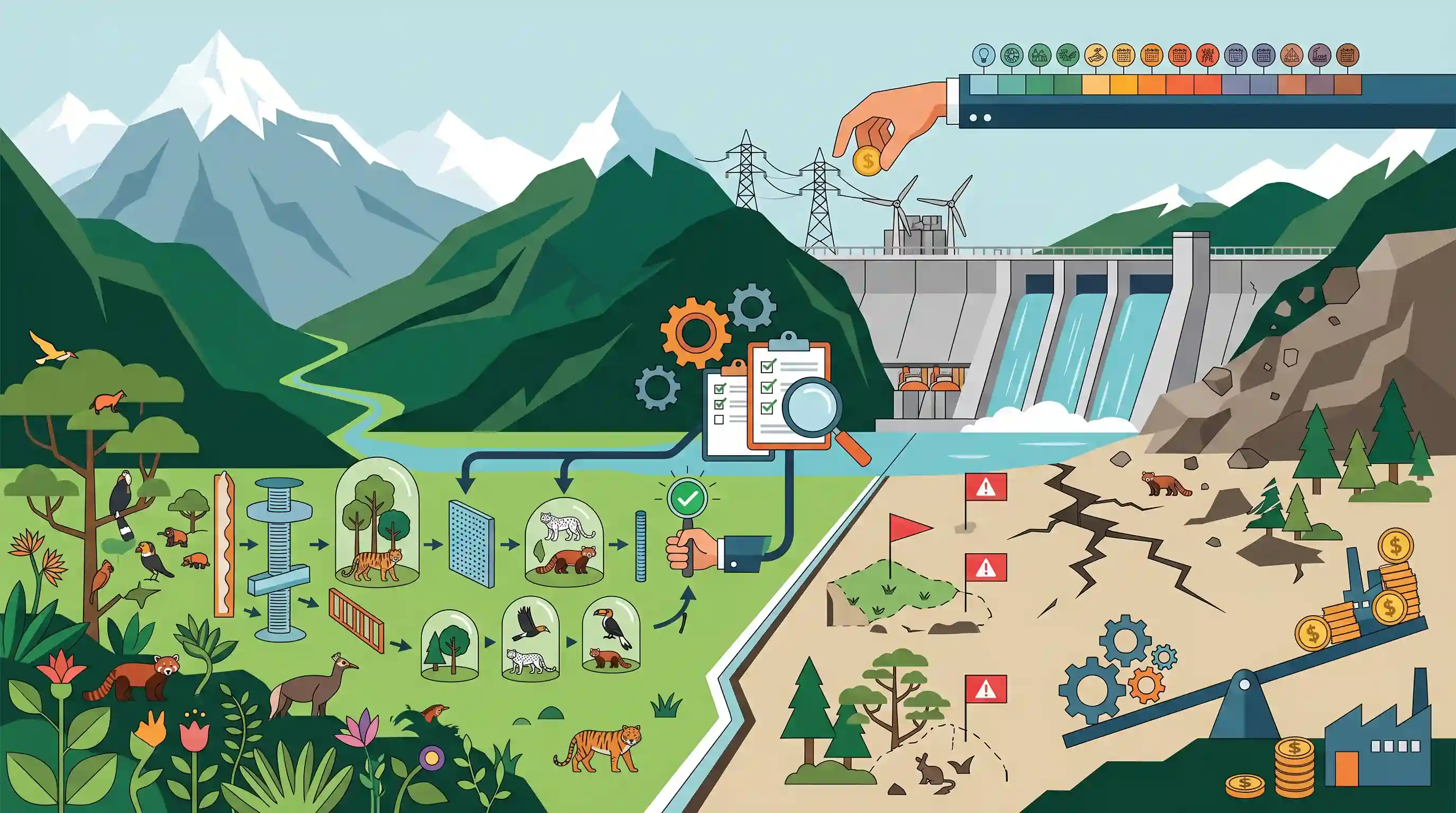
Why It Matters
The extension of environmental clearances for mega infrastructure projects in fragile ecosystems without stringent wildlife safeguards exemplifies the ongoing tension between development and conservation. This is highly relevant for GS-3 questions on EIA efficacy, the ecological footprint of hydropower, and biodiversity conservation strategies.
Summary
The Union Environment Ministry has reportedly granted an 11-year extension to the environmental clearance for a massive hydropower project in Arunachal Pradesh, extending its validity to 2037. However, environmental experts are deeply concerned because the extended "green nod" omits critical wildlife safeguards and warnings that are essential for minimizing ecological damage. Arunachal Pradesh, which falls in a globally recognized biodiversity hotspot and a seismically active Himalayan zone, is highly vulnerable to the impacts of large-scale dam construction. The dilution of these wildlife conditions raises serious questions about the rigor of the Environmental Impact Assessment (EIA) framework and the regulatory oversight by the MoEFCC. The issue highlights the ongoing "development versus conservation" dilemma, pointing to the ecological risks of prioritizing energy infrastructure without adequate environmental mitigations.
Key Points
- A massive hydroelectric power project in Arunachal Pradesh has received an 11-year extension on its environmental clearance (EC), keeping it valid until 2037.
- Environmental experts have raised serious alarms because the extended clearance omits a crucial 'wildlife' warning or condition, posing a severe threat to local biodiversity.
- The omission of these ecological safeguards highlights a potential dilution in regulatory oversight and undermines the fundamental objectives of Environmental Impact Assessments (EIAs).
- The development underscores the critical tension between aggressively expanding hydropower for energy security and protecting the fragile, seismically active Himalayan ecosystem.
Important Terms
Environmental Impact Assessment (EIA)

Statutory process evaluating environmental, social, and economic impacts of a proposed project under the Environment Protection Act, 1986, prior to government approval.
UPSC context
GS Paper III: Environment. Central to sustainable development and the legal framework for industrial and infrastructure clearances in India.
Ministry of Environment, Forest and Climate Change (MoEFCC)
The nodal central ministry responsible for India's environmental policies, forest conservation, wildlife protection, and fulfilling international climate commitments under UNFCCC.
UPSC context
GS Paper II: Governance. Crucial for understanding administrative structures and executive decision-making in environmental and climate governance.
Expert Appraisal Committee (EAC)
A multi-disciplinary committee within MoEFCC that reviews project proposals and recommends environmental clearance based on the rigorousness of their EIA reports.
UPSC context
GS Paper III: Environment. Part of the institutional mechanism for Category A project approvals and regulatory oversight.
National Board for Wildlife (NBWL)
A statutory body under the Wildlife (Protection) Act, 1972, chaired by the Prime Minister, that approves projects within or near protected areas.
UPSC context
GS Paper III: Biodiversity. Tests understanding of the highest legal authority for wildlife protection in developmental contexts.
National Green Tribunal (NGT)
A specialized quasi-judicial body for the expedited disposal of environmental cases, empowered to overrule government clearances based on ecological merit.
UPSC context
GS Paper II: Statutory Bodies. Key to environmental justice and the balance between judicial review and executive power.
Biodiversity Hotspot
Biogeographic regions with high levels of endemic species under significant threat; Arunachal Pradesh falls within the Eastern Himalaya and Indo-Burma hotspots.
UPSC context
Prelims/GS III. Important for identifying globally critical ecosystems under threat from development.
Zero Period
A regulatory provision excluding time lost to litigation or unavoidable delays from the official validity count of a project's environmental clearance.
UPSC context
GS Paper III: Infrastructure/Environment. Illustrates modern policy shifts balancing industrial "ease of doing business" with environmental timelines.
Prelims Trap
"Time spent by a project in litigation is counted towards the expiration period of its Environmental Clearance under the EIA framework."
MoEFCC's 'zero period' policy explicitly excludes litigation time from EC expiration calculations. Additionally, river valley/hydro project base validity was increased to 13 years in 2022.
Static Concepts Connected
What is the regulatory framework for Environmental Clearances (EC) in India?
- EIA 2006 Stages: The statutory process involves four main stages: Screening, Scoping, Public Consultation, and Appraisal before an EC is granted or rejected.
- Extended Validity: A 2022 amendment increased the base EC validity for river valley and hydroelectric projects to 13 years, reflecting their exceptionally long gestation periods.
What is the ecological and geographical significance of the Lohit River?
- Brahmaputra Tributary: It is a major left-bank tributary of the Brahmaputra River, originating in eastern Tibet and flowing through the seismically active landscape of Arunachal Pradesh.
- White-bellied Heron: The river basin is a crucial habitat for this avian species, which is classified as Critically Endangered on the IUCN Red List.
- Kamlang Tiger Reserve: The river flows adjacent to this protected area, highlighting the conflict between massive run-of-river hydroelectric dams and critical wildlife corridors.
Cross-Topic Patterns
Run-of-river dams & Himalayan seismicity
Infrastructure in Arunachal Pradesh closely connects to disaster management. UPSC frequently links massive Himalayan hydro projects to ecological fragility, seismic zones, and Glacial Lake Outburst Flood (GLOF) risks.
NGT oversight vs. Ease of Doing Business
The NGT's power to suspend secondary clearances when wildlife safeguards are omitted illustrates the ongoing tension between statutory environmental checks and executive policies favoring rapid infrastructure rollout.

Expect a 2026 Prelims question mixing the 'zero period' EIA rule, the White-bellied Heron's IUCN status, and Lohit River's geography.
Linked PYQs · 3
Linked PYQs · 3
- 2024MainsGS3
What role do environmental NGOs and activists play in influencing Environmental Impact Assessment (EIA) outcomes for major projects in India? Cite four examples with all important details.
- 2014MainsGS3
Environmental Impact Assessment studies are increasingly undertaken before a project is cleared by the Government. Discuss the environmental impacts of coal-fired thermal plants located at coal pitheads.
- 2013MainsGS3
What do you understand by Run-of-river hydroelectricity project ? How is it different from any other hydroelectricity project?
