State Specific Disaster Declaration for Tidal Flooding in Kerala
Source:The Hindu ↗
આ શા માટે મહત્વનું છે
The article highlights a critical governance mechanism in India's disaster management framework—the autonomy of states to fund localized disasters. It also introduces 'Kallakkadal', an important geographical and environmental phenomenon affecting India's western coastline, highly relevant for Prelims geography and Mains disaster management/climate change questions.
સારાંશ
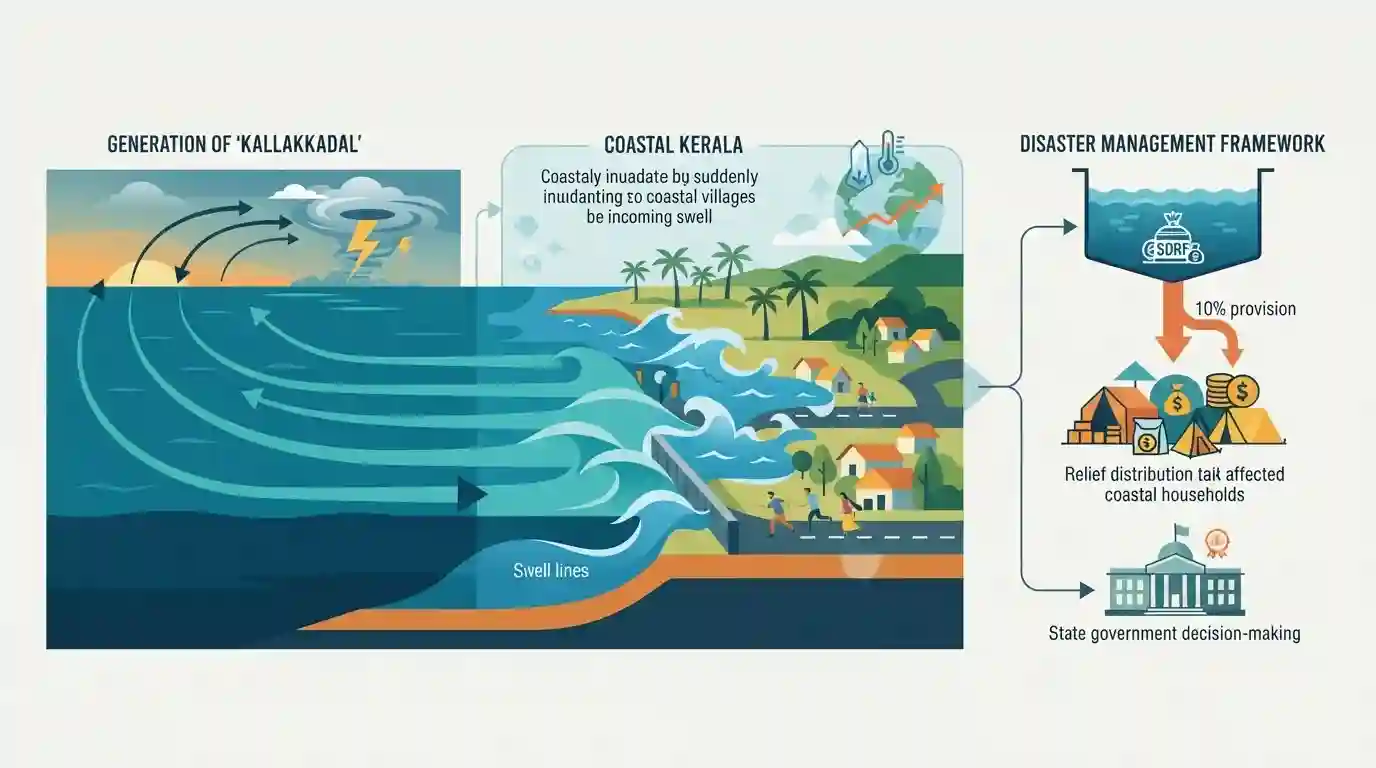
Kerala recently declared 'Kallakkadal' (sudden tidal flooding) a State-specific disaster, allowing affected coastal populations to access compensation and relief from the State Disaster Response Fund (SDRF). Kallakkadal involves massive sea swells generated by distant ocean storms, causing sudden coastal inundation without local cyclonic activity—a hazard worsening with climate change and sea-level rise. The move utilizes a provision under the Disaster Management Act that empowers states to allocate up to 10% of their SDRF for localized disasters not explicitly listed by the Ministry of Home Affairs.
મુખ્ય મુદ્દા
- Kerala has officially declared 'Kallakkadal' (sudden tidal flooding) as a State-specific disaster, enabling the state to disburse immediate financial relief to affected coastal communities.
- Under the Disaster Management Act, 2005, states are permitted to utilize up to 10% of their State Disaster Response Fund (SDRF) to address localized natural disasters that are not included in the central government's notified list.
- Kallakkadal refers to sudden, massive sea swells and coastal inundation caused by distant ocean storms (often in the Southern Indian Ocean), striking without local cyclonic precursors or weather warnings.
- The increasing frequency and severity of these tidal flooding events are exacerbated by climate change and global sea-level rise, severely impacting the livelihoods and housing of fishing communities.
મહત્વપૂર્ણ શબ્દો
Disaster Management Act, 2005

A central legislation providing the legal and institutional framework for disaster management in India, mandating the creation of NDMA, SDMAs, DDMAs, and specific mitigation and response funds.
UPSC context
GS Paper III: Disaster Management. Tests knowledge of India's legislative and institutional frameworks for handling natural and man-made calamities.
State Disaster Response Fund (SDRF)
The primary statutory fund available to states under Section 48 of the DM Act, 2005, primarily funded by the Centre (75% or 90%) to provide immediate relief for notified and local disasters.
UPSC context
GS Paper III: Disaster Management & Fiscal Federalism. Relates to disaster financing, center-state financial relations, and state autonomy in managing localized hazards.
Indian National Centre for Ocean Information Services (INCOIS)
An autonomous unit under the Ministry of Earth Sciences providing ocean data, advisory services, and early warnings, such as tsunami alerts and swell surge forecasts to coastal states.
UPSC context
GS Paper III: Science & Tech / Disaster Management. Tests understanding of technological applications, oceanography, and early warning systems for coastal safety.
Kallakkadal
A coastal flooding hazard along southwest India caused by massive swell waves travelling from distant ocean storms (e.g., Southern Ocean), occurring unexpectedly without local weather changes.
UPSC context
GS Paper I: Geography (Oceanography) & GS Paper III: Disaster Management. Covers localized coastal hazards, climate change impacts, and ocean wave dynamics.
Kerala State Disaster Management Authority (KSDMA)
A state-level statutory body chaired by the Chief Minister of Kerala, tasked with disaster policy formulation, coordinating local mitigation, and declaring state-specific disasters under the DM Act.
UPSC context
GS Paper III: Disaster Management. Examines the decentralised institutional framework of disaster response and the executive powers of state-level authorities.
પ્રિલિમ્સ ટ્રેપ
Kallakkadal is a localized coastal flooding phenomenon triggered by sudden underwater earthquakes or local cyclonic winds.
Kallakkadal is purely meteorological. It is driven by distant ocean storms (often in the Southern Ocean) creating long-period swell waves, not seismic activity (like Tsunamis) or local cyclonic winds.
સંલગ્ન સ્થિર ખ્યાલો
How is the State Disaster Response Fund (SDRF) constituted and utilized?
- DM Act 2005: Constituted under Section 48(1)(a) of the Disaster Management Act, 2005, serving as the primary fund available with State Governments for responses.
- Funding Ratio: Funded in a 75:25 ratio between the Centre and General Category States, and a 90:10 ratio for Special Category States.
- State-Specific Provision: States can utilize up to 10% of their SDRF allocation to provide immediate relief for unlisted "state-specific" natural disasters.
- Restricted Usage: Strictly for immediate, short-term relief (food, shelter, medical aid), not for long-term reconstruction or property compensation.
What distinguishes Swell Surges, Storm Surges, and Tsunamis?
- Swell Surges (Kallakkadal): Meteorological; generated by distant intense storms. They travel thousands of kilometers away from the generating area as long-period waves without local wind precursors.
- Storm Surges: Meteorological; localized abnormal rise of water caused by atmospheric pressure drops and strong local cyclonic winds driving water inland.
- Tsunamis: Geological; triggered by sudden underwater displacements of massive volumes of water (e.g., earthquakes, volcanic eruptions, submarine landslides).
આંતર-વિષય પેટર્ન
Climate Change & Fiscal Federalism
Rising localized climate events (tidal flooding, lightning) are pushing states to demand expansion of MHA's 12 notified disasters list and greater autonomy over SDRF/NDRF allocations.
INCOIS and Coastal Multi-Hazard Systems
Connects physical geography to space/tech. INCOIS (under MoES) utilizes deep ocean sensors and coastal flood monitoring systems to forecast both seismic tsunamis and meteorological swell surges.

Multi-statement Q contrasting Kallakkadal (distant swells) with Tsunamis (seismic) & testing the 10% SDRF state-specific rule is likely.
સંલગ્ન PYQ · 3
સંલગ્ન PYQ · 3
- 2022MainsGS3
Explain the causes and effects of coastal erosion in India. What are the available coastal management techniques for combating the hazard?
- 2024MainsGS3
What is disaster resilience? How is it determined? Describe various elements of a resilience framework. Also mention the global targets of Sendai Framework for Disaster Risk Reduction (2015–2030).
- 2026PrelimsGS1
Which of the following best explain(s) the rationale for protecting mangrove ecosystems in the context of climate resilience? 1. Mangroves reduce tidal energy and store freshwater, making them ideal sites for paddy cultivation in saline estuarine belts. 2. Their salt-sensitive roots filter seawater, making mangroves key to converting coastal land into freshwater aquaculture zones. 3. By withstanding tidal surges and offering biomass resources, mangroves function both as natural bio-shields and livelihood bases for rural communities. Select the answer using the code given below :
