Opposition Questions Education Minister Tenure Over Exam Paper Leaks
Source:The Hindu ↗
Why It Matters
The recurring paper leaks in national-level examinations (like NEET-UG and UGC-NET) highlight critical systemic vulnerabilities in India's higher education assessment framework. For UPSC aspirants, this illustrates issues in governance, the efficacy of the National Testing Agency (NTA), the necessity for strict legislative measures (like the Public Examination Prevention of Unfair Means Act, 2024), and the broader ethical implications of political and institutional accountability.
Summary
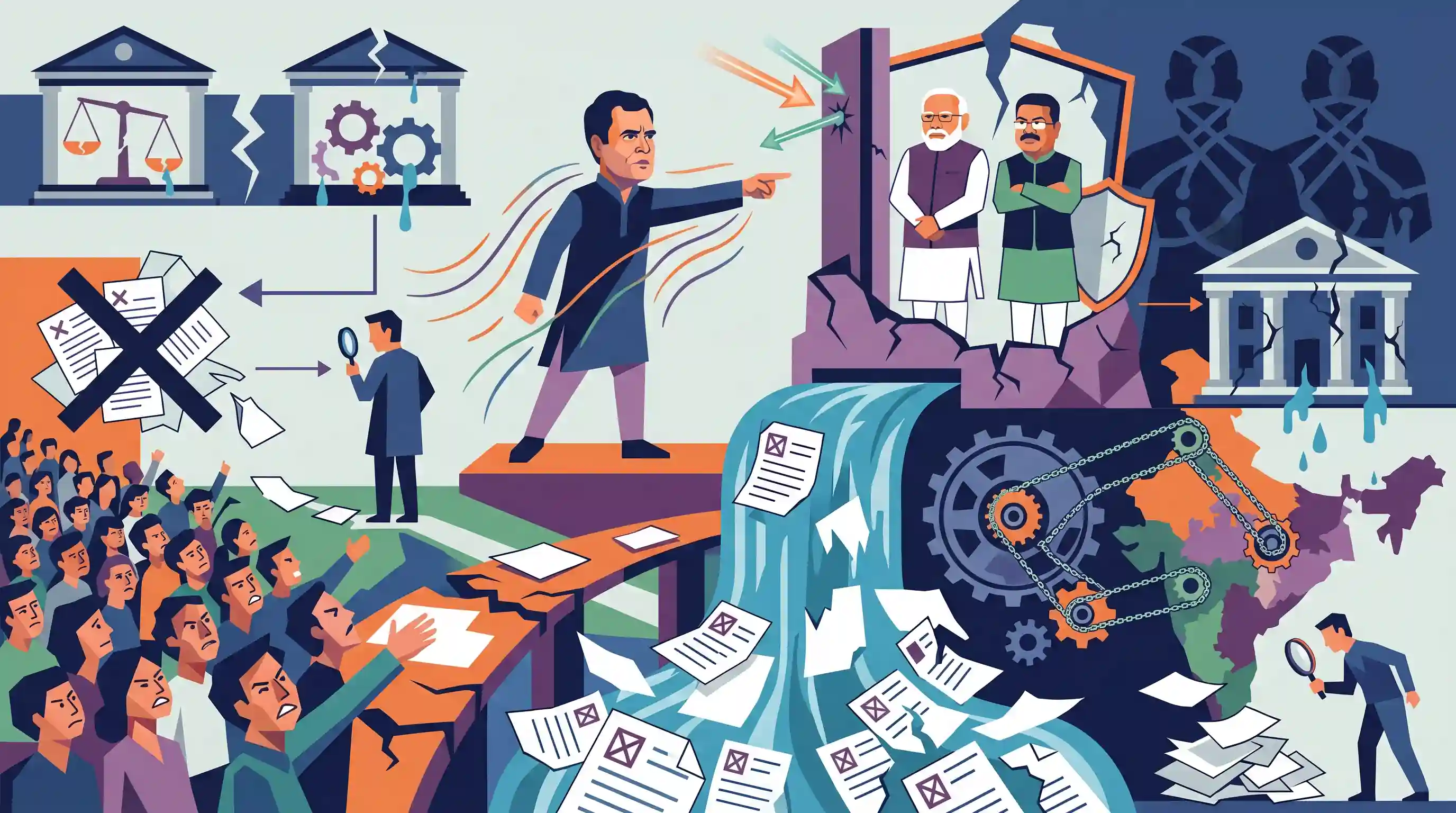
Congress leader Rahul Gandhi criticized Prime Minister Narendra Modi over the repeated leaks of examination papers, specifically questioning why Education Minister Dharmendra Pradhan has not been sacked. Citing the NEET-UG and UGC-NET controversies, Gandhi alleged that the BJP-RSS nexus has compromised the integrity of India's educational institutions by appointing incompetent individuals based on ideological affiliation. He likened the current national crisis to the expansion of the 'Vyapam model' of exam rigging from Madhya Pradesh and Gujarat, arguing that mere CBI inquiries and exam cancellations are insufficient to address the systemic collapse affecting millions of students.
Key Points
- Rahul Gandhi questioned PM Modi's silence and the retention of Education Minister Dharmendra Pradhan despite widespread outrage over the NEET-UG and UGC-NET paper leaks.
- Gandhi alleged a systemic breakdown in the education sector caused by the appointment of ideologically aligned but incompetent individuals by the BJP-RSS to key institutional roles.
- He described the recent exam irregularities as the national expansion of the 'Vyapam model' of corruption, previously seen in Madhya Pradesh and Gujarat.
- Dismissing the efficacy of CBI investigations, Gandhi argued that they serve to cover up systemic failures rather than ensure genuine accountability.
- The Congress leader emphasized the severe psychological and professional toll these repeated leaks take on millions of students whose futures depend on these critical national examinations.
Important Terms
National Testing Agency (NTA)

An autonomous, self-sustained organization under the Ministry of Education, registered under the Societies Registration Act, 1860. It conducts entrance examinations for higher education admissions and fellowships, including NEET and JEE.
UPSC context
UPSC GS Paper 2 (Regulatory Bodies). Tests knowledge of institutional transparency, accountability, and the management of India's large-scale educational testing framework.
The Public Examination (Prevention of Unfair Means) Act, 2024
A 2024 law designed to curb malpractices in public examinations. It imposes stringent penalties—up to 10 years' imprisonment and ₹1 crore fine—for paper leaks and organized cheating.
UPSC context
UPSC GS Paper 2 (Governance/Legislation). Relevant for discussions on administrative reforms, probity in governance, and legal measures against systemic corruption.
NEET-UG
The nationwide entrance examination for undergraduate medical programs in India. In 2024, it faced significant controversy regarding paper leaks, grace marks, and the integrity of its merit-based results.
UPSC context
UPSC GS Paper 2 (Education/Social Sector). Focuses on challenges in the medical education sector and the integrity of national merit-based systems.
UGC-NET
A national-level test conducted to determine eligibility for Assistant Professorship and Junior Research Fellowship. The June 2024 session was cancelled following reports suggesting the exam's integrity was compromised.
UPSC context
UPSC GS Paper 2 (Education). Relates to standard-setting for higher education and the stability of the academic research ecosystem.
Central Bureau of Investigation (CBI)
India’s premier investigative agency under the Ministry of Personnel, Public Grievances and Pensions. It probes high-profile cases involving corruption, economic crimes, and systemic failures in public institutions.
UPSC context
UPSC GS Paper 2 (Statutory/Non-constitutional bodies). Tests understanding of central agencies' roles in maintaining internal security and accountability.
Prelims Trap
"The National Testing Agency (NTA) is a statutory body established by an Act of Parliament."
Aspirants often assume apex national institutions are statutory. However, the NTA is an autonomous society registered under the Societies Registration Act, 1860, not a statutory body created by parliamentary legislation.
Static Concepts Connected
What is the constitutional basis for Ministerial Responsibility?
- Collective Responsibility: Article 75(3) mandates that the Council of Ministers is collectively responsible to the House of the People (Lok Sabha).
- Individual Responsibility: Article 75(2) dictates ministers hold office during the President's pleasure, establishing individual accountability for departmental lapses and omissions.
- Ethical Accountability: Constitutional conventions expect ministers to resign on moral grounds for massive departmental failures, upholding the principle of probity in governance.
What is the legal framework and mandate of the National Testing Agency (NTA)?
- Society Status: It is registered as a society under the Indian Societies Registration Act, 1860. It operates as an autonomous, self-sustained body, not a statutory one.
- Core Mandate: Approved by the Union Cabinet in 2017 to conduct entrance exams for higher educational institutions, relieving CBSE and AICTE from testing duties.
Cross-Topic Patterns
GS-4: Probity & Institutional Integrity
The 'Vyapam' comparison makes this a perfect GS-4 case study on how ideological appointments compromise foundational civil service values like merit, non-partisanship, and institutional integrity.
Education + Public Exam Act 2024
GS-2 answers on education must now critically evaluate the Public Examination (Prevention of Unfair Means) Act, 2024 against the systemic administrative failures of autonomous bodies like NTA.

Expect a Prelims question on NTA's legal status (Society vs Statutory) paired with the provisions of the Public Examination Act, 2024.
Linked PYQs · 3
Linked PYQs · 3
- 2024MainsGS2
What are the aims and objects of recently passed and enforced, The Public Examination (Prevention of Unfair Means) Act, 2024? Whether University/State Education Board examinations, too, are covered under the Act ?
- 2015MainsGS2
The quality of higher education in India requires major improvements to make it internationally competitive. Do you think that the entry of foreign educational institutions would help improve the quality of higher and technical education in the country? Discuss.
- 2019MainsGS4
"Non-performance of duty by a public servant is a form of corruption". Do you agree with this view? Justify your answer.
