Chhattisgarh Tara Coal Block Auction and Local Opposition
Source:The Hindu ↗
ఇది ఎందుకు ముఖ్యం
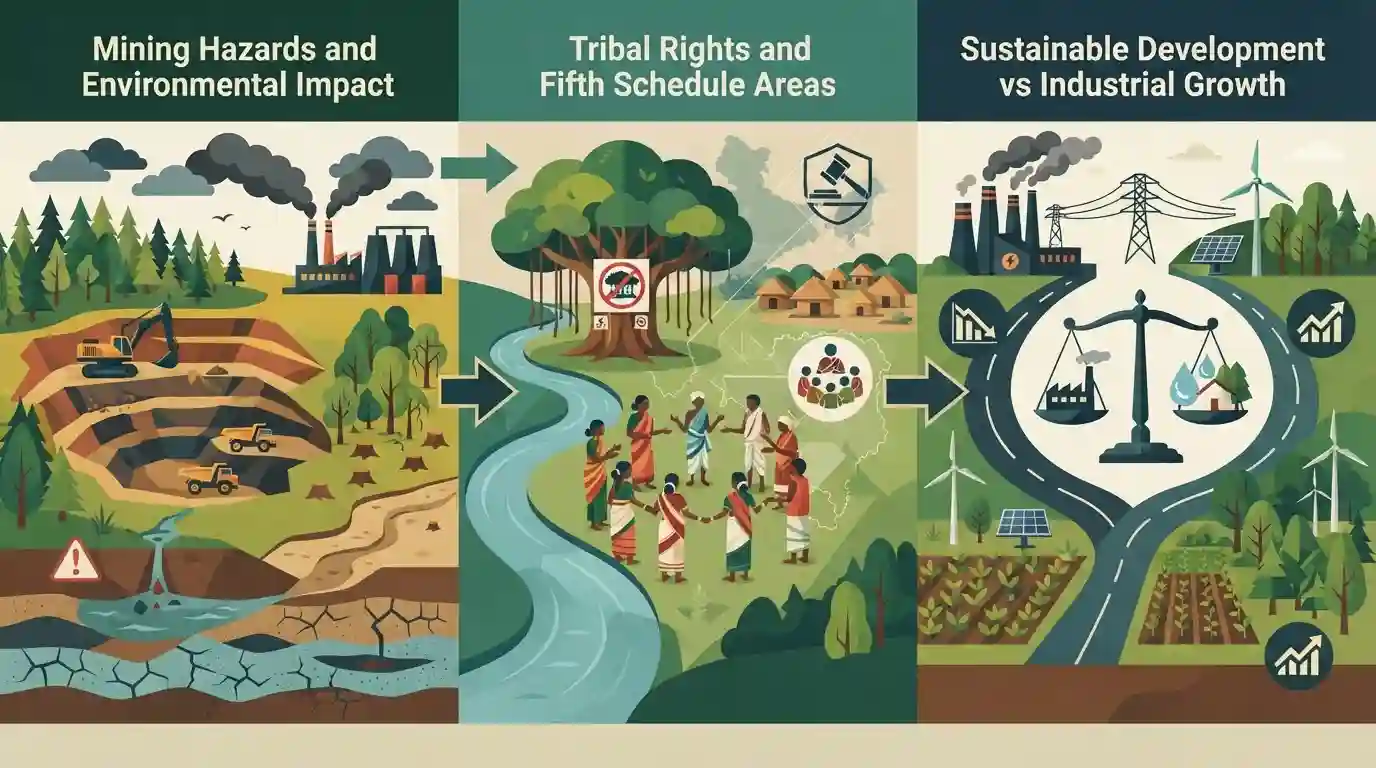
It represents the classic conflict between national energy security and industrial growth versus environmental sustainability and the rights of indigenous communities protected under special constitutional provisions like the Fifth Schedule and PESA.
సారాంశం
This article explains the reasons behind the intense local opposition to the auction of the Tara coal block in Chhattisgarh, highlighting issues related to tribal rights, environmental concerns, displacement, and statutory provisions like PESA and the Forest Rights Act.
ముఖ్య అంశాలు
- The Tara coal block in Chhattisgarh's Surajpur district has faced stiff opposition from local residents and gram sabhas regarding its auction.
- Concerns center around environmental degradation, loss of forest cover, displacement of tribal populations, and violation of local governance rights under PESA and FRA.
- Coal mining projects in dense forest regions trigger conflicts between industrial energy demands and ecological/indigenous rights conservation.
ముఖ్యమైన పదాలు
Panchayat (Extension to Scheduled Areas) Act (PESA)

Legislation extending Part IX of the Constitution to Fifth Schedule areas, granting Gram Sabhas extensive powers of self-governance, consultation on land acquisition, and management of local natural resources.
UPSC context
GS Paper II / Polity and Governance: Tests understanding of tribal rights, decentralized governance, and statutory protections in Scheduled Areas.
Forest Rights Act (FRA)
A law recognizing and vesting forest rights and occupation in forest land in forest-dwelling Scheduled Tribes and traditional forest dwellers, correcting historical injustices of forest policies.
UPSC context
GS Paper III / Environment and Biodiversity: Tests issues related to conservation versus tribal rights, land displacement, and statutory clearances.
ప్రిలిమ్స్ ఉచ్చు
Gram Sabha recommendations are merely advisory and non-binding for coal block auctions in Fifth Schedule areas.
The Gram Sabha's consent under PESA and FRA is a statutory prerequisite for forest land diversion and mining, not merely a consultative formality.
అనుసంధానమైన స్థిర భావనలు
What are the key statutory protections for tribal communities in Fifth Schedule areas of India?
- Constitutional Mandate: Constitutional provisions empower the Governor to modify laws and restrict land transfer in Scheduled Areas under the Fifth Schedule.
- PESA Act 1996: The Panchayats (Extension to Scheduled Areas) Act (PESA) 1996 vests mandatory powers of consultation and approval with Gram Sabhas for minor minerals and land acquisition.
- FRA 2006: The Forest Rights Act (FRA) 2006 recognizes individual and community forest rights, requiring Gram Sabha consent prior to any forest diversion.
అంతర-అంశ నమూనాలు
Coal Auctions vs Net-Zero Commitments
Commercial coal block allocations in dense forests test the balance between national energy security and India's international climate commitments under net-zero targets.
Fifth Schedule Governance vs Industrial Mining
Mining projects in Fifth Schedule areas frequently pit developmental resource extraction against statutory tribal self-governance rights protected by PESA and FRA.

Tribal rights (PESA/FRA) and Fifth Schedule constitutional safeguards in forest-dense mining blocks will feature in prelims/mains.
అనుసంధాన PYQలు · 3
అనుసంధాన PYQలు · 3
- 2025MainsGS3
Mineral resources are fundamental to the country's economy and these are exploited by mining. Why is mining considered an environmental hazard? Explain the remedial measures required to reduce the environmental hazard due to mining.
- 2014MainsGS3
Environmental Impact Assessment studies are increasingly undertaken before a project is cleared by the Government. Discuss the environmental impacts of coal-fired thermal plants located at coal pitheads.
- 2020MainsGS3
Explain intra-generational and inter-generational issues of equity from the perspective of inclusive growth and sustainable development.
