Drivers Behind Sudden Increase in Domestic and Global Sugar Prices
Source:The Hindu ↗
Why It Matters
Sugar is a highly politically and economically sensitive commodity in India. This issue highlights critical UPSC themes, including the governance of agricultural pricing (FRP/MSP dynamics), the policy trade-offs between clean energy targets (biofuels) and domestic food security (inflation), and the increasing vulnerability of Indian agriculture to climate-induced monsoon failures.
Summary
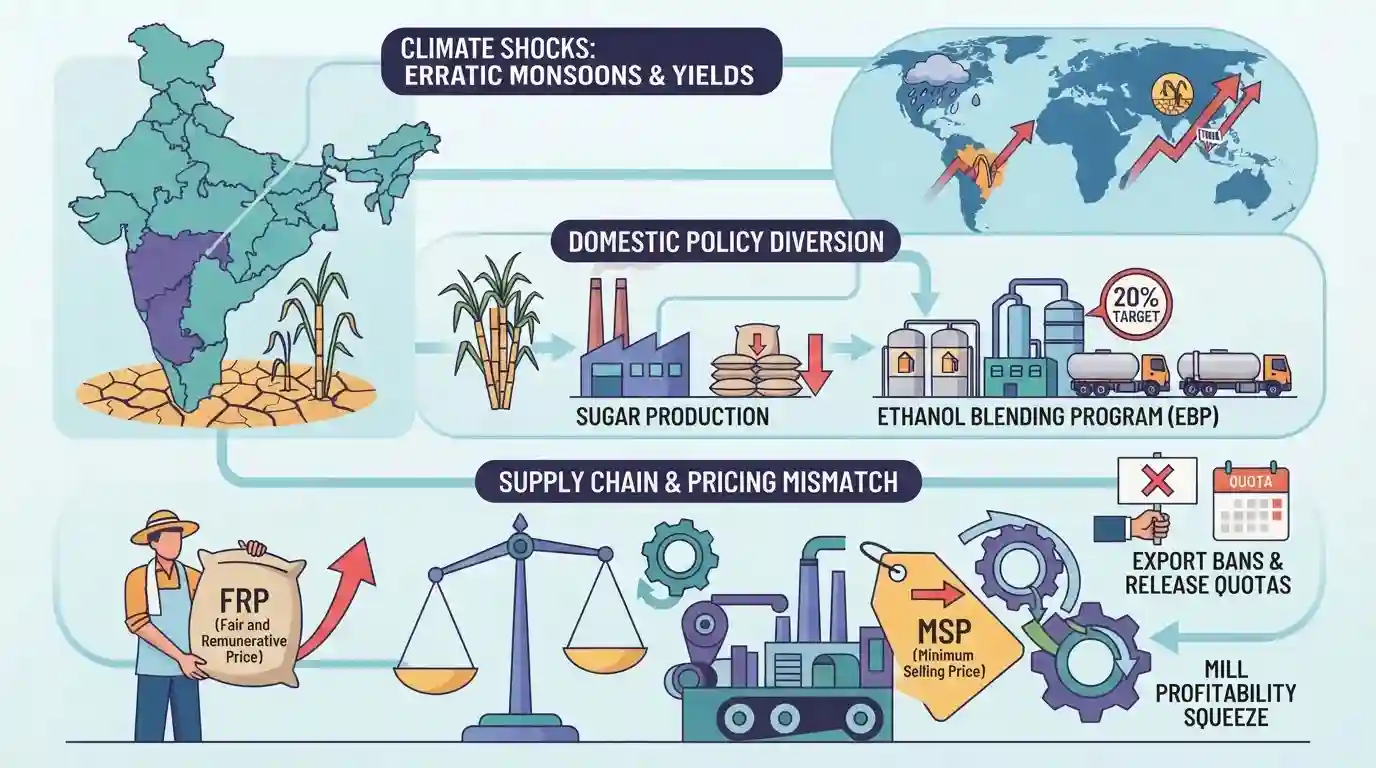
The article explains the drivers behind the sudden rise in domestic and global sugar prices. Domestically, erratic monsoons have lowered sugarcane yields in Maharashtra and Karnataka, while the diversion of sugarcane feedstocks to meet the 20% Ethanol Blending target by 2025-26 has reduced domestic sugar stocks. Globally, climate shocks in Brazil and Thailand have sent sugar prices soaring. Despite government export bans and monthly release quotas to control food inflation, a pricing mismatch persists—rising Fair and Remunerative Prices (FRP) for farmers alongside stagnant sugar Minimum Selling Prices (MSP) have squeezed sugar mills' profitability and squeezed domestic supplies.
Key Points
- Production Shortfall: Erratic monsoon patterns and El Niño-induced dry spells in key peninsular states like Maharashtra and Karnataka significantly reduced sugarcane yields and sugar recovery rates, creating domestic supply concerns.
- The Biofuel Trade-off: Under the Ethanol Blending Programme (EBP), sugar mills diverted substantial amounts of sugarcane juice and B-heavy molasses to produce ethanol. This diversion reduced the overall volume of sugar available for domestic consumption, driving up prices.
- Global Supply Shocks: Global raw sugar prices hit multi-year highs due to production deficits in other major exporting nations like Brazil (impacted by severe dry weather) and Thailand, which exerted upward pressure on domestic sentiments despite India's export restrictions.
- Pricing Mismatch (FRP vs. MSP): While the government has steadily increased the Fair and Remunerative Price (FRP) of sugarcane to protect farmer incomes, the Minimum Selling Price (MSP) of sugar has remained frozen at ₹31 per kg since 2019, severely squeezing the liquidity of sugar mills.
- Regulatory Interventions: To manage domestic food inflation, the government actively uses supply-side tools, including monthly release quotas, restrictions on ethanol diversion, and export bans, highlighting the delicate policy balance between farmer profitability, energy transition, and consumer inflation.
Important Terms
Ethanol Blending Programme (EBP)

A government initiative under the National Policy on Biofuels to mix ethanol, derived primarily from sugarcane and biomass, with petrol. It aims to reduce import dependence, curb carbon emissions, and boost farmer incomes.
UPSC context
Crucial for GS Paper 3 (Environment/Energy); tests understanding of renewable energy transitions, energy security, and the food vs. fuel debate.
Fair and Remunerative Price (FRP)
The statutory minimum price that sugar mills are legally bound to pay sugarcane farmers. It is approved by the Cabinet Committee on Economic Affairs based on recommendations from the Commission for Agricultural Costs and Prices.
UPSC context
Essential for GS Paper 3 (Agriculture/Economy); frequently tested in Prelims and Mains regarding agricultural pricing, subsidies, and mill profitability.
State Advised Price (SAP)
A regional pricing floor for sugarcane announced by major producing states like Uttar Pradesh and Punjab. It is generally set higher than the central government's FRP, often creating pricing disparities and financial strain on mills.
UPSC context
Relevant for GS Paper 3 (Agriculture); highlights center-state policy divergences and pricing distortions affecting the agro-industry's financial health.
Commission for Agricultural Costs and Prices (CACP)
A decentralized expert body under the Ministry of Agriculture. It recommends Minimum Support Prices (MSPs) and FRP for agricultural commodities by analyzing production costs, market trends, and supply-demand dynamics.
UPSC context
Highly significant for Prelims and GS Paper 3; tests knowledge of institutional frameworks governing India's agricultural price support mechanisms.
Essential Commodities Act
A central law enacted in 1955 allowing the government to regulate the production, supply, and distribution of essential goods like sugar. It is primarily used to prevent hoarding and control food inflation during crises.
UPSC context
Vital for GS Paper 3 (Economy/Food Security) and GS Paper 2; tests understanding of inflation control and government market interventions.
Prelims Trap
Sugarcane farmers are paid the Minimum Selling Price (MSP) determined by the CACP.
Farmers receive Fair & Remunerative Price (FRP) for cane. Mills are subject to a Minimum *Selling* Price for processed sugar. Furthermore, CACP only recommends FRP; CCEA approves it.
Static Concepts Connected
How is sugarcane pricing determined in India?
- FRP (Centre): Recommended by the CACP and approved by the CCEA, it is the mandatory minimum price sugar mills must pay to sugarcane farmers.
- Recovery Rate Link: The FRP is statutorily linked to a basic sugar recovery rate, with a premium paid for higher sugar recoveries.
- SAP (States): Major sugarcane-producing states (like UP, Punjab, Haryana) announce their own State Advised Prices, which are generally higher than the Centre's FRP.
What is the difference between B-heavy and C-heavy molasses in ethanol production?
- B-heavy Molasses: An intermediate byproduct that still contains crystallizable sugar. Diverting it to ethanol production directly reduces the final sugar output.
- C-heavy Molasses: The final byproduct of the sugar extraction process. It contains essentially no commercially recoverable sugar.
- Policy Incentives: The government uses differential pricing to incentivize ethanol production from B-heavy molasses and direct sugarcane juice to meet the E20 blending targets.
Cross-Topic Patterns
Biofuels & Food Inflation Trade-off
Diverting sugarcane juice and grains (maize/broken rice) to meet the 20% ethanol blending target directly strains domestic food supplies and drives up inflation during poor monsoon years.
El Niño & Global Agri-shocks
Synchronized climate anomalies hitting peninsular India, Brazil, and Thailand showcase how globalised agricultural dependencies amplify domestic inflation, overriding the effect of local export bans.

Expect a multi-statement question combining sugarcane pricing (FRP vs SAP) with the food-vs-fuel debate via B-heavy/C-heavy molasses.
Linked PYQs · 4
Linked PYQs · 4
- 2015PrelimsGS1
The Fair and Remunerative Price (FRP) of sugarcane is approved by the
- 2025PrelimsGS1
Consider the following statements : Statement I: Of the two major ethanol producers in the world, i.e., Brazil and the United States of America, the former produces more ethanol than the latter. Statement II: Unlike in the United States of America where corn is the principal feedstock for ethanol production, sugarcane is the principal feedstock for ethanol production in Brazil. Which one of the following is correct in respect of the above statements?
- 2025MainsGS3
Elaborate the scope and significance of supply chain management of agricultural commodities in India.
- 2017MainsGS3
How do subsidies affect the cropping pattern, crop diversity and economy of farmers? What is the significance of crop insurance, minimum support price and food processing for small and marginal farmers?
