United Kingdom Diplomatic Shift on Palestinian Statehood Recognition
Source:The Hindu ↗
Why It Matters
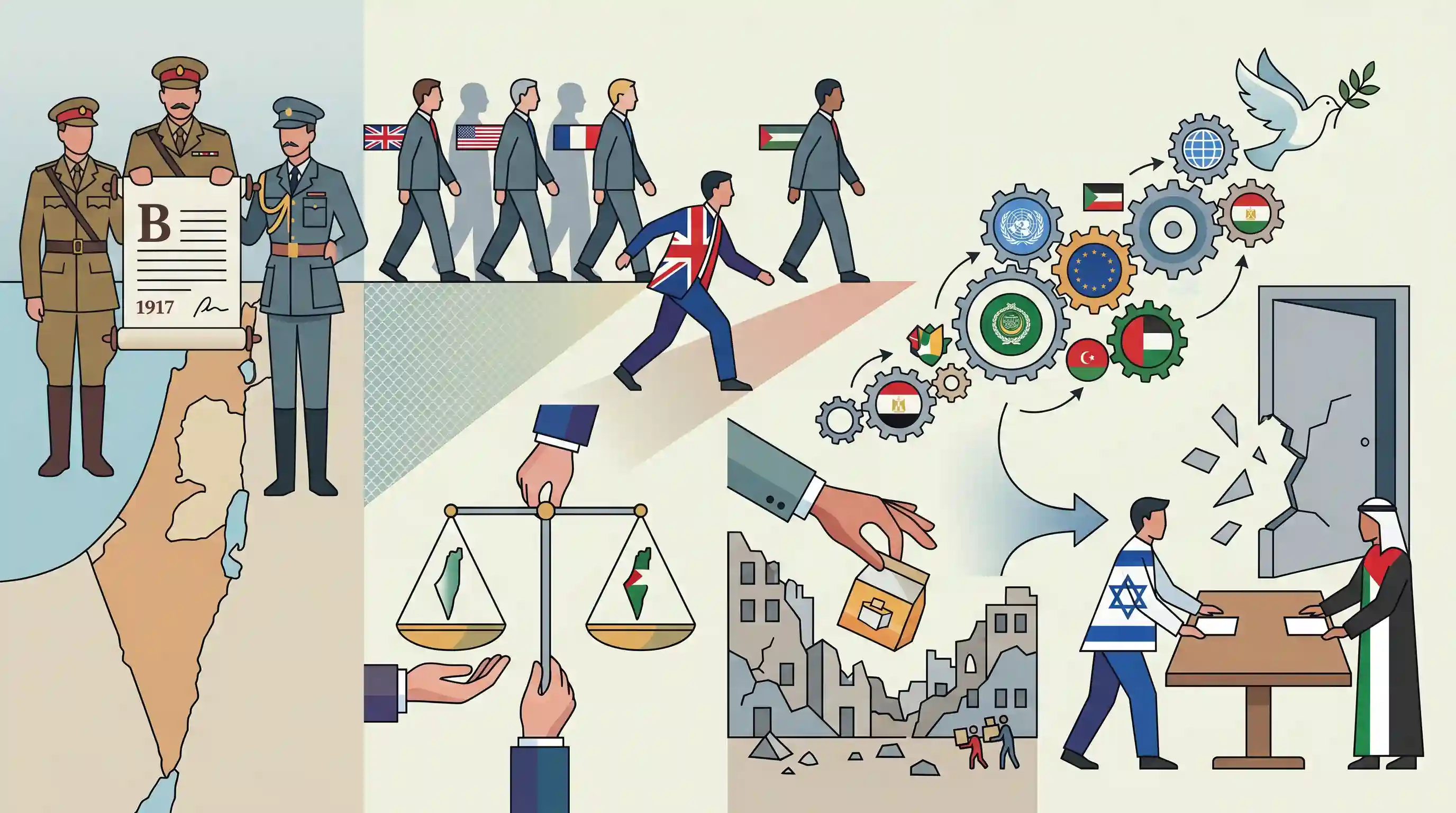
The U.K.'s diplomatic pivot on Palestine connects GS1 World History (colonial mandates and the Balfour Declaration) with GS2 International Relations. Understanding this shift is essential for analyzing Western diplomatic realignments, the evolving dynamics of the Middle East peace process, and the broader global push for a two-state solution.
Summary
The article examines the geopolitical and historical importance of the United Kingdom's evolving diplomatic stance on Palestinian statehood. Due to its foundational role in the region's modern history—highlighted by the Balfour Declaration—the U.K.'s potential recognition of a Palestinian state represents a major shift from Western diplomatic norms. This move is driven by the need to salvage the two-state solution and address the humanitarian crisis in Gaza, potentially catalyzing broader international momentum for Middle East peace and pressuring Israel into renewed negotiations.
Key Points
- The U.K.'s stance on Palestine holds immense historical significance due to its colonial legacy in the region, particularly the 1917 Balfour Declaration and the British Mandate, which laid the groundwork for the creation of Israel.
- Recent diplomatic signals suggest a potential shift in the U.K.'s approach, moving toward the recognition of an independent Palestinian state even before a final peace settlement is reached with Israel.
- This evolving position aims to provide a tangible political horizon for Palestinians and to revive the stalled two-state solution amid the ongoing devastation of the Gaza conflict.
- A formal change in the U.K.'s diplomatic posture would exert considerable pressure on other Western allies, including the United States, to recalibrate their strategies regarding the Middle East peace process.
Important Terms
Balfour Declaration

A 1917 public statement by the British government supporting the establishment of a "national home for the Jewish people" in Palestine, then an Ottoman region.
UPSC context
GS Paper 1 (World History) & GS Paper 2 (IR). Tests understanding of colonial legacies and roots of West Asian conflict.
Two-State Solution
The proposed diplomatic framework to resolve the Israel-Palestine conflict by establishing two independent, sovereign states—Israel and Palestine—coexisting side-by-side between the Jordan River and the Mediterranean.
UPSC context
GS Paper 2 (International Relations). Essential for discussing West Asian geopolitics and India's long-standing diplomatic position.
Arab League
A regional organization of 22 Arab nations founded in 1945 to coordinate policy and protect member sovereignty. It recognizes the State of Palestine as a full member.
UPSC context
GS Paper 2 (International Organizations). Tests knowledge of regional blocs and their role in collective diplomacy and conflict resolution.
UN Non-Member Observer State
The specific status granted to Palestine by the UN General Assembly in 2012 (Resolution 67/19), allowing participation in debates and access to international bodies like the ICC.
UPSC context
GS Paper 2 (IR/UN). Relates to the legal mechanics of international recognition and the functional status of "states-in-waiting."
Montevideo Convention
The 1933 treaty defining the legal criteria for statehood: a permanent population, a defined territory, a functioning government, and the capacity to enter into foreign relations.
UPSC context
GS Paper 2 (International Law). Used to evaluate the legitimacy of statehood claims in disputed regions like Palestine.
Prelims Trap
"India currently does not formally recognize the State of Palestine due to its deepening defense and strategic ties with Israel."
False. India was one of the first non-Arab states to recognize Palestine in 1988. It currently employs "de-hyphenation" to maintain parallel, independent relations with both.
Static Concepts Connected
What is India's 'De-hyphenation' policy in West Asia?
- Independent ties: Treating relations with Israel and Palestine as distinct, mutually exclusive entities rather than a zero-sum game.
- Operational shift: Moving away from diplomatic balancing acts, such as linking a state visit to Israel with a mandatory reciprocal visit to Ramallah.
- Strategic autonomy: Allows India to maximize defense and technology partnerships with Israel while continuing to advocate for a two-state solution for Palestinians.
What was the significance of the 1917 Balfour Declaration?
- British Pledge: A letter expressing UK government support for establishing a "national home for the Jewish people" in Palestine.
- Mandate System: It laid the diplomatic and administrative groundwork for the British Mandate of Palestine after the collapse of the Ottoman Empire.
- Historical Catalyst: It remains the foundational historical catalyst for the demographic shifts and territorial disputes driving the modern Israel-Palestine conflict.
Cross-Topic Patterns
UN Non-Member Observer Status
Palestine's statehood quest connects to UN General Assembly rules, where it holds "non-member observer state" status (like the Holy See), enabling its participation in the International Criminal Court.
Decolonization and the Mandate System
The British Mandate over Palestine links directly to the League of Nations' post-WWI mandate system, a classic World History topic regarding colonial legacies and arbitrary border drawing.
De-hyphenation to Minilateralism
India's shift from balancing Israel-Palestine to forging economic corridors (IMEC) and minilaterals (I2U2) demonstrates a transition from ideologically driven diplomacy to strategic pragmatism in West Asia.

Expect a multi-statement Prelims question matching historic Middle East declarations (Balfour, Oslo, Abraham Accords, Arab Peace Initiative).
Linked PYQs · 2
Linked PYQs · 2
- 2018MainsGS2
“India’s relations with Israel have, of late, acquired a depth and diversity, which cannot be rolled back.” Discuss.
- 2023PrelimsGS1
Consider the following statements: Statement-I: Israel has established diplomatic relations with some Arab States. Statement-II: The 'Arab Peace Initiative' mediated by Saudi Arabia was signed by Israel and Arab League. Which one of the following is correct in respect of the above statements?
