Supreme Court Examines Constitutional Validity of Polygamy and Islam
Source:The Hindu ↗
কেন এটি গুরুত্বপূর্ণ
The intersection of religious personal laws and constitutional fundamental rights is a recurring theme in UPSC Polity and Social Justice. Understanding the Supreme Court's approach to the Essential Religious Practices test and the Narasu Appa Mali precedent is crucial for Mains GS2 answers on secularism, gender equality, and the Uniform Civil Code.
সারসংক্ষেপ
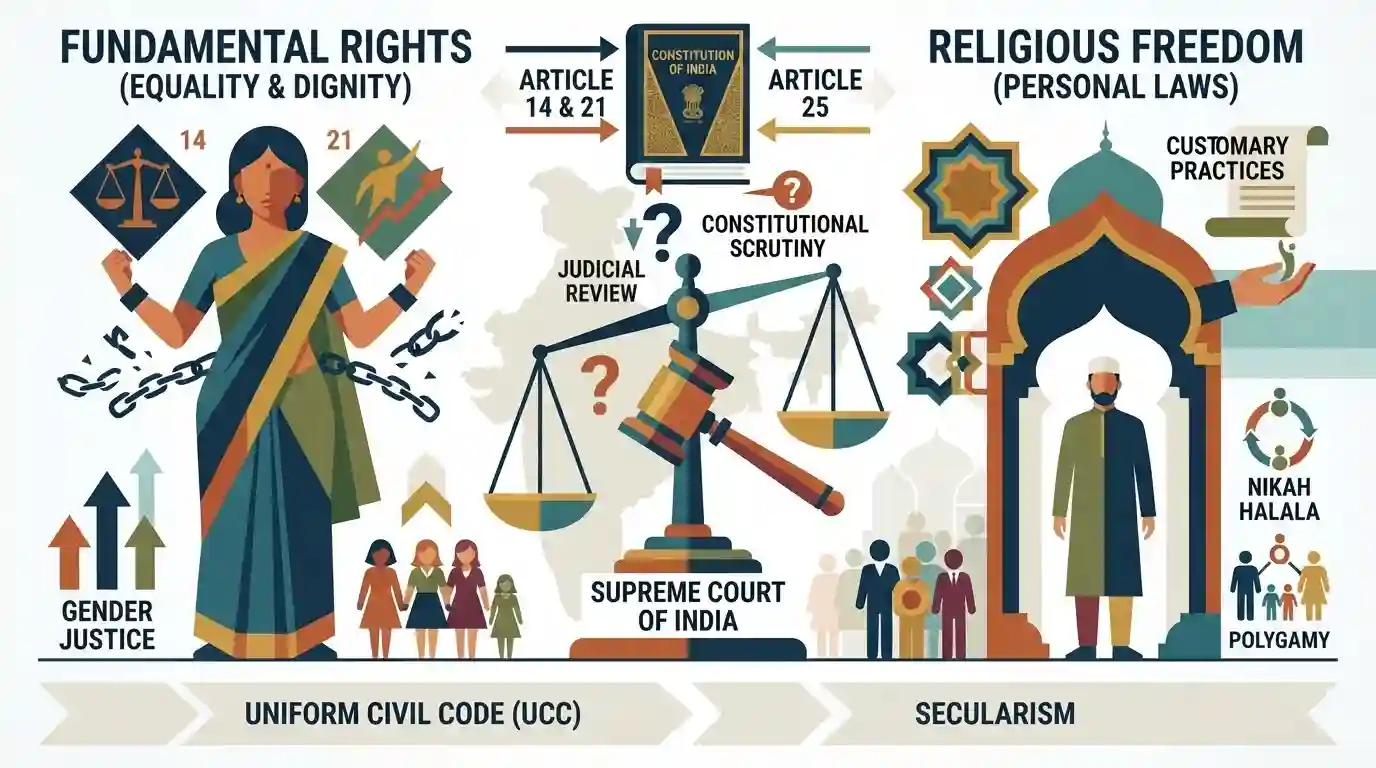
The Supreme Court of India is examining the constitutionality of polygamy and nikah halala under Muslim Personal Law. The legal challenge weighs the fundamental rights of women, specifically the right to equality and life with dignity (Articles 14 and 21), against the constitutionally protected right to religious freedom (Article 25). The judicial review will likely involve assessing whether these practices constitute 'essential religious practices' and reconsidering older precedents that shielded uncodified personal laws from fundamental rights scrutiny. The outcome will have profound implications for gender justice and the debate over the Uniform Civil Code (UCC).
মূল বিষয়
- The Supreme Court is examining the constitutional validity of polygamy and nikah halala under Muslim Personal Law following petitions challenging these practices.
- The core constitutional conflict lies between the Right to Equality (Article 14) and Right to Life with Dignity (Article 21) versus the Freedom to Manage Religious Affairs (Article 25 and 26).
- The Court may employ the 'Essential Religious Practices' (ERP) test to determine whether polygamy is an integral and mandatory part of the Islamic faith.
- The hearings are expected to revisit the 1951 State of Bombay vs. Narasu Appa Mali judgment, which held that uncodified personal laws are not 'laws' under Article 13, and therefore cannot be struck down for violating Fundamental Rights.
- This judicial scrutiny runs parallel to the ongoing political and social discourse surrounding the implementation of a Uniform Civil Code (Article 44).
গুরুত্বপূর্ণ শব্দ
Uniform Civil Code (UCC)

A constitutional directive under Article 44 aiming to replace religion-specific personal laws with a common set of civil laws governing marriage, divorce, inheritance, and adoption for all Indian citizens.
UPSC context
Highly relevant for GS 2 (Polity). Evaluates the ongoing conflict between Directive Principles, gender justice, and the Right to Religious Freedom.
Muslim Personal Law (Shariat) Application Act, 1937
A colonial-era statute mandating that Muslim personal affairs—including marriage, divorce, and inheritance—be governed by Islamic law (Shariat). It is currently under Supreme Court scrutiny for alleged gender discrimination.
UPSC context
Vital for GS 2 (Constitutional Law). Tests the tension between statutory personal laws and fundamental rights like equality (Article 14) and dignity.
Law Commission of India
An executive, non-statutory body constituted by the Union Government to recommend legal reforms. It frequently examines the feasibility, social impact, and framework of complex legal overhauls like the Uniform Civil Code.
UPSC context
GS 2 (Governance). Tests knowledge of non-statutory advisory bodies and their structural role in guiding major legislative and socio-legal reforms.
Hindu Marriage Act, 1955
A codified law regulating marriage and divorce among Hindus. By explicitly outlawing polygamy and enforcing monogamy, it serves as a critical comparative baseline in modern debates concerning a Uniform Civil Code.
UPSC context
GS 1 (Society) and GS 2. Highlights the state's historical capacity to reform religious personal laws, contrasting with uncodified practices.
প্রিলিমস ফাঁদ
Uncodified personal laws have been explicitly ruled by the Supreme Court to be 'laws' under Article 13.
While individual judgments have questioned the 1951 Narasu Appa Mali ruling, it has not been formally overruled by a larger bench of the Supreme Court.
সংযুক্ত স্থির ধারণা
What is the 'Essential Religious Practices' (ERP) test?
- Origin: Introduced in the Shirur Mutt case (1954) to identify practices absolutely integral to a religion.
- Judicial Power: Empowers courts, rather than religious leaders, to decide if a ritual is mandatory or optional.
- Limitation: Often criticized for shifting judicial focus from constitutional rights to complex theological interpretations.
How does Article 13 define 'laws' in relation to Fundamental Rights?
- Scope of definition: Includes ordinances, rules, regulations, notifications, customs, and usages having the force of law.
- Personal law exclusion: The 1951 Narasu Appa Mali judgment held that uncodified personal laws fall outside Article 13.
- Pre-constitutional laws: Under Article 13(1), pre-constitutional laws inconsistent with Fundamental Rights are declared void to that extent.
আন্তঃবিষয় প্যাটার্ন
Gender Justice vs. Federal Diversity
State-level UCC enactments (like Uttarakhand's) expose the constitutional friction between safeguarding uniform gender rights and preserving distinct regional or tribal customs under federal arrangements.
Judicial Reforms vs. Separation of Powers
Supreme Court interventions in personal laws test the boundary between judicial correction of gender inequalities and the legislature's role in social reform.

Multiple-statement MCQs on Article 13 and the ERP doctrine's origins will test the limits of judicial review over personal laws.
সংযুক্ত PYQ · 3
সংযুক্ত PYQ · 3
- 2023MainsGS2
Explain the constitutional perspectives of Gender Justice with the help of relevant Constitutional Provisions and case laws.
- 2024MainsGS2
Discuss India as a secular state and compare with the secular principles of the US constitution.
- 2020MainsGS2
Judicial Legislation is antithetical to the doctrine of separation of powers as envisaged in the Indian Constitution. In this context justify the filing of large number of public interest petitions praying for issuing guidelines to executive authorities.
