Strait of Hormuz Strategic Importance for Global Energy Security
Source:The Hindu ↗
Why It Matters
The Strait of Hormuz is frequently in the news due to Middle East tensions and directly intersects with UPSC's focus on India's energy security, geographic chokepoints (Prelims mapping), and international relations in West Asia.
Summary
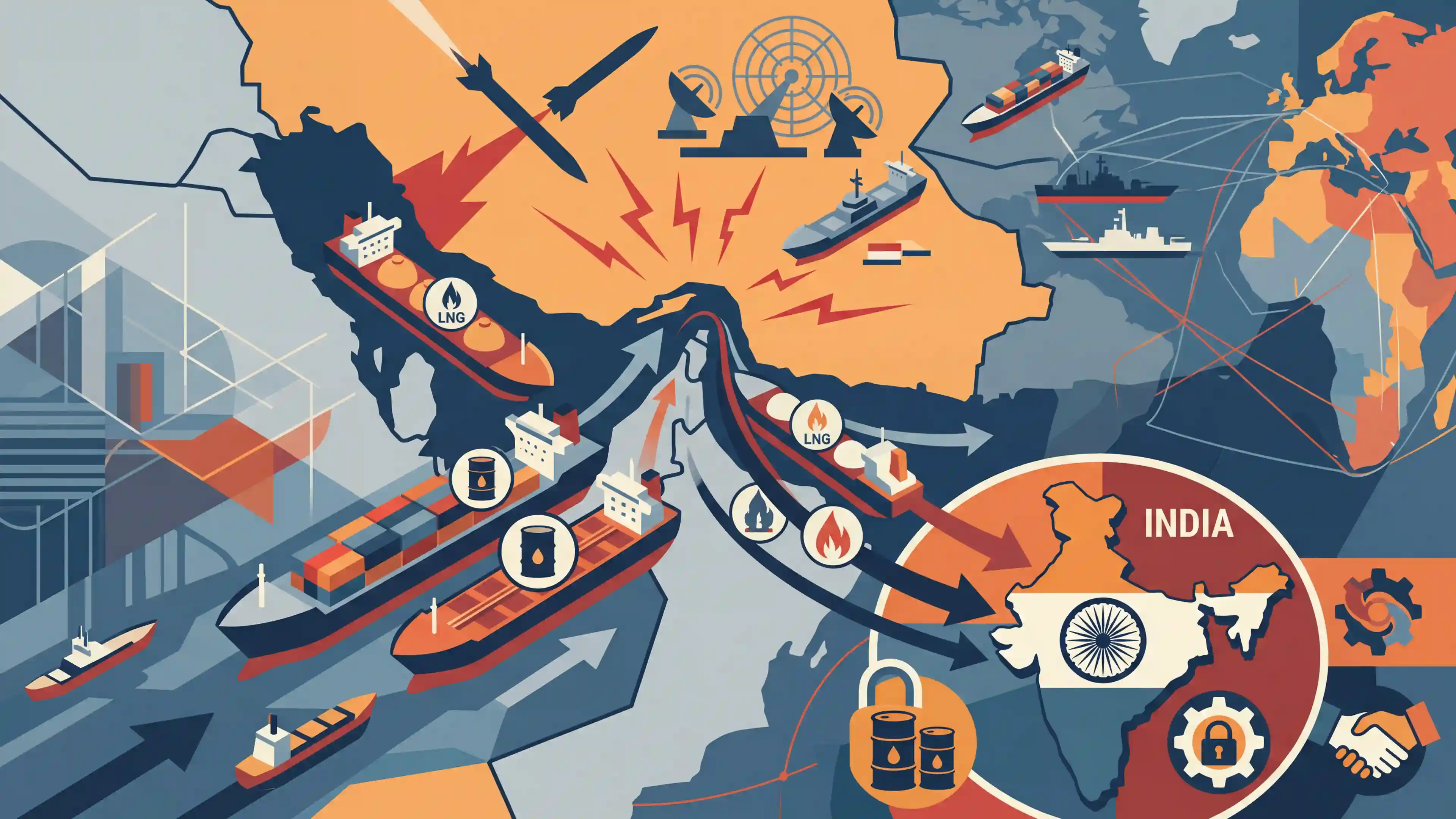
The Strait of Hormuz is arguably the world's most critical maritime chokepoint, connecting the oil-rich Persian Gulf to the Gulf of Oman and the Arabian Sea. It facilitates the transit of over a fifth of global oil consumption and a significant portion of Liquefied Natural Gas (LNG). Its geographical narrowness makes it highly vulnerable to disruptions. Amid escalating geopolitical tensions in the Middle East involving Iran, Israel, and the US, the strait's security is under severe focus. For India, which imports a substantial majority of its crude oil and natural gas from the region, ensuring unimpeded flow through the Strait of Hormuz remains a foundational pillar of its energy security and foreign policy.
Key Points
- Geographic significance: A narrow waterway (about 21 miles wide at its narrowest) separating Iran from Oman and the UAE, serving as the sole sea passage from the Persian Gulf to the open ocean.
- Economic lifeline: Transits approximately 20 million barrels of oil per day (around 20% of global demand) and a massive volume of LNG, primarily from Qatar to Asian markets.
- Geopolitical vulnerability: Highly susceptible to blockades or disruptions due to regional conflicts, notably escalating tensions between Iran and Israel/US, as well as broader Middle Eastern instability.
- Implications for India: As a major importer of crude oil and natural gas from the Middle East, India's energy security and macroeconomic stability are critically dependent on the unimpeded flow of energy through this chokepoint.
Important Terms
Strait of Hormuz

A narrow waterway between Iran and Oman connecting the Persian Gulf to the Gulf of Oman; it facilitates over 20% of global oil consumption transit.
UPSC context
GS Paper 1 (Geography) & GS Paper 2 (International Relations); tests knowledge of critical maritime geography and global energy lifelines.
Maritime Chokepoint
Narrow geographical features (straits or canals) along global shipping routes that handle high traffic volumes, making them strategic but vulnerable to disruption.
UPSC context
GS Paper 1 (World Geography) & GS Paper 3 (Energy/Economy); essential for mapping and analyzing trade vulnerability and supply chain shocks.
Organization of the Petroleum Exporting Countries (OPEC)
A permanent intergovernmental organization of 12 major oil-exporting nations that coordinates petroleum policies to stabilize markets and ensure fair returns for producers.
UPSC context
GS Paper 2 (International Groups) & GS Paper 3 (Economy); important for understanding global oil pricing and India's energy import bill.
Energy Security
The reliable availability of energy sources at an affordable price, involving both long-term infrastructure investment and short-term resilience to supply shocks.
UPSC context
GS Paper 3 (Energy & Economy); a core pillar of Indian policy, testing understanding of import dependency and strategic resilience.
Strategic Petroleum Reserves (SPR)
Large underground storage facilities for crude oil maintained by a country to safeguard against unforeseen disruptions in the global energy supply chain.
UPSC context
GS Paper 3 (Economy/Infrastructure); tests knowledge of India's emergency mitigation strategies against geopolitical shocks and energy crises.
UNCLOS (United Nations Convention on the Law of the Sea)
The 1982 international agreement establishing a legal framework for all marine and maritime activities, including the rights of transit passage through international straits.
UPSC context
GS Paper 2 (International Relations); the primary legal framework for maritime disputes, freedom of navigation, and territorial waters.
Prelims Trap
The Strait of Hormuz is bordered by Iran, Saudi Arabia, and the United Arab Emirates.
Saudi Arabia does not border the strait. It is flanked by Iran to the north, and the UAE and Oman (via the Musandam Peninsula) to the south.
Static Concepts Connected
What are the primary maritime chokepoints in the Middle East?
- Strait of Hormuz: Connects the Persian Gulf to the Gulf of Oman and Arabian Sea. Critical for Persian Gulf oil and Qatari LNG.
- Bab-el-Mandeb: Connects the Red Sea to the Gulf of Aden. Key transit route for global shipping passing through the Suez Canal.
- Suez Canal: An artificial sea-level waterway in Egypt, connecting the Mediterranean Sea to the Red Sea, enabling direct route to Europe.
How does India mitigate risks of crude oil supply disruptions?
- Strategic Petroleum Reserves: Underground rock caverns (Visakhapatnam, Mangaluru, Padur) store emergency crude oil to provide a crucial buffer against short-term global supply shocks.
- Import Diversification: India actively reduces its Middle Eastern dependency by increasingly sourcing crude from Russia, the US, and African nations.
Cross-Topic Patterns
Hormuz bypass via Chabahar Port
India's investment in Iran's Chabahar Port, situated on the Gulf of Oman just outside the Strait of Hormuz, strategically bypasses this highly vulnerable maritime chokepoint.
Red Sea Crisis & IMEC relevance
Concurrent vulnerabilities in Bab-el-Mandeb (Red Sea) and Hormuz heighten the strategic imperative for the India-Middle East-Europe Economic Corridor (IMEC) to diversify and secure trade routes.

Expect a map-based Prelims question matching global maritime chokepoints (Hormuz, Bab-el-Mandeb, Malacca) with their bordering nations.
Linked PYQs · 4
Linked PYQs · 4
- 2025MainsGS2
"Energy security constitutes the dominant kingpin of India's foreign policy, and is linked with India's overarching influence in Middle Eastern countries.” How would you integrate energy security with India's foreign policy trajectories in the coming years?
- 2017MainsGS2
The question of India's Energy Security constitutes the most important part of India's economic progress. Analyze India's energy policy cooperation with West Asian countries.
- 2024PrelimsGS1
Consider the following statements : Statement-I : Sumed pipeline is a strategic route for Persian Gulf oil and natural gas shipments to Europe. Statement-II : Sumed pipeline connects the Red Sea with the Mediterranean Sea. Which one of the following is correct in respect of the above statements?
- 2022PrelimsGS1
The term "Levant" often heard in the news roughly corresponds to which of the following regions?
