Rice Price Inflation and Food Security Management
Source:The Hindu ↗
આ શા માટે મહત્વનું છે
Essential for understanding food inflation dynamics, agricultural economics, and food security policies in India, which frequently feature in GS Paper 3.
સારાંશ
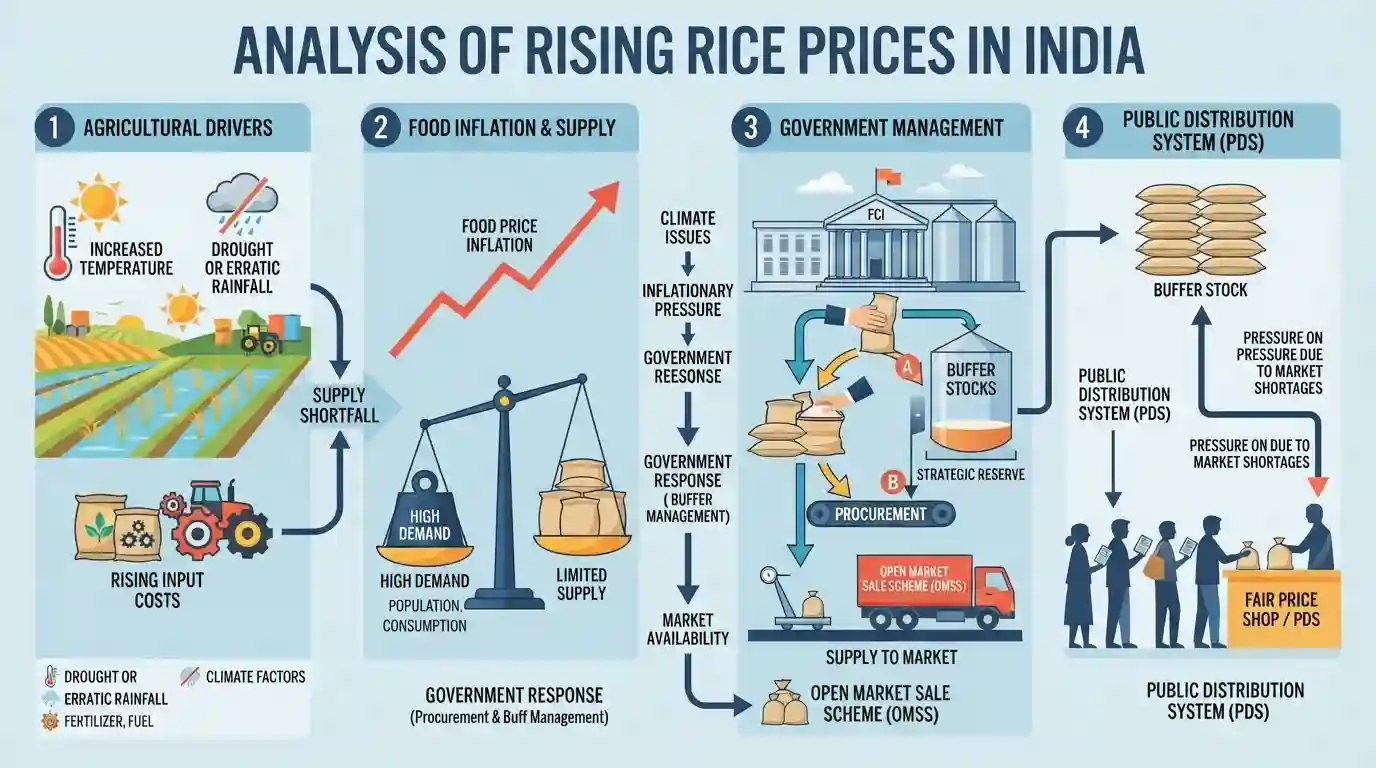
An analytical explanation of the reasons behind rising rice prices across India, detailing the interplay of food inflation, government procurement, buffer stocks, and open market policies.
મુખ્ય મુદ્દા
- Rice prices across India have been on an upward trend due to various factors including production shocks, weather anomalies, and export dynamics.
- Government interventions such as the Open Market Sale Scheme (OMSS) and buffer stock management play a crucial role in curbing food inflation.
- Rising input costs and MSP increases also contribute to structural shifts in cereal pricing.
મહત્વપૂર્ણ શબ્દો
Minimum Support Price

A government-set guaranteed price floor at which public agencies procure food grains from farmers, protecting them against sharp market price slumps and assuring national food security.
UPSC context
UPSC Prelims/Mains (GS Paper III): Crucial for Agriculture, food security, PDS, and farmer economics questions.
Open Market Sale Scheme
A policy tool used by the Food Corporation of India to sell surplus food grains from the central pool in the open market via e-auctions to curb inflation.
UPSC context
UPSC Prelims/Mains (GS Paper III): Important for food inflation management, agricultural trade, and buffer stock policies.
Food Corporation of India
The premier statutory body set up under the Food Corporations Act 1964 responsible for procuring, storing, moving, and distributing food grains across India.
UPSC context
UPSC Prelims/Mains (GS Paper III): Essential for understanding public distribution systems, food security, and agricultural logistics.
પ્રિલિમ્સ ટ્રેપ
The Reserve Bank of India directly manages the Open Market Sale Scheme (OMSS) to auction surplus buffer stocks.
OMSS is managed by the FCI for open market auctions to curb inflation, not by the RBI or through direct farm-gate MSP operations.
સંલગ્ન સ્થિર ખ્યાલો
What are the key operational mandates of the Food Corporation of India (FCI)?
- Grain Procurement: Procurement of food grains at Minimum Support Prices (MSP) from farmers across surplus states.
- Buffer Management: Maintenance of strategic buffer stocks to ensure national food security during deficit years.
- PDS Distribution: Distribution of food grains to state governments for the Targeted Public Distribution System (TPDS).
- Market Intervention: Moderation of open market prices during supply shocks via mechanisms like the Open Market Sale Scheme (OMSS).
આંતર-વિષય પેટર્ન
Food Inflation vs. Monetary Policy Transmission
Rising cereal prices interact directly with RBI's inflation targeting mandate, forcing monetary policy committees to weigh food shocks against core inflation trends.
Export Controls vs. WTO Agri-Trade Norms
Export restrictions and MSP hikes highlight the delicate policy balance between protecting domestic consumers and ensuring remunerative prices for farmers under WTO disciplines.

Food inflation drivers (MSP, OMSS, buffer stocks) frequently appear as multi-statement prelims questions testing FCI and RBI mandates.
સંલગ્ન PYQ · 2
સંલગ્ન PYQ · 2
- 2024MainsGS3
Elucidate the importance of buffer stocks for stabilizing agricultural prices in India. What are the challenges associated with the storage of buffer stock? Discuss.
- 2024MainsGS3
What are the causes of persistent high food inflation in India? Comment on the effectiveness of the monetary policy of the RBI to control this type of inflation.
