NEP Higher Education Reforms and Undergraduate Course Challenges
Source:The Hindu ↗
Why It Matters
Highlights the critical gap between policy design (NEP 2020) and grassroots implementation in India's higher education sector. It provides essential context for answering questions on education reforms, capacity building, and human capital development in GS Paper 2 and Essays.
Summary
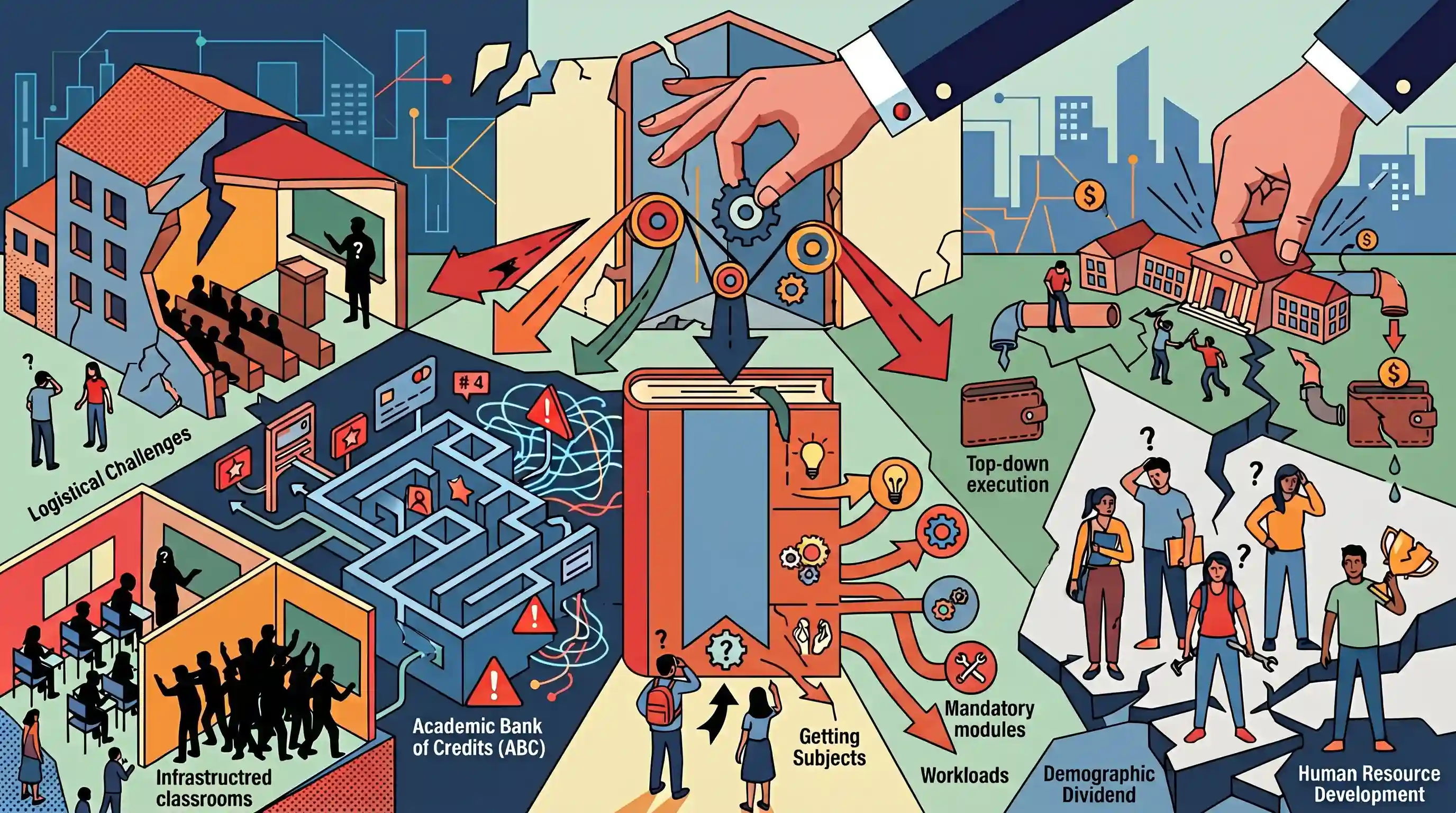
The implementation of the Four-Year Undergraduate Programme (FYUP) under the National Education Policy (NEP) 2020 has triggered widespread confusion and logistical challenges across Indian universities. While the policy introduces a Multiple Entry and Exit System (MEES) and a multidisciplinary curriculum aimed at global competitiveness, the transition has exposed severe systemic inadequacies. Major hurdles include acute faculty shortages, insufficient infrastructure for the extra cohort of fourth-year students, and complexities in managing the Academic Bank of Credits (ABC). Furthermore, the imposition of mandatory foundational courses has led to concerns about the dilution of core subjects and increased academic workloads. The hasty, top-down execution by regulatory bodies without commensurate financial and administrative support threatens to undermine the NEP's fundamental goal of enhancing higher education quality and human resource development.
Key Points
- The rollout of the Four-Year Undergraduate Programme (FYUP) under NEP 2020 has caused significant disruption across universities due to a lack of structural preparation.
- Universities are facing severe faculty shortages and a lack of infrastructure to accommodate the addition of a fourth year of undergraduate students and research-oriented curriculum.
- The Multiple Entry and Exit System (MEES), intended to offer flexibility, has created confusion regarding the actual job market value of early-exit certificates and diplomas.
- Educators and students have criticized the mandatory multidisciplinary foundational courses for diluting the depth of core subjects and increasing continuous assessment workloads.
- There are concerns about the hasty, top-down implementation by the UGC without adequate financial backing, threatening the qualitative objectives of the NEP.
Important Terms
National Education Policy (NEP) 2020

A landmark reform aiming to transform India into a "global knowledge superpower" through holistic and multidisciplinary education. It replaces the 1986 policy, emphasizing 21st-century skills and global competitiveness.
UPSC context
GS Paper II (Education). Relevant for mains questions on education policy impact and human resource development strategies.
Four-Year Undergraduate Programme (FYUP)
A flexible degree structure allowing students to choose 3-year or 4-year durations. The fourth year focuses on research or specialization, aiming to align Indian degrees with international standards.
UPSC context
GS Paper II (Governance). Tests understanding of higher education structural reforms and their impact on research ecosystems.
Multiple Entry and Exit System (MEES)
A student-centric pathway allowing exits with certification (Certificate/Diploma/Degree) after each year and subsequent re-entry. It aims to reduce dropout rates and support lifelong learning flexibility.
UPSC context
GS Paper II (Human Resource Development). Evaluates strategies to improve the Gross Enrolment Ratio (GER) and address student dropouts.
Academic Bank of Credits (ABC)
A digital repository established to store academic credits earned by students. It facilitates credit transfer and redemption, enabling mobility across universities and supporting the MEES framework.
UPSC context
GS Paper II/III (E-Governance). Focuses on digital interventions in governance and their role in enhancing educational institutional transparency.
University Grants Commission (UGC)
A statutory body responsible for coordinating and maintaining higher education standards. It acts as the primary regulator implementing NEP reforms and disbursing grants to Indian universities.
UPSC context
GS Paper II (Statutory Bodies). Tests knowledge of regulatory frameworks and the evolution of institutional governance in India.
Prelims Trap
"HEFA provides direct financial grants to universities to fund infrastructure for NEP expansion."
HEFA does not issue grants. It issues 10-year loans where institutions must repay the principal via internal accruals, shifting the financial burden onto universities.
Static Concepts Connected
What is the Higher Education Financing Agency (HEFA)?
- Joint Venture: It is a non-profit NBFC formed as a joint venture between the Ministry of Education and Canara Bank.
- Loan-based funding: It provides 10-year loans for institutional infrastructure creation, largely replacing the older system of direct budgetary grants from the UGC.
- Repayment structure: Institutions must repay the principal amount from their internal revenue (like fee collections), while the Central Government services the interest portion.
How is legislative power over Education distributed in the Constitution?
- Concurrent List: Education was shifted from the State List to the Concurrent List (Entry 25) by the 42nd Constitutional Amendment Act, 1976, allowing both tiers to legislate.
- Union List (Entry 66): The Centre retains exclusive power over the coordination and determination of standards in institutions for higher education and research (Entry 66).
Cross-Topic Patterns
UGC mandates vs. Federalism in Education
Top-down UGC implementation of FYUP frequently clashes with state universities' resource capacities, echoing broader Centre-State friction in regulating Concurrent List subjects.
MEES and the Demographic Dividend
Early-exit credentials under MEES attempt to bridge academic degrees with vocational skilling, a critical transition needed to harness India's closing demographic window.

Expect a multi-statement Prelims question testing the exact tiers of NEP's Multiple Entry System alongside HEFA's loan-based funding model.
Linked PYQs · 4
Linked PYQs · 4
- 2020MainsGS2
National Education Policy 2020 is in conformity with the Sustainable Development Goal-4 (2030). It intends to restructure and reorient education system in India. Critically examine the statement.
- 2015MainsGS2
The quality of higher education in India requires major improvements to make it internationally competitive. Do you think that the entry of foreign educational institutions would help improve the quality of higher and technical education in the country? Discuss.
- 2023MainsGS2
The crucial aspect of development process has been the inadequate attention paid to Human Resource Development in India. Suggest measures that can address this inadequacy.
- 2016MainsGS2
Demographic Dividend in India will remain only theoretical unless our manpower becomes more educated, aware, skilled and creative." What measures have been taken by the government to enhance the capacity of our population to be more productive and employable?
