Kaziranga Eco-Sensitive Zone Conservation and Development Pressures
Source:The Hindu ↗
આ શા માટે મહત્વનું છે
Understanding Eco-Sensitive Zones (ESZs) and wildlife corridors like those around Kaziranga is critical for balancing developmental imperatives with biodiversity conservation under GS Paper III (Environment).
સારાંશ
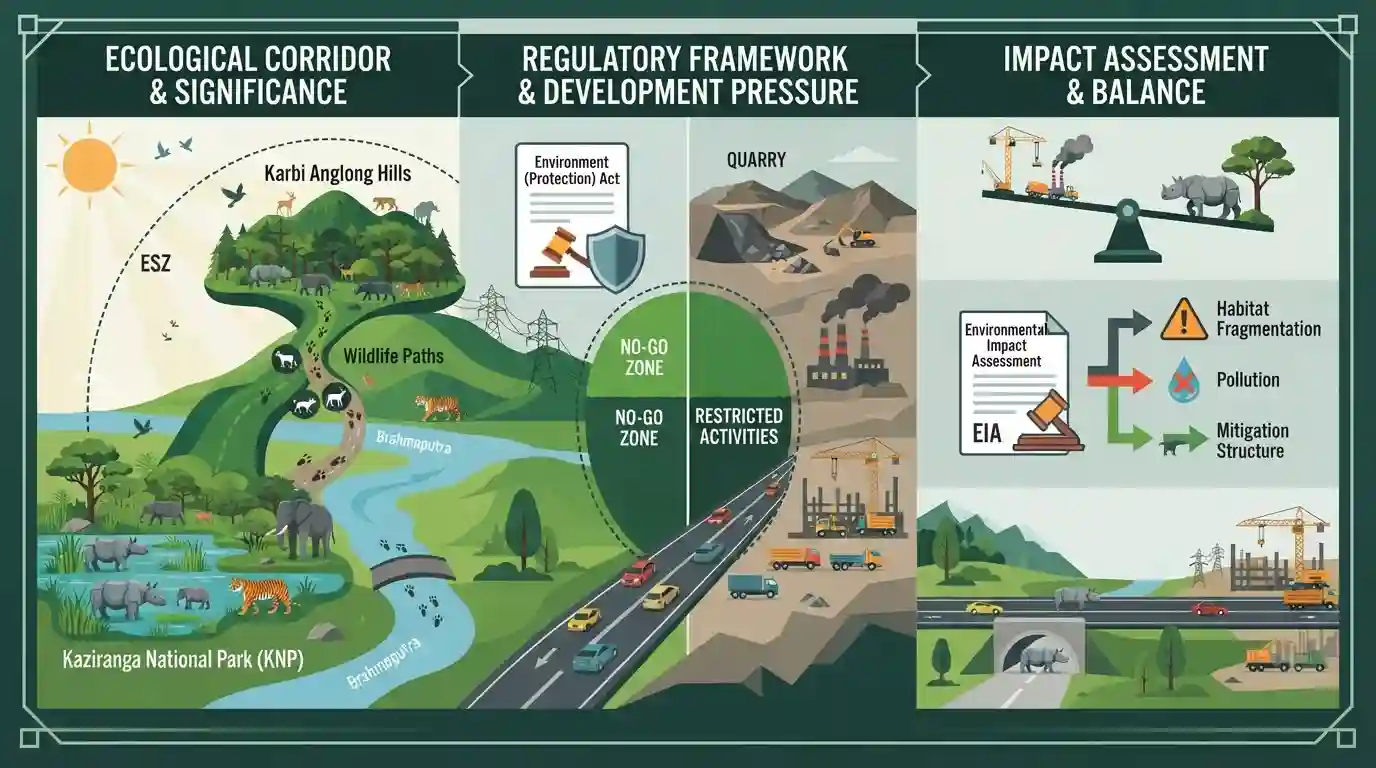
An analysis of why Kaziranga National Park's Eco-Sensitive Zone (ESZ) is in the news, focusing on the ecological significance, wildlife corridors with Karbi Anglong hills, regulatory frameworks under the Environment (Protection) Act, and the friction between developmental pressures and wildlife conservation.
મુખ્ય મુદ્દા
- The Eco-Sensitive Zone (ESZ) around Kaziranga National Park has come into sharp focus due to ongoing conservation challenges, human-wildlife conflict, and developmental pressures.
- Kaziranga is a UNESCO World Heritage Site famous for the one-horned rhinoceros, requiring strict ecological buffers to protect its unique floodplains and animal corridors connecting to the Karbi Anglong hills.
- Eco-Sensitive Zones serve as shock absorbers around protected areas, regulating commercial activities while balancing local livelihood needs.
- Legal framework governing ESZs stems from the Environment (Protection) Act, 1986, rather than the Wildlife Protection Act.
મહત્વપૂર્ણ શબ્દો
Environment (Protection) Act, 1986

An umbrella legislation enacted in 1986 under Article 253, empowering the Central Government to coordinate actions of state agencies, regulate environmental pollution, and notify Eco-Sensitive Zones (ESZs).
UPSC context
UPSC Prelims & GS Paper III (Environment & Biodiversity); core statute for environmental governance and statutory notifications like ESZs.
Wildlife (Protection) Act, 1972
Comprehensive legislation providing legal frameworks for the protection of wild animals, birds, and plants, and managing protected areas like National Parks and Sanctuaries.
UPSC context
UPSC Prelims & GS Paper III (Conservation); tests statutory mechanisms for protected areas, wildlife corridors, and anti-poaching measures.
Supreme Court of India
The apex judicial body in India responsible for constitutional interpretation and enforcing environmental jurisprudence, including guidelines on Eco-Sensitive Zones and protected areas.
UPSC context
UPSC GS Paper II (Polity & Judiciary) and Paper III (Environment); evaluates judicial activism and rulings balancing development with conservation.
Ministry of Environment, Forest and Climate Change
The nodal union ministry responsible for planning, promoting, and coordinating environmental and forestry policies, including the notification of ESZs around protected areas.
UPSC context
UPSC Prelims & GS Paper III (Environment); core administrative body for framing wildlife and environmental rules in India.
UNESCO
A specialized agency of the United Nations that designates global World Heritage Sites, recognizing places of outstanding universal value such as Kaziranga National Park.
UPSC context
UPSC Prelims & GS Paper I/III (International Conventions & Biodiversity); tests knowledge of international conservation recognitions.
સંલગ્ન સ્થિર ખ્યાલો
What is the legal framework and purpose of Eco-Sensitive Zones (ESZs) in India?
- Statutory Basis: Declared under Sections 3(2)(v) and 5 of the Environment (Protection) Act, 1986, to act as shock absorbers around Protected Areas.
- Prohibited Activities: Regulates heavy industries, commercial mining, and sawmills while allowing sustainable agriculture and livelihood activities.
- Boundary Extent: The 10 km default radius under the National Wildlife Action Plan is subject to modifications via site-specific central notifications.
આંતર-વિષય પેટર્ન
Protected Areas vs Landscape Ecology
Kaziranga's seasonal flood migration to Karbi Anglong highlights how protected area boundaries must transcend maps to protect ecological corridors and holistic geography.

Expect a statement-based prelims question pairing ESZ legal roots under EPA 1986 with Wildlife Protection Act 1972 confusions.
સંલગ્ન PYQ · 2
સંલગ્ન PYQ · 2
- 2014PrelimsGS1
With reference to 'Eco-Sensitive Zones', which of the following statements is/are correct? 1. Eco-Sensitive Zones are the areas that are declared under the Wildlife (Protection) Act, 1972. 2. The purpose of the declaration of Eco-Sensitive Zones is to prohibit all kinds of human activities in those zones except agriculture. Select the correct answer using the code given below.
- 2019MainsGS3
Define the concept of carrying capacity of an ecosystem as relevant to an environment. Explain how understanding this concept is vital while planning for sustainable development of a region.
