Kaziranga Eco-Sensitive Zone Notification and Wildlife Corridors
Source:The Hindu ↗
Why It Matters
This article illustrates the classic development-vs-conservation conflict in ecologically fragile regions, highlighting the legal mechanisms of ESZs under the Environment (Protection) Act, 1986, and the critical importance of wildlife corridors for animal survival during natural disasters like floods.
Summary
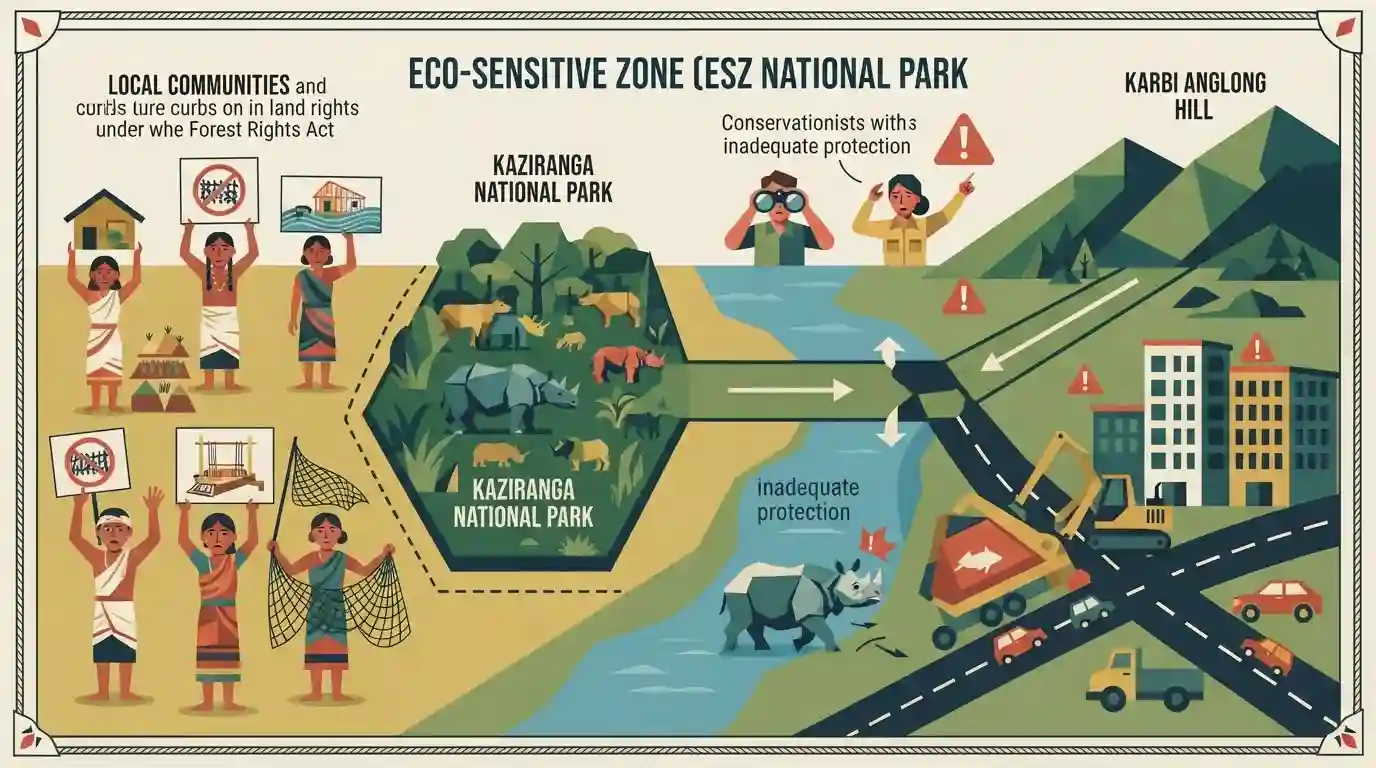
The draft notification by the MoEFCC declaring a 1,141.79 sq km Eco-Sensitive Zone (ESZ) around Assam's Kaziranga National Park has triggered intense debate. While local communities and tribal groups protest against potential curbs on land rights and traditional livelihoods under the Forest Rights Act, conservationists are alarmed by the inadequate protection of critical animal corridors. These corridors are vital for wildlife migrating to the Karbi Anglong hills during annual floods, and their dilution risks commercial encroachment by hospitality and infrastructure projects.
Key Points
- Draft ESZ Notification: The Union Ministry of Environment, Forest and Climate Change (MoEFCC) recently published a draft notification to declare an Eco-Sensitive Zone (ESZ) around the Kaziranga National Park and Tiger Reserve (KNPTR) in Assam, spanning approximately 1,141.79 sq km across Golaghat, Nagaon, and Karbi Anglong districts.
- Purpose of ESZ: Declared under the Environment (Protection) Act, 1986, ESZs act as 'shock absorbers' or transition zones around protected areas, regulating human activities to minimize negative ecological impacts.
- Local Communities' Concerns: Local residents and indigenous groups are protesting the draft, fearing that the ESZ restrictions will curb land rights, traditional agriculture, and infrastructure development, potentially causing displacement. They also allege a lack of grassroots consultation with Gram Sabhas, violating the Forest Rights Act (FRA), 2006.
- Conservationists' Concerns: Environmentalists argue that key wildlife corridors (such as Panbari and Kanchanjuri) connecting Kaziranga to the high-altitude Karbi Anglong hills are either excluded or inadequately protected, which opens up these critical migration routes to commercial tourism projects and luxury resorts.
- Monsoon Migration: Safeguarding these corridors is vital because Kaziranga (home to the world's largest population of the Great Indian One-Horned Rhinoceros) suffers heavy annual flooding from the Brahmaputra River, forcing wildlife to seek refuge in the Karbi Anglong hills.
Important Terms
Kaziranga National Park and Tiger Reserve (KNPTR)

A major protected area in Assam's Brahmaputra floodplain, famous for hosting over two-thirds of the world's great Indian one-horned rhinoceroses. It is also a UNESCO World Heritage Site and has a high tiger density.
UPSC context
GS Paper III (Biodiversity & Conservation). Tests knowledge of key national parks, flagship species, conservation issues, and geographical/ecological characteristics in India.
Forest Rights Act (FRA), 2006
A landmark Indian law that recognizes and vests legal land and resource rights to forest-dwelling Scheduled Tribes and other traditional forest dwellers, aiming to correct historical injustices and empower decentralized forest governance.
UPSC context
GS Papers II & III (Governance/Environment). Tests understanding of tribal land rights, forest conservation, and the role of Gram Sabhas.
Environment (Protection) Act, 1986
India's umbrella environmental legislation enacted post-Bhopal gas tragedy. It empowers the Central Government to establish environmental standards, regulate industrial activities, and declare ecologically fragile areas or Eco-Sensitive Zones around protected sites.
UPSC context
GS Paper III (Environmental Legislation). Tests understanding of regulatory power, environmental standard-setting, and administrative measures like Eco-Sensitive Zones.
Wildlife (Protection) Act, 1972
India’s core legal framework for conserving wild animals, birds, and plants. It establishes various categories of protected areas (such as National Parks and Sanctuaries) and sets strict schedules protecting diverse species.
UPSC context
GS Paper III (Biodiversity & Legislation). Tests legal classifications of protected species, institutional framework (NBWL/NTCA), and boundaries of protected areas.
UNESCO
A specialized UN agency that promotes international cooperation in education, sciences, and culture. It designates World Heritage Sites of outstanding universal value, helping conserve irreplaceable cultural and natural heritage globally.
UPSC context
GS Papers I & II (Culture and International Relations). Tests awareness of international organizations, conservation conventions, and World Heritage Sites in India.
Ministry of Environment, Forest and Climate Change (MoEFCC)
The nodal agency of the Indian Central Government responsible for planning, promoting, coordinating, and overseeing environmental and forestry policies, wildlife conservation programmes, and enforcing regulatory guidelines across India.
UPSC context
GS Paper II (Polity and Governance). Tests understanding of the executive machinery, administrative structures, environmental rules, and policy implementation in India.
Prelims Trap
Eco-Sensitive Zones (ESZs) are officially notified under the Wildlife (Protection) Act, 1972.
Despite functioning as protective buffers for wildlife parks, ESZs are legally notified under the Environment (Protection) Act, 1986, not the Wildlife (Protection) Act.
Static Concepts Connected
What is the legal and regulatory framework governing Eco-Sensitive Zones (ESZs)?
- Legal Backing: ESZs are notified under Section 3 of the Environment (Protection) Act, 1986, serving as 'shock absorbers' or transition zones around Protected Areas.
- Regulatory Tiers: Human activities are divided into Prohibited (commercial mining), Regulated (hotels, tree felling), and Permitted (ongoing local agriculture).
- Supreme Court Stance: In 2023, the SC modified its 1-km uniform ESZ rule, allowing site-specific zones and essential linear infrastructure like highways in buffer areas.
What are the core geographical and ecological features of Kaziranga National Park?
- Geography: Situated on the Brahmaputra River floodplains in the north and bordered by the Karbi Anglong (Mikir) Hills in the south.
- Annual Floods: Monsoon floods submerge most of the park, forcing wildlife to migrate south via corridors to seek refuge in the higher Karbi Anglong hills.
- Key Fauna: Known for hosting the world's largest population of the Great Indian One-Horned Rhinoceros.
Cross-Topic Patterns
ESZs vs. Forest Rights Act (FRA)
Highlights the governance conflict between top-down ecological boundaries under the EPA and decentralized indigenous land rights managed by Gram Sabhas under the FRA 2006.
Linear Infrastructure in Wildlife Habitats
The elevated highway corridor on NH-715 reflects a growing UPSC theme: engineering solutions to balance linear transport infrastructure with critical wildlife migration routes.

Expect a multi-statement question mapping Kaziranga's geography (Brahmaputra/Karbi Anglong) alongside ESZ legal provisions (EPA vs WPA).
Linked PYQs · 1
Linked PYQs · 1
- 2014PrelimsGS1
With reference to 'Eco-Sensitive Zones', which of the following statements is/are correct? 1. Eco-Sensitive Zones are the areas that are declared under the Wildlife (Protection) Act, 1972. 2. The purpose of the declaration of Eco-Sensitive Zones is to prohibit all kinds of human activities in those zones except agriculture. Select the correct answer using the code given below.
