Coal gasification technology and energy security strategy
Source:The Hindu ↗
Why It Matters
Coal gasification highlights the critical intersection of energy security, economic self-reliance, and environmental sustainability. It is vital for UPSC aspirants to understand how India intends to leverage its massive coal reserves responsibly while pursuing its net-zero emissions targets.
Summary
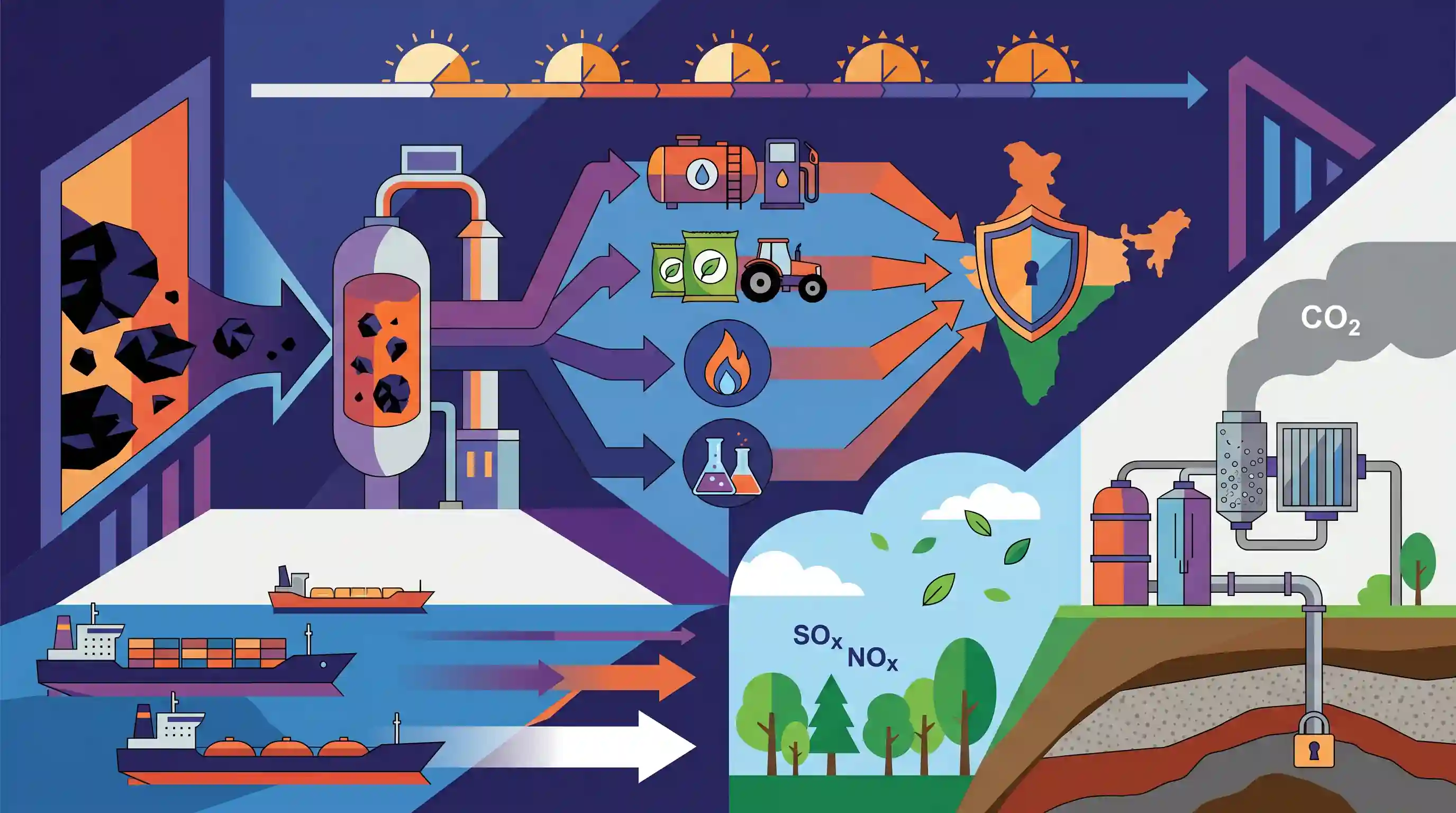
India is accelerating its push toward coal gasification as a cleaner alternative to conventional coal combustion, backed by an ₹8,500 crore incentive scheme to gasify 100 million tonnes by 2030. The process converts coal into syngas, which can be further processed into methanol, ammonia, synthetic natural gas, and other vital chemicals. This strategic initiative aims to bolster energy security by reducing the nation's reliance on imported crude oil, natural gas, and fertilizer inputs. Although gasification minimizes emissions of traditional pollutants like SOx and NOx, it continues to produce carbon dioxide, making the integration of carbon capture technologies crucial for realizing its potential as a sustainable transition technology.
Key Points
- The Indian government has approved an ₹8,500 crore financial assistance scheme to promote coal gasification projects, setting a target of 100 million tonnes of coal gasification by 2030.
- Coal gasification is a process that converts coal into syngas (a mixture of carbon monoxide, hydrogen, carbon dioxide, methane, and water vapour) rather than burning it directly.
- Syngas is a versatile chemical feedstock used to produce methanol, synthetic natural gas (SNG), ammonia (vital for urea fertilizers), and dimethyl ether (DME), thereby reducing India's import bills.
- While the process significantly curtails local pollutants like sulfur dioxide (SOx), nitrogen oxides (NOx), and particulate matter, it still emits CO2, meaning it must be paired with Carbon Capture, Utilization, and Storage (CCUS) to be climate-friendly.
- Major implementation challenges include high upfront capital costs, the technical difficulty of gasifying high-ash Indian coal, and substantial water requirements.
Important Terms
Coal Gasification

A thermo-chemical process that converts coal into synthesis gas (syngas) using steam and controlled oxygen. It is a cleaner alternative to traditional combustion for industrial feedstock production.
UPSC context
GS Paper 3 (Energy/Science); tests understanding of clean coal technologies and their role in industrial self-reliance.
Syngas (Synthesis Gas)
A fuel gas mixture of Hydrogen and Carbon Monoxide. It serves as a vital intermediate for producing methanol, ammonia, synthetic natural gas, and various chemicals.
UPSC context
GS Paper 3 (Science/Industry); relevant for industrial applications, import substitution, and alternative fuel sources.
Coal Gasification Scheme
A ₹8,500 crore financial incentive approved by the Union Cabinet to encourage public and private projects to gasify 100 million tonnes of coal by 2030.
UPSC context
GS Paper 3 (Economy/Infrastructure); tests awareness of policy frameworks for energy transition and reducing trade deficits.
Carbon Capture, Utilization, and Storage (CCUS)
Technology that captures CO2 from industrial sources like gasification plants to prevent atmospheric release. The carbon is then stored underground or used in commercial products.
UPSC context
GS Paper 3 (Environment); crucial for climate change mitigation strategies and India’s Net-Zero 2070 goal.
Energy Security
The uninterrupted availability of energy sources at an affordable price. This initiative aims to reduce dependence on imported natural gas, crude oil, and fertilizer inputs.
UPSC context
GS Paper 3 (Economy/Energy); tests strategic resource management and the pursuit of national self-sufficiency.
Prelims Trap
Coal gasification is a clean, zero-emission technology that eliminates carbon dioxide outputs.
While it effectively cuts local pollutants (SOx, NOx, particulate matter), coal gasification still emits significant CO2 and requires Carbon Capture (CCUS) to be climate-friendly.
Static Concepts Connected
What is Synthesis Gas (Syngas) and its primary composition?
- Core Composition: A combustible gas mixture consisting primarily of Carbon Monoxide (CO) and Hydrogen (H2), alongside minor amounts of CO2, methane, and water vapour.
- Industrial Feedstock: Acts as a versatile chemical building block for producing ammonia (for urea), methanol, and synthetic natural gas (SNG).
Why is Indian coal structurally challenging for standard gasification?
- High Ash Content: Domestic Gondwana coal typically contains 30-45% ash, which drastically reduces the efficiency of conventional gasifiers designed for low-ash imported coal.
- Technology Mismatch: To process domestic coal efficiently, India requires specialized pressurized fluidised-bed gasification technology rather than standard fixed-bed reactors.
Cross-Topic Patterns
Syngas + Urea Import Substitution
Ammonia derived from coal gasification feeds urea production, directly linking India's clean coal mission to agricultural security and reducing the ballooning fertilizer subsidy bill.
NITI Aayog's Methanol Economy
Gasifying high-ash coal produces methanol and Di-methyl Ether (DME), directly supporting NITI Aayog's targets to blend alternative fuels with diesel and cut crude oil import dependency.

Expect a 2026 Prelims multi-statement question testing Syngas composition (CO+H2) alongside India's high-ash coal gasification hurdles.
Linked PYQs · 3
Linked PYQs · 3
- 2025PrelimsGS1
Consider the following substances: I. Ethanol II. Nitroglycerine III. Urea Coal gasification technology can be used in the production of how many of them?
- 2025MainsGS3
How can India achieve energy independence through clean technology by 2047? How can biotechnology can play a crucial role in this endeavour?
- 2022MainsGS3
Do you think India will meet 50 percent of its energy needs from renewable energy by 2030 ? Justify your answer. How will the shift of subsidies from fossil fuels to renewables help achieve the above objective ? Explain.
