Urban Microplastic Pollution and Marine Ecosystem Threats in Chennai
Source:The Hindu ↗
Why It Matters
Microplastic pollution is a recurring theme in UPSC Prelims and Mains (e.g., questions on microbeads and solid waste disposal). Understanding urban microplastic sources and the inadequacies in current waste management frameworks is critical for answering questions on environmental conservation, marine pollution, and sustainable urbanization.
Summary
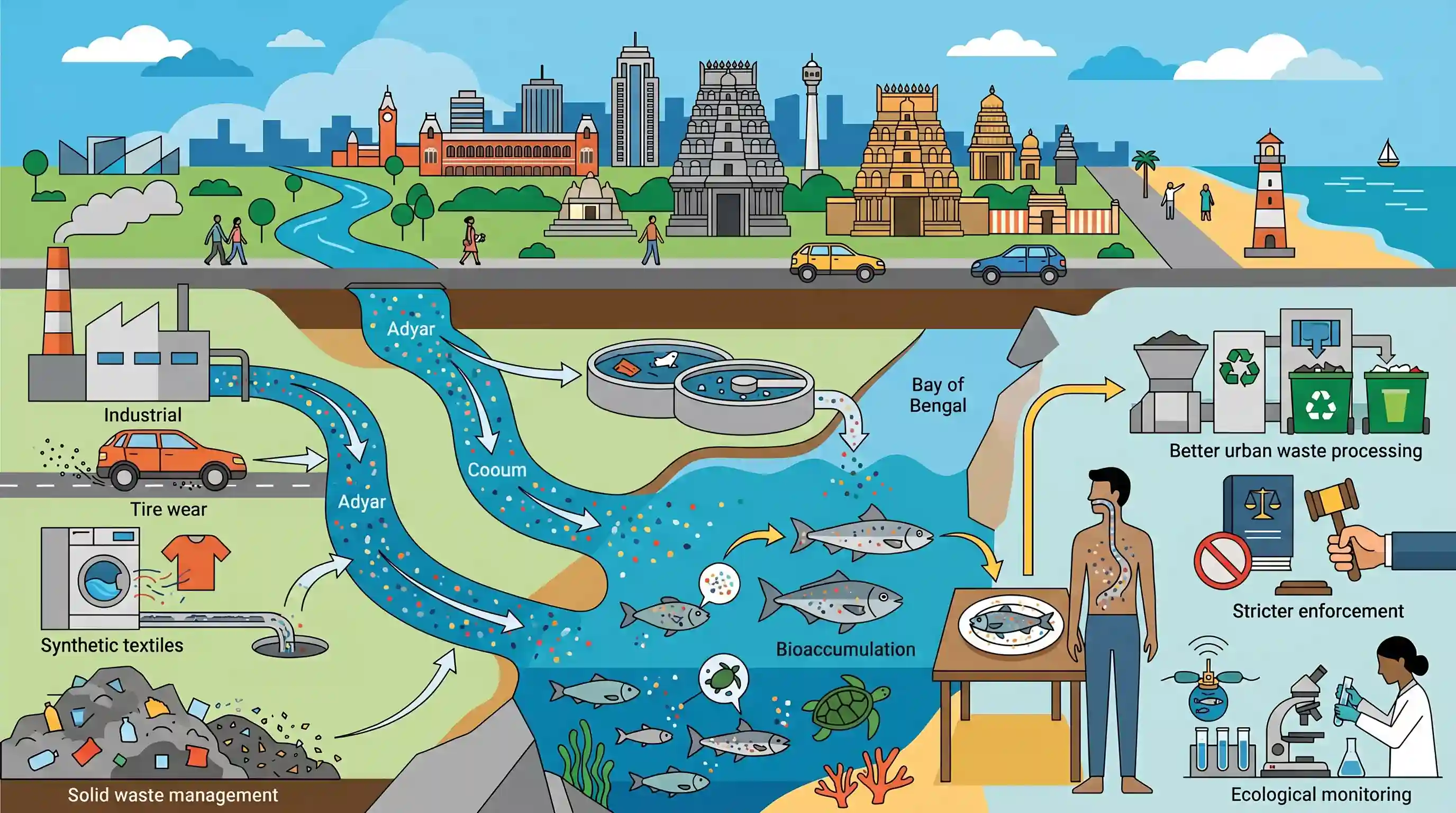
The article examines the hidden but pervasive issue of microplastic pollution in Chennai. Despite outward appearances, Chennai's water bodies, including rivers like the Adyar and Cooum, coastal areas, and urban ecosystems, contain alarming levels of microplastics (particles smaller than 5 mm). These microscopic pollutants originate from multiple sources such as the degradation of larger plastic waste due to inadequate solid waste management, synthetic textiles, tire wear, and industrial effluents. The concealed nature of microplastics allows them to bypass conventional wastewater treatment, eventually accumulating in marine environments and entering the human food chain through bioaccumulation in marine life. The crisis underscores the pressing need for stricter enforcement of the Plastic Waste Management Rules, improved urban waste processing infrastructure, and comprehensive ecological monitoring to mitigate the long-term impact on environmental and public health.
Key Points
- Invisible Crisis: Microplastics (particles smaller than 5mm) heavily pollute Chennai's coastal and riverine ecosystems, presenting a far greater ecological threat than visible macroplastic litter.
- Primary Sources: The pollutants originate from the degradation of mismanaged municipal solid waste, synthetic fibers released during laundry, tire wear from vehicular traffic, and industrial discharge.
- Treatment Challenges: Existing wastewater and sewage treatment plants in urban centers like Chennai are often ill-equipped to filter out microscopic plastic particles, allowing them to flow directly into the sea.
- Biological Impact: Microplastics are ingested by marine organisms, causing physical harm and acting as vectors for toxic chemicals, which bioaccumulate up the food web and pose risks to human health.
- Policy Action Required: Tackling the crisis demands rigorous enforcement of the Plastic Waste Management Rules, upgrading municipal sewage treatment infrastructure, and adopting circular economy models to reduce plastic use.
Important Terms
Microplastics

Synthetic solid particles or polymeric matrices smaller than 5 mm, categorized as primary (manufactured) or secondary (degraded larger plastics). They persist in ecosystems, bypassing filtration.
UPSC context
GS Paper 3 (Environment); tests emerging pollutants, their ecological impacts, and mitigation strategies in marine/urban ecosystems.
Plastic Waste Management Rules
Indian regulations (2016, amended 2022/2024) mandating waste segregation, phasing out single-use plastics, and enforcing Extended Producer Responsibility (EPR) to promote a circular economy.
UPSC context
GS Paper 3 (Environment/Governance); relevant for waste management policies and government interventions to curb pollution.
Extended Producer Responsibility (EPR)
A policy approach making producers responsible for the end-of-life management of their products, including collection, recycling, and final disposal, to reduce environmental impact.
UPSC context
GS Paper 3 (Economy/Environment); tests knowledge of market-based instruments for sustainable waste management.
Central Pollution Control Board (CPCB)
A statutory organization established in 1974 under the Water Act, responsible for air and water quality monitoring and coordinating State Pollution Control Boards.
UPSC context
GS Paper 2 (Statutory Bodies) & GS Paper 3; tests India's institutional framework for environmental regulation.
Bioaccumulation
The process where toxins like microplastics accumulate in an organism's tissues faster than they are excreted, leading to increasing concentration over time.
UPSC context
GS Paper 3 (Environment/Science); essential for understanding non-biodegradable pollutants' long-term impact on food chains.
UN Environment Programme (UNEP)
The leading global authority that sets the environmental agenda and coordinates the United Nations' environmental activities, headquartered in Nairobi, Kenya.
UPSC context
GS Paper 3 (International Relations/Environment); relevant for global treaties and India's international environmental commitments.
Prelims Trap
Modern municipal sewage treatment plants effectively filter out microplastics before they reach marine ecosystems.
Conventional wastewater plants are not designed to capture particles <5mm. They act as conduits, discharging microscopic plastics from textiles and cosmetics directly into rivers and seas.
Static Concepts Connected
What is the difference between Bioaccumulation and Biomagnification?
- Bioaccumulation: The buildup of toxic substances, like microplastics, within a single organism over its lifetime because absorption outpaces the organism's ability to excrete it.
- Biomagnification: The progressive increase in the concentration of toxic substances as they move up successive trophic levels in a food chain (e.g., from plankton to fish to humans).
What are the core mechanisms of Extended Producer Responsibility (EPR) in India?
- Mandatory Targets: Producers, importers, and brand owners must meet legally binding annual targets for recycling and reusing plastic packaging waste.
- Centralized Monitoring: Compliance is tracked through a CPCB centralized portal, ensuring transparency and accountability in the plastic waste supply chain.
- Environmental Compensation: Financial penalties are levied on entities failing to meet their EPR targets, operating on the polluter-pays principle.
Cross-Topic Patterns
Microplastics as POP vectors (Stockholm Convention)
Microplastics absorb Persistent Organic Pollutants from water, acting as toxic Trojan horses when ingested by marine life, bridging local municipal waste issues with global chemical treaties.
Urban Flooding & Waste Choke Points
Poor municipal solid waste management generates secondary microplastics while physically choking coastal wetlands, directly linking everyday waste generation to severe urban flooding vulnerability.

Expect a 2026 multi-statement prelims question linking secondary microplastic sources (tire wear) with biomagnification and EPR targets.
Linked PYQs · 4
Linked PYQs · 4
- 2019PrelimsGS1
Why is there a great concern about the 'microbeads' that are released into environment?
- 2024PrelimsGS1
Consider the following statements : Statement-I: Many chewing gums found in the market are considered a source of environmental pollution. Statement-II : Many chewing gums contain plastic as gum base. Which one of the following is correct in respect of the above statements?
- 2018MainsGS3
What are the impediments in disposing the huge quantities of discarded solid wastes which are continuously being generated? How do we remove safely the toxic wastes that have been accumulating in our habitable environment?
- 2024MainsGS3
Industrial pollution of river water is a significant environmental issue in India. Discuss the various mitigation measures to deal with this problem and also the government's initiatives in this regard.
