Demographic Transition and Declining School Enrollments
Source:The Hindu ↗
Why It Matters
The topic illustrates the real-world socio-economic impacts of population stabilization. It forces UPSC aspirants to connect demographic data (TFR, replacement rates) with public policy challenges (school consolidation, resource allocation) and contrasts the demographic dividend with the emerging concept of a demographic winter.
Summary
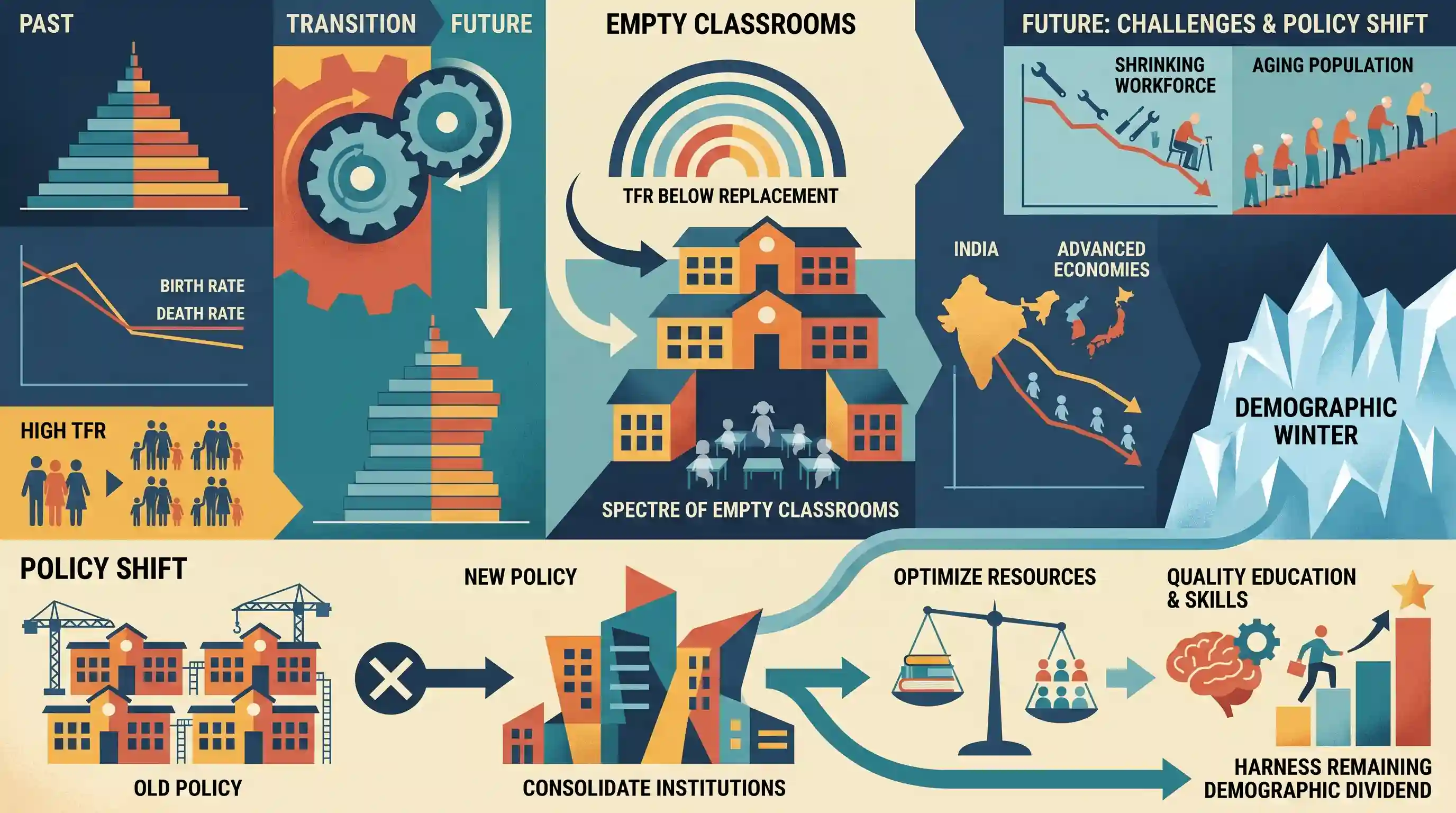
The article explores the phenomenon of declining school enrollments—the "spectre of empty classrooms"—driven by shifting demographic patterns. As the Total Fertility Rate (TFR) falls below replacement levels in several Indian states, the base of the population pyramid is shrinking, leading to fewer children entering the primary education system. This demographic transition, mirroring advanced economies like Japan and South Korea, poses new challenges for educational infrastructure planning. It necessitates a shift in public policy from merely building more schools to consolidating existing institutions, optimizing resource allocation, and focusing on the quality of education and skill development to harness the remaining demographic dividend before facing a potential 'demographic winter'.
Key Points
- Many Indian states, particularly in the south, are experiencing a Total Fertility Rate (TFR) below the replacement level of 2.1, resulting in a shrinking school-age population.
- The immediate consequence of this demographic shift is the 'spectre of empty classrooms', leading to lower enrollments in primary schools and prompting governments to consider school mergers and closures.
- This phenomenon reflects early signs of a 'demographic winter', a scenario already severe in countries like Japan and South Korea where thousands of schools have shut down.
- Policy focus in low-TFR states must shift from expanding physical infrastructure (a primary goal of the RTE Act) to improving the quality of education and reallocating resources towards higher education and skill development for the existing youth cohort.
Important Terms
Total Fertility Rate (TFR)

The average number of children a woman would have during her lifetime (15-49 years). India's TFR recently dropped to 2.0 (NFHS-5), below the replacement level.
UPSC context
GS Paper I (Population) and Paper II (Social Justice); critical for understanding demographic transition and future social infrastructure needs.
Replacement Level Fertility
The fertility level (TFR of 2.1) at which a population exactly replaces itself from one generation to the next without migration, ensuring long-term population stability.
UPSC context
GS Paper I (Geography/Society); tests knowledge of population stabilization targets under the National Population Policy 2000.
Demographic Dividend
Economic growth potential resulting from a shift in age structure where the working-age population (15-64) is larger than the dependent population (children and elderly).
UPSC context
GS Paper III (Economy) and Paper I (Society); focuses on human capital, skilling, and the 'window of opportunity' ending by 2055.
Demographic Winter
A phase of population decline characterized by birth rates significantly below replacement level, leading to a shrinking workforce, rapid aging, and potential economic stagnation.
UPSC context
GS Paper I (Society/Geography); a recurring theme in 2024 Mains regarding global demographic shifts and 'spectre of empty classrooms'.
Right to Education (RTE) Act
A landmark 2009 law making free and compulsory education a Fundamental Right for children aged 6-14 under Article 21A of the Indian Constitution.
UPSC context
GS Paper II (Governance/Polity); tests legal obligations of the State in education and the 25% reservation for disadvantaged sections.
Population Pyramid
A graphical representation showing the distribution of various age groups in a population; a shrinking base indicates declining birth rates and future enrollment drops.
UPSC context
GS Paper I (Geography); used to analyze demographic transitions and visualize 'inverted' pyramids in aging societies.
Prelims Trap
"A TFR falling below the replacement level of 2.1 results in an immediate absolute decline in the country's total population."
Even with a TFR below 2.1, India's total population will keep growing for decades due to "population momentum"—a massive existing reproductive-age cohort.
Static Concepts Connected
What are Replacement Level Fertility and Population Momentum?
- Replacement Level (2.1): The average number of children a woman must have to keep the population constant in the long run, usually pegged at 2.1 to account for infant mortality.
- Population Momentum: The tendency for population growth to continue even after replacement-level fertility has been achieved, primarily because a high proportion of the population is in the reproductive age group.
What are the RTE Act (2009) neighborhood norms for schools?
- Distance mandates: Requires governments to establish primary schools within 1 km and upper primary schools within 3 km of all neighborhoods/habitations.
- Consolidation conflict: These strict legal distance limits complicate modern state efforts to merge sparsely populated 'empty classroom' schools into larger, better-equipped hub schools.
Cross-Topic Patterns
TFR divergence and Lok Sabha Delimitation
Southern states experiencing "demographic winters" face a double-edged sword: underutilized social infrastructure today, and fears of drastically reduced political representation if the Lok Sabha delimitation freeze is lifted.
School Rationalization vs. RTE mandates
Initiatives like NITI Aayog's SATH-E promote merging sub-scale schools to pool resources and improve quality, fundamentally shifting policy away from the RTE Act's initial focus on decentralized neighborhood micro-schools.

Expect a 2026 Prelims question contrasting North-South TFR divergence and how population momentum delays a demographic winter in India.
Linked PYQs · 4
Linked PYQs · 4
- 2024MainsGS1
What is the concept of a 'demographic winter'? Is the world moving towards such a situation? Elaborate.
- 2024PrelimsGS1
The total fertility rate in an economy is defined as:
- 2013PrelimsGS1
To obtain full benefits of demographic dividend, what should India do?
- 2016MainsGS2
Professor Amartya Sen has advocated important reforms in the realms of primary education and primary health care. What are your suggestions to improve their status and performance?
