Manipur census opposition reflects ethnic and demographic concerns
Source:The Hindu ↗
આ શા માટે મહત્વનું છે
The ongoing debate over the Census in Manipur serves as a crucial case study for UPSC aspirants on how demographic data collection can become deeply entwined with ethnic conflicts, border security, and political representation. It illustrates the real-world complexities of managing porous borders, illegal immigration, and the implementation of mechanisms like the NRC in sensitive regions like the Northeast.
સારાંશ
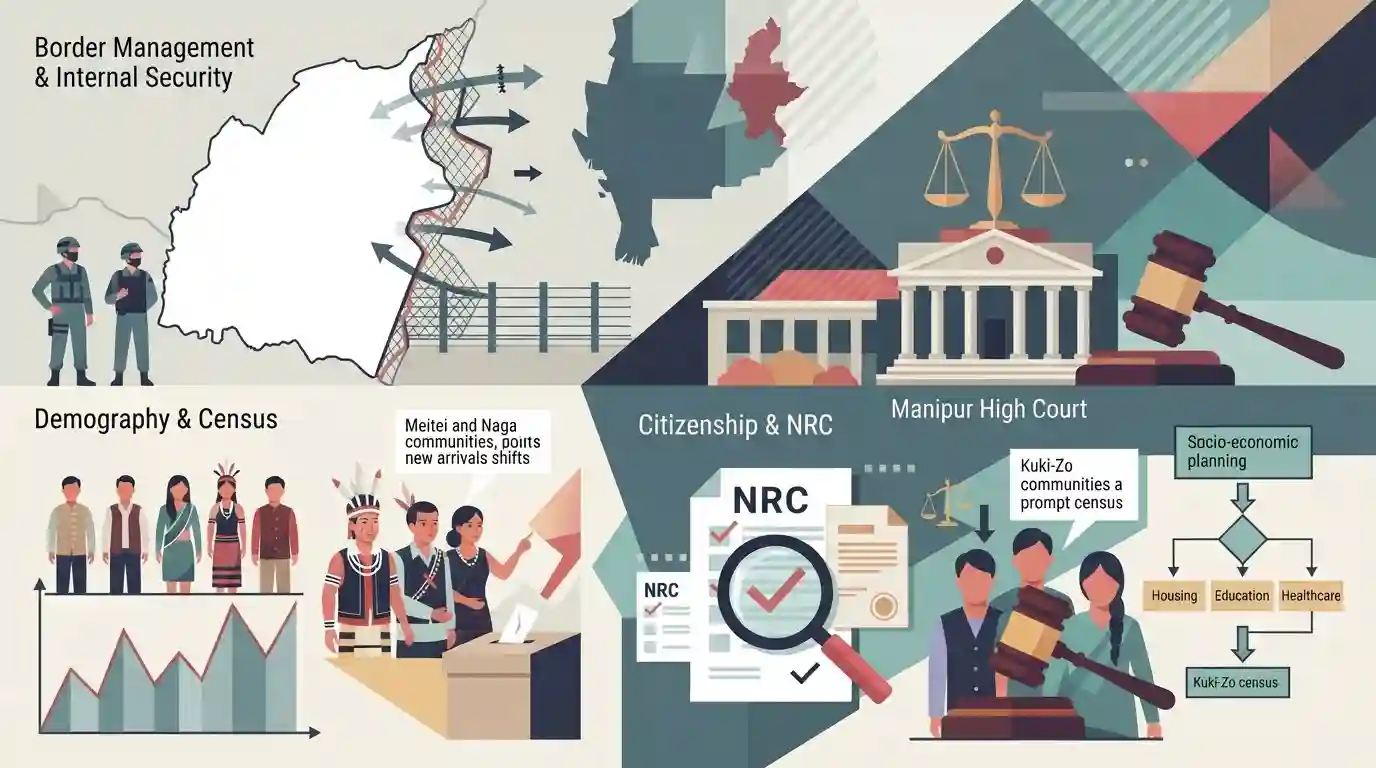
In Manipur, the impending Census has become a major point of contention. Prominent Meitei and Naga groups are vehemently demanding that the National Register of Citizens (NRC) be updated prior to the Census, driven by concerns that recent waves of illegal immigration—exacerbated by the crisis in neighboring Myanmar—will permanently alter the state's demographics. They argue that counting these populations would inadvertently grant them political power during subsequent delimitation exercises, marginalizing indigenous communities. However, Kuki-Zo groups are advocating for a prompt and impartial Census, stating that delays hinder essential socio-economic planning. The issue has reached the Manipur High Court, which has requested responses from the governments, highlighting the volatile intersection of demographic data, citizenship, and internal security in India's Northeast.
મુખ્ય મુદ્દા
- A significant section of society in Manipur, primarily Meitei and Naga groups, is opposing the upcoming Census unless the National Register of Citizens (NRC) is implemented first to weed out illegal immigrants.
- There are widespread fears that including illegal immigrants in the Census would artificially alter demographic equations, subsequently granting them undue political representation during future delimitation exercises.
- Conversely, the Kuki-Zo Council and related bodies have strongly opposed postponing the Census, demanding an impartial and immediate headcount to ensure equitable socio-economic development and data collection.
- The Manipur High Court has formally issued notices to the State and Central governments, seeking their response on the demand to complete the NRC update before proceeding with the Census.
- The conflict highlights the deep intersections between cross-border migration (especially from Myanmar), demographic shifts, ethnic tensions, and the broader challenges of internal security and border management in the Northeast.
મહત્વપૂર્ણ શબ્દો
National Register of Citizens (NRC)

A government register designed to document legal Indian citizens and identify illegal immigrants. Initially created in 1951, it was updated in Assam and is now demanded in Manipur to address demographic and ethnic concerns.
UPSC context
Crucial for GS Paper 2 (Citizenship) and GS Paper 3 (Internal Security) to understand demographic anxieties and border state politics.
Census
A decennial official enumeration of India's population covering demographic, social, and economic data. Conducted under the Census Act of 1948, it provides the fundamental data required for government planning, resource allocation, and political delimitation.
UPSC context
Important for GS 1 (Population dynamics) and GS 2 (Governance), as it forms the baseline for delimitation and policy targeting.
Delimitation
The process of redrawing the boundaries of legislative constituencies to reflect population changes based on recent Census data. Conducted by an independent Delimitation Commission, it aims to ensure proportional and fair political representation across regions.
UPSC context
Key for GS Paper 2 (Polity, Representation of People Act), highlighting the intersection of demography and electoral representation.
Registrar General of India
The statutory authority under the Ministry of Home Affairs responsible for conducting the decennial Census and overseeing the Civil Registration System for births and deaths. It forms the backbone of India's demographic and administrative governance.
UPSC context
Highly relevant for GS Paper 2 (Statutory Bodies, Governance) regarding population data collection, the Census, and evidence-based policymaking.
Coordinating Committee on Manipur Integrity (COCOMI)
A prominent civil society umbrella organization representing the Meitei community in Manipur's Imphal Valley. It strongly advocates for the state's territorial integrity, demands the implementation of the NRC, and opposes separate administrative divisions for tribal groups.
UPSC context
Significant for GS 2 (Role of Civil Society) and GS 3 (Internal Security), illustrating the ethnic dimensions of Northeast conflicts.
Kuki-Zo Council
An apex political and community organization representing the Kuki-Zo tribal groups in Manipur. Amid ongoing ethnic conflicts, it advocates for the community’s rights and security, notably demanding a separate administration or Union Territory to ensure their protection.
UPSC context
Relevant for GS 2 (State Politics) and GS 3 (Internal Security), highlighting identity politics, decentralization, and separate administration demands.
પ્રિલિમ્સ ટ્રેપ
The National Register of Citizens (NRC) is mandatorily updated alongside every decadal Census under the Census Act, 1948.
The Census is governed by the Census Act, 1948, whereas the NRC is governed by the Citizenship Act, 1955 and Citizenship Rules, 2003. They are entirely separate statutory exercises.
સંલગ્ન સ્થિર ખ્યાલો
What is the legal framework governing the Census of India?
- Union Subject: Article 246 places the Census under Entry 69 of the Seventh Schedule (Union List) of the Constitution.
- Nodal Authority: Conducted by the Office of the Registrar General and Census Commissioner under the Ministry of Home Affairs.
- Statutory Basis: Governed by the Census Act, 1948, which ensures strict confidentiality of individual demographic data.
How is the Delimitation Commission constituted and empowered?
- Constitutional Basis: Set up under Article 82 (Parliamentary seats) and Article 170 (State Assemblies) following a Census.
- Judicial Immunity: Its orders have the force of law and cannot be challenged in any court of law.
- Composition: Appointed by the President, comprising retired Supreme Court judges, Chief Election Commissioner, and State Election Commissioners.
આંતર-વિષય પેટર્ન
Border Porosity and Internal Security
Myanmar's instability and the suspension of the Free Movement Regime show how external border dynamics directly disrupt internal demographic balances and political representation in Northeast India.
Data Deficit and Welfare Federalism
Postponing the Census due to regional ethnic conflicts hampers state-level socio-economic planning and equitable devolution of central welfare funds that depend on updated population metrics.

The legal intersection of Census (Union List), Delimitation (Art 82), and NRC (Citizenship Rules 2003) is ripe for a multi-statement question.
સંલગ્ન PYQ · 3
સંલગ્ન PYQ · 3
- 2019MainsGS3
Cross-border movement of insurgents is only one of the several security challenges facing the policing of the border in North-East India. Examine the various challenges currently emanating across the India-Myanmar border. Also, discuss the steps to counter the challenges.
- 2025MainsGS3
What are the major challenges to internal security and peace process in the North-Eastern States? Map the various peace accords and agreements initiated by the government in the past decade.
- 2020MainsGS3
For effective border area management, discuss the steps required to be taken to deny local support to militants and also suggest ways to manage favourable perception among locals.
