Structural Impediments to Economic Inequality Reduction and Growth
Source:Indian Express ↗
Why It Matters
Inclusive growth and issues relating to poverty and planning are core pillars of the GS3 syllabus. This article provides essential data points from the World Inequality Report and breaks down the structural impediments to wealth distribution in India, offering valuable arguments for Mains answers on economic development, land reforms, and social infrastructure.
Summary
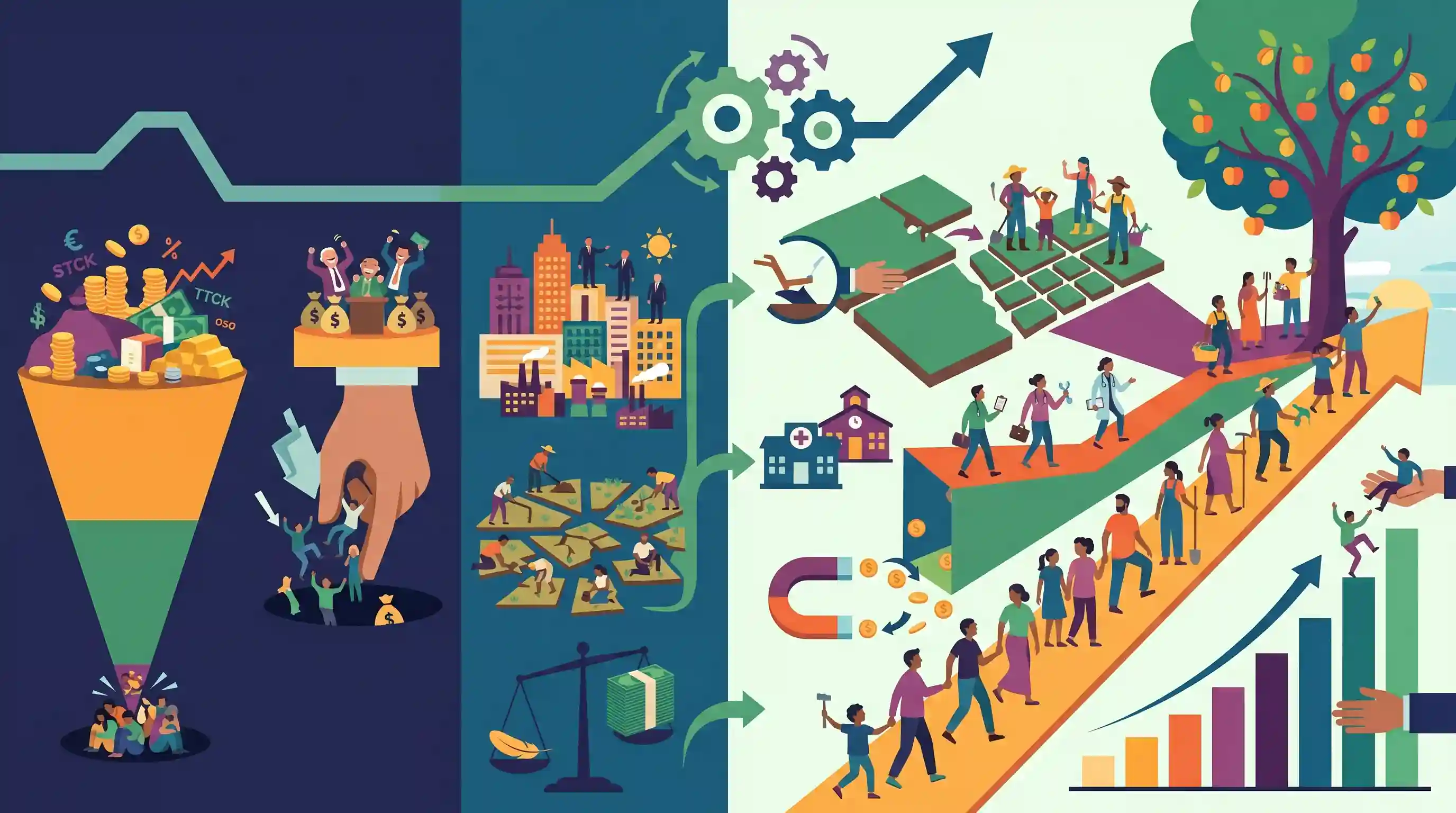
The 2026 World Inequality Report illustrates a stark stagnation in global and Indian efforts to reduce economic inequality. In India, deep structural issues such as massive rural landlessness, inadequate public investment in education and healthcare, and the ongoing financialisation of wealth ensure that wealth and income remain heavily concentrated at the top. The report underscores that without structural interventions—ranging from effective land reforms and progressive taxation to extensive public investments in human capital—true inclusive growth remains elusive for the bottom 50% and the stagnant 'patrimonial middle class'.
Key Points
- The 2026 World Inequality Report highlights extreme global disparities, with the richest 10% holding nearly 75% of global wealth and the poorest half owning barely 2%.
- In India, income concentration is acute: the top 10% captures roughly 58% of national income, while the bottom 50% receives only 15%, leading to stagnant growth for the middle 40% (patrimonial middle class).
- Structural barriers like widespread rural landlessness (about 46% of rural households), lack of equitable access to quality education and healthcare, and poor social safety nets perpetuate Indian inequality.
- The rapid financialisation of wealth disproportionately benefits the rich while limiting social mobility for marginalized and rural populations.
- Tackling inequality requires robust redistributive mechanisms, progressive taxation, effective land reforms, and large-scale public investment in human capital formation.
Important Terms
World Inequality Lab

A research center hosting a global database on inequality, co-directed by Thomas Piketty, which tracks income and wealth disparities to inform public debate and policy.
UPSC context
Relevant for GS Paper 3 (Inclusive Growth) and Paper 2 (Social Justice/Reports) to substantiate arguments on economic disparity.
Patrimonial Middle Class
The middle 40% of the population who, historically, accumulated wealth through state-led welfare and progressive taxation, but now face stagnation relative to the ultra-wealthy.
UPSC context
Tested in GS Paper 3/Sociology; explains why moderate-income groups feel squeezed despite national GDP growth.
Financialisation of Wealth
The increasing dominance of financial markets and motives over real economic activities like manufacturing, leading to wealth concentration through stock gains rather than wage increases.
UPSC context
GS Paper 3 (Indian Economy); critical for discussing structural risks in capital markets and widening wealth gaps.
Human Capital Formation
The process of increasing the skills, education, and health levels of a population, enabling them to contribute more effectively to economic production and social development.
UPSC context
Core topic in GS Paper 3; essential for answers on the demographic dividend and long-term poverty alleviation.
Progressive Taxation
A tax system where the tax rate increases as the taxable amount increases, designed to reduce inequality by placing a higher burden on those with greater ability to pay.
UPSC context
GS Paper 3 (Fiscal Policy); often cited as a key structural intervention to fund public investments and reduce disparity.
Inclusive Growth
Economic growth that creates opportunities for all segments of the population and distributes the dividends of prosperity fairly across society, particularly the marginalized.
UPSC context
Primary theme in GS Paper 3; tests understanding of the quality of growth beyond simple GDP metrics.
Prelims Trap
"The World Inequality Report is an annual flagship publication of the World Economic Forum (WEF)."
Aspirants often confuse the World Inequality Report (published by the World Inequality Lab) with the Global Gender Gap Report (WEF) or the Poverty and Shared Prosperity Report (World Bank).
Static Concepts Connected
What are the key statistical measures used to calculate economic inequality?
- Lorenz Curve: A graphical representation of income distribution; the further the curve sags below the 45-degree line of perfect equality, the higher the inequality.
- Gini Coefficient: A mathematical ratio derived from the Lorenz curve, ranging from 0 (perfect equality) to 1 (maximum inequality).
- Palma Ratio: The ratio of the richest 10% of the population's share of gross national income divided by the poorest 40%'s share.
What were the primary components of Post-Independence Land Reforms in India?
- Abolishing Intermediaries: Eliminating Zamindars and Jagirdars to bring actual cultivators into direct contact with the state apparatus.
- Tenancy Reforms: Regulating rent amounts, providing legal security of tenure, and conferring ownership rights to long-standing tenants.
- Land Ceilings: Fixing maximum land ownership limits per household and redistributing the surplus land to landless agricultural laborers.
Cross-Topic Patterns
Tenant Farming + Financial Inclusion
Without land titles, the 46% of landless rural households are excluded from formal agri-credit, linking GS3 land reforms directly to GS3 inclusive banking and rural poverty challenges.
Asset Bubbles + Jobless Growth
Capital accumulation in equities rarely translates to grassroots employment, bridging extreme wealth concentration with India's demographic dividend and jobless growth challenges.

Mains 2026 will likely feature a GS3 question linking 'financialisation of wealth' to stagnant inclusive growth and rural landlessness.
Linked PYQs · 5
Linked PYQs · 5
- 2020MainsGS3
Explain intra-generational and inter-generational issues of equity from the perspective of inclusive growth and sustainable development.
- 2022MainsGS3
Is inclusive growth possible under market economy ? State the significance of financial inclusion in achieving economic growth in India.
- 2019MainsGS3
It is argued that the strategy of inclusive growth is intended to meet the objectives of inclusiveness and sustainability together. Comment on this statement.
- 2023MainsGS3
State the objectives and measures of land reforms in India. Discuss how land ceiling policy on landholding can be considered as an effective reform under economic criteria.
- 2021MainsGS3
How did land reforms in some parts of the country help to improve the socio-economic conditions of marginal and small farmers?
