Energy Efficiency Standards for Air Conditioners Amid Warming
Source:The Hindu ↗
Why It Matters
With intensifying heatwaves, access to cooling is becoming a life-saving necessity rather than a luxury. Understanding the policy gap between the India Cooling Action Plan and actual AC efficiency standards (BEE ratings) is crucial for UPSC aspirants, as it directly impacts India's energy security, carbon footprint, and adherence to Paris Agreement NDCs.
Summary
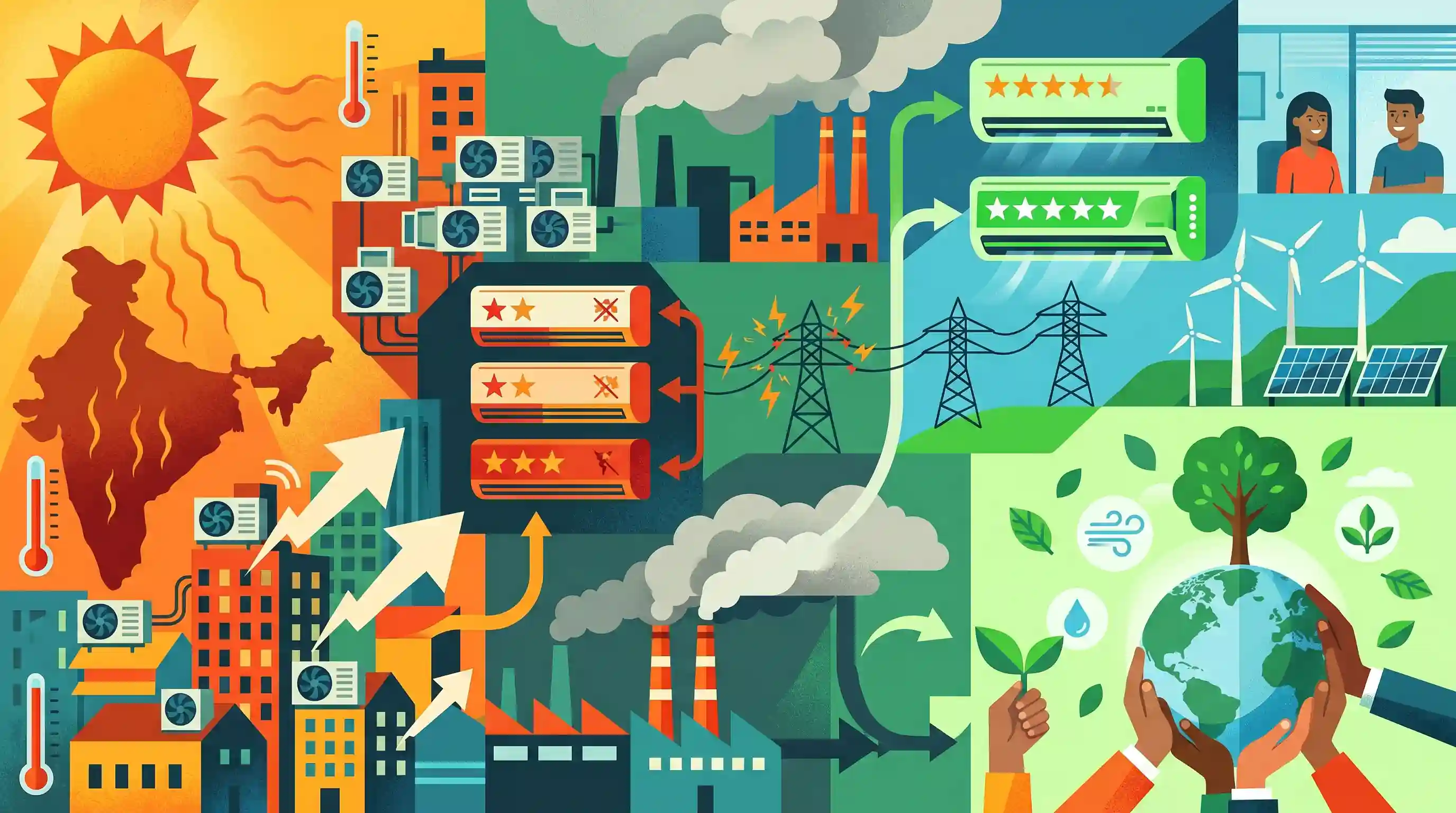
As 2024 marks the warmest year on record, India faces surging cooling demands across sectors. However, despite the India Cooling Action Plan (2019), Indian air conditioners remain among the least efficient globally, with lagging star ratings. Experts emphasize that improving AC energy efficiency is vital not just for managing domestic energy demand and preventing grid overloads, but also for ensuring thermal comfort and meeting India's global climate commitments.
Key Points
- 2024 has been recorded as the warmest year globally and in India, leading to surging cooling needs in homes, transport, and industry.
- Despite the launch of the India Cooling Action Plan in 2019, India's air conditioners remain among the least energy-efficient globally.
- Lagging BEE star ratings for ACs in India have severe implications for national energy demand and grid stability as temperatures rise.
- Improving cooling energy efficiency is critical for India to ensure equitable thermal comfort while simultaneously meeting its climate goals and emission targets.
Important Terms
India Cooling Action Plan (2019)

A 20-year roadmap launched by the MoEFCC to manage India's cooling demand across sectors while reducing energy consumption (25-40%) and refrigerant demand by 2037-38.
UPSC context
GS Paper III: Environment & Energy. Key policy for sustainable cooling and climate-resilient infrastructure.
Bureau of Energy Efficiency (BEE)
A statutory body under the Ministry of Power (Energy Conservation Act, 2001) that develops policies to reduce the energy intensity of the Indian economy.
UPSC context
GS Paper III: Infrastructure (Energy). Tests knowledge of regulatory bodies and energy conservation initiatives.
BEE Star Rating
A grading system (1–5 stars) implemented by BEE to indicate the energy efficiency of appliances; higher stars signify greater energy savings and lower emissions.
UPSC context
GS Paper III: Environment/Energy. Important for Prelims (schemes) and Mains (demand-side management).
Indian Seasonal Energy Efficiency Ratio (ISEER)
A metric used by BEE to rate AC efficiency in India, calculating the annual heat removal relative to energy consumption while accounting for Indian seasonal temperature variations.
UPSC context
GS Paper III: Environment. Specific technical standard for evaluating climate-smart technology in India.
Nationally Determined Contributions (NDCs)
Self-defined climate action plans submitted by countries under the Paris Agreement, outlining their targets for reducing greenhouse gas emissions and adapting to climate impacts.
UPSC context
GS Paper III: Environment. Central to questions on global climate governance and India's international pledges.
Paris Agreement
A legally binding 2015 international treaty aiming to limit global warming to well below 2°C, preferably 1.5°C, compared to pre-industrial levels.
UPSC context
GS Paper II & III: International Relations/Environment. Fundamental framework for global climate negotiations and policy.
Prelims Trap
The Bureau of Energy Efficiency (BEE) operates under the Ministry of Environment, Forest and Climate Change.
BEE is a statutory body under the Ministry of Power, established by the Energy Conservation Act. Aspirants often wrongly guess MoEFCC due to its climate outcomes.
Static Concepts Connected
What is the statutory mandate of the Bureau of Energy Efficiency (BEE)?
- Statutory Body: Formed under the Energy Conservation Act, 2001, functioning directly under the Ministry of Power.
- Star Labeling: Mandates star ratings for specified appliances (like ACs, refrigerators) to indicate energy efficiency and inform consumer choices.
- Building Codes: Develops the Energy Conservation Building Code (ECBC) for commercial buildings and Eco-Niwas Samhita for residential buildings.
How does the Kigali Amendment impact India's cooling sector?
- HFC Phase-down: Mandates the gradual reduction of Hydrofluorocarbons (HFCs), which are potent greenhouse gases widely used as refrigerants in ACs.
- India's Timeline: India is committed to phase down HFCs by 80-85% by 2047 compared to its baseline, a later target year than developed nations.
- Ozone vs Climate: Unlike older CFCs, HFCs do not deplete the ozone layer but possess an extremely high Global Warming Potential (GWP).
Cross-Topic Patterns
Urban Heat Islands & Building Codes
Rising AC usage exacerbates the Urban Heat Island effect. Passive cooling codes like ECBC-R (Eco-Niwas Samhita) link electrical energy efficiency directly with sustainable urban infrastructure and climate resilience.
Thermal Comfort as Climate Justice
With intensifying heatwaves, cooling is shifting from a luxury to a survival necessity. Substandard AC efficiency disproportionately burdens lower-income groups through inflated energy bills, creating a climate justice challenge.

Expect a 2026 Prelims question interlinking BEE's statutory powers, ICAP's 2037-38 targets, and India's Kigali Amendment timeline.
Linked PYQs · 3
Linked PYQs · 3
- 2016PrelimsGS1
On which of the following can you find the Bureau of Energy Efficiency Star Label? 1. Ceiling fans 2. Electric geysers 3. Tubular fluorescent lamps Select the correct answer using the code given below.
- 2022MainsGS3
Discuss global warming and mention its effects on the global climate. Explain the control measures to bring down the level of greenhouse gases which cause global warming, in the light of the Kyoto Protocol, 1997.
- 2016MainsGS3
Give an account of the current status and the targets to be achieved pertaining to renewable energy sources in the country. Discuss in brief the importance of National Programme on Light Emitting Diodes (LEDs).
