Governance Failures and Institutional Fragmentation in Air Pollution
Source:The Hindu ↗
Why It Matters
This article provides a critical administrative perspective on one of India's most chronic environmental challenges. It moves beyond standard causes of pollution (like stubble burning or vehicular emissions) to diagnose the underlying governance and institutional failures. This analytical approach is crucial for Mains GS2 (governance and institutional design) and GS3 (environmental policy implementation).
Summary
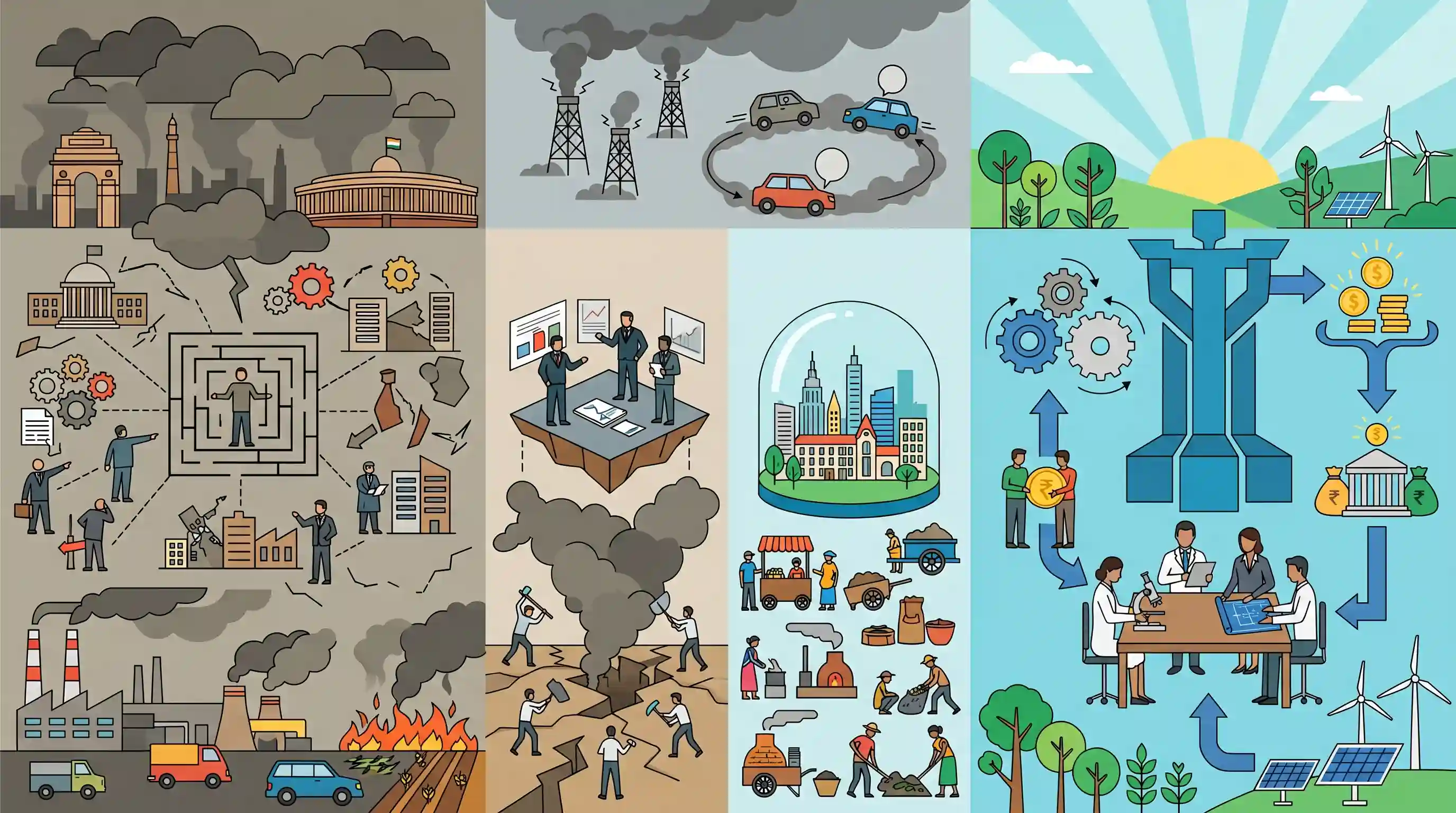
The article critiques India's persistent failure to manage air pollution, attributing the crisis to profound structural and governance inadequacies rather than scientific deficits. It highlights how air quality management, particularly in Delhi and the NCR, is paralyzed by institutional fragmentation across multiple state and central bodies, leading to a lack of accountability. The author identifies two primary policy pitfalls: an "intellectual trap" where elite-designed solutions ignore the ground realities of under-resourced pollution control boards, and a "Western trap" of blindly adopting foreign regulatory models unsuitable for India's informal economy. Moving beyond superficial, reactive measures like smog towers and odd-even rules necessitates a new, robust clean-air law with clear statutory mandates, dedicated funding, and better integration of science into public administration.
Key Points
- India's inability to solve its air pollution crisis is rooted in structural and governance flaws rather than a lack of scientific understanding.
- Air quality management suffers from severe institutional fragmentation, involving numerous overlapping bodies (e.g., MoEFCC, CPCB, CAQM, municipal corporations) with no single entity taking definitive ownership.
- Policymaking is hindered by an "intellectual trap," where elite institutions design solutions that fail to account for the underfunded and understaffed reality of grassroots regulatory bodies.
- There is also a "Western trap" of importing global best practices and technologies without adapting them to India's unique socio-economic landscape, such as its vast informal economy.
- Effectively addressing the crisis requires a modern, comprehensive clean-air law that defines explicit mandates, ensures stable funding, and integrates professional science managers into the governance framework.
Important Terms
Commission for Air Quality Management (CAQM)

A statutory body established in 2021 specifically for the National Capital Region (NCR) to coordinate air quality management and research. It has overarching powers to override state-level pollution board directives.
UPSC context
GS Paper II (Statutory Bodies) and GS III (Environment); tests knowledge of regional governance frameworks for air pollution.
Central Pollution Control Board (CPCB)
India's apex statutory organization for pollution control, established under the Water Act (1974) and empowered by the Air Act (1981). It sets national environmental standards and provides technical guidance to state boards.
UPSC context
GS Paper II and III; fundamental for understanding the institutional framework of environmental protection and statutory mandates.
State Pollution Control Boards (SPCBs)
State-level statutory bodies responsible for ground-level enforcement of environmental laws. They monitor industrial compliance and air quality but often face critical staff and funding shortages.
UPSC context
GS Paper III (Environmental Pollution and Degradation); tests understanding of implementation challenges and administrative bottlenecks in environmental governance.
Delhi Pollution Control Committee (DPCC)
An autonomous body delegated with the powers of the CPCB specifically for the National Capital Territory (NCT) of Delhi. It acts as the frontline regulator for industrial emissions and construction dust.
UPSC context
GS Paper II (Governance) and GS III; relevant for cases involving the specific administrative challenges of pollution control in Delhi.
Ministry of Environment, Forest and Climate Change (MoEFCC)
The nodal central ministry for planning and overseeing India's environmental, forestry, and climate policies. It manages the National Clean Air Programme (NCAP) and international climate negotiations.
UPSC context
GS Paper III (Environment); the primary administrative entity for government interventions, policy formulation, and environmental conservation.
Prelims Trap
"The National Clean Air Programme (NCAP) is a statutory framework with legally binding targets for states."
NCAP is a scheme with non-binding targets, not a statutory framework. Aspirants often confuse it with the CAQM Act, which is legally binding but restricted to the NCR region.
Static Concepts Connected
How does CPCB differ from CAQM in mandate and jurisdiction?
- CPCB Origins: Established under the Water Act (1974) and entrusted with powers under the Air Act (1981) with a pan-India mandate.
- CAQM Origins: Established via an Act in 2021 specifically to manage air quality in the NCR and adjoining areas (Punjab, Haryana, Rajasthan, UP).
- Override Power: In case of a conflict regarding orders for the NCR region, CAQM's directives legally override those of the CPCB.
What is the "Airshed" approach in air quality management?
- Definition: An airshed is a geographical area where local topography and meteorology limit the dispersion of pollutants.
- Policy Shift: It moves policymaking away from political/administrative boundaries to geographical realities, acknowledging that pollution travels across states (e.g., the Indo-Gangetic plain).
Cross-Topic Patterns
Informal sector vs environmental compliance
Western regulatory models fail in India because highly polluting sectors like brick kilns and unregistered MSMEs operate largely outside formal taxation, labor, and environmental regulatory nets.
Urban governance and multi-agency overlap
The air crisis mirrors broader urban governance failures, where overlapping parastatals (MCD, DPCC, CAQM, NDMC) dilute accountability, directly linking environmental management to Polity's 74th Amendment gaps.

Expect a tricky Prelims statement contrasting the statutory nature of CAQM with the non-binding nature of NCAP targets and airshed planning.
Linked PYQs · 4
Linked PYQs · 4
- 2015MainsGS1
Mumbai, Delhi and Kolkata are the three mega cities of the country but the air pollution is much more serious problem in Delhi as compared to the other two. Why is this so?
- 2021MainsGS3
Describe the key points of the revised Global Air Quality Guidelines (AQGs) recently released by the World Health Organisation (WHO). How are these different from its last update in 2005? What changes in India's National Clean Air Programme are required to achieve these revised standards?
- 2020MainsGS3
What are the key features of the National Clean Air Programme (NCAP) initiated by the Government of India?
- 2022MainsGS3
Discuss in detail the photochemical smog emphasizing its formation, effects and mitigation. Explain the 1999 Gothenburg Protocol.
