Ecological Significance of Urban Forests in Indian Cities
Source:The Hindu ↗
Why It Matters
This topic sits at the intersection of GS1 (Urbanization issues like heat islands), GS2 (Judicial interventions and Article 21), and GS3 (Environmental conservation and disaster mitigation). Understanding the conflict between developmental infrastructure and urban ecology, along with corresponding government missions and judicial safeguards, is crucial for Mains answers.
Summary
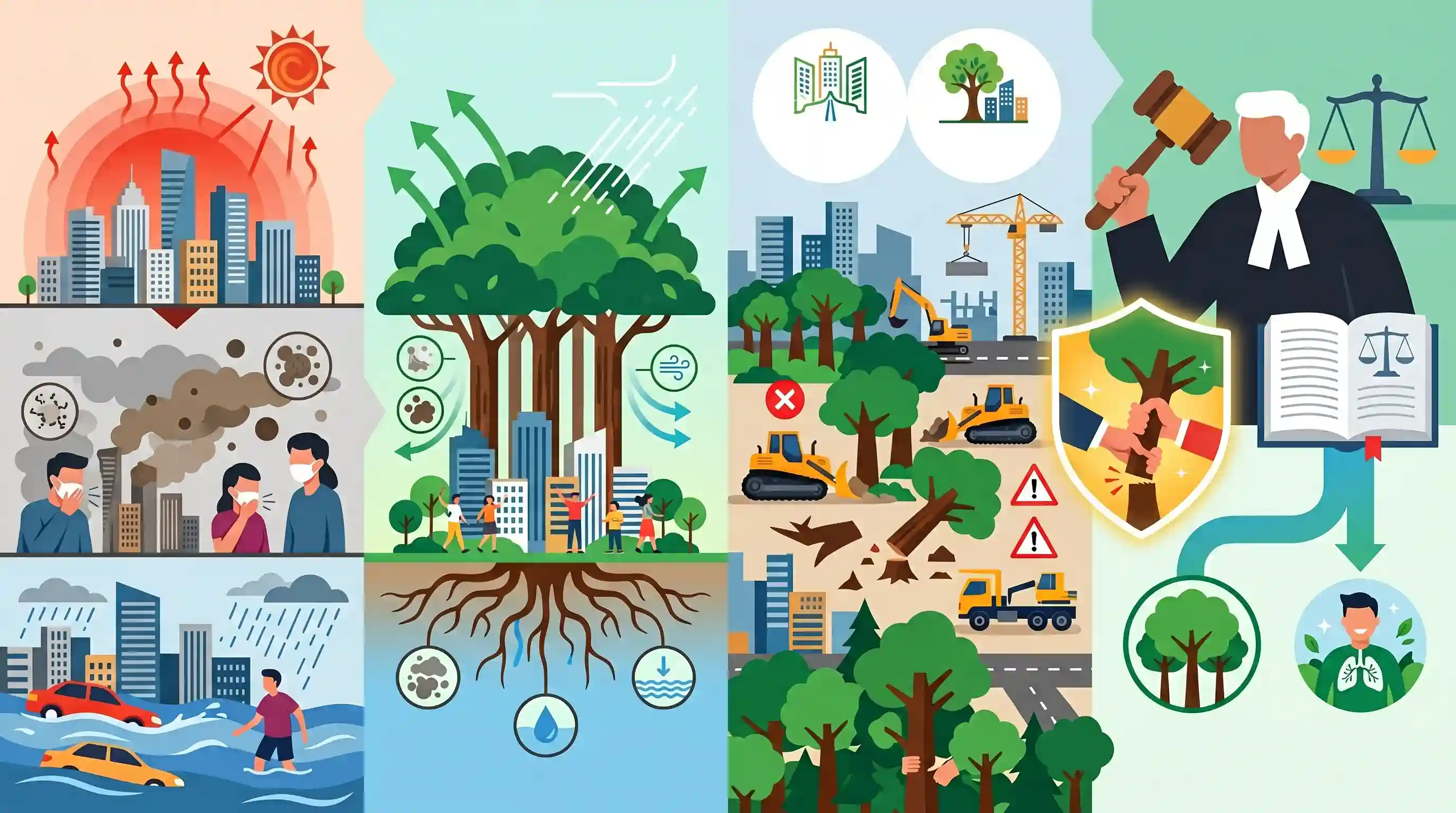
The article highlights the indispensable role of urban forests in India for mitigating the adverse effects of climate change, such as the urban heat island effect, severe air pollution, and urban flooding. Despite government initiatives like the Nagar Van Yojana and the Smart Cities Mission to enhance urban green cover, rapid infrastructure expansion consistently threatens existing forests like Mumbai's Aarey and Hyderabad's Kancha Gachibowli. Consequently, the judiciary, including the Supreme Court and the NGT, increasingly intervenes to halt indiscriminate felling by upholding constitutional mandates such as Article 21 (right to a healthy environment) and the Godavarman judgment's broad definition of forests.
Key Points
- Urban forests are critical for Indian cities to act as carbon sinks, reduce the urban heat island effect, manage stormwater, and combat severe air pollution.
- Rapid infrastructure development frequently threatens urban green spaces, leading to conflicts seen in Aarey (Mumbai) and Kancha Gachibowli (Hyderabad).
- The judiciary has frequently stepped in to protect urban forests by invoking the Right to a Healthy Environment under Article 21, and utilizing the expanded definition of forests from the 1996 Godavarman judgment.
- Government initiatives like the Nagar Van Yojana aim to develop 1,000 urban forests by 2027, working alongside broader urban schemes like the Smart Cities Mission and AMRUT.
Important Terms
Nagar Van Yojana (NVY)

Launched in 2020, this scheme aims to develop 1,000 urban forests (Nagar Vans) by 2027 to improve urban greenery, biodiversity, and quality of life using CAMPA funds.
UPSC context
GS Paper 3: Environmental Conservation; GS Paper 2: Government Schemes. Tests knowledge of urban climate adaptation strategies.
Godavarman Judgment (1996)
A landmark 1996 Supreme Court ruling that expanded the legal definition of 'forest' to include its dictionary meaning and all statutorily recognized forests, regardless of ownership.
UPSC context
GS Paper 2: Judicial Activism; GS Paper 3: Environmental Legislation. Key for understanding forest protection and land-use conflicts.
National Forest Policy 1988
A flagship 1988 policy aiming to ensure environmental stability by maintaining 33% of India's land under forest/tree cover and prioritizing ecological balance over direct economic benefit.
UPSC context
GS Paper 3: Environmental Conservation. Foundational for questions on India’s long-term ecological goals and afforestation targets.
Smart Cities Mission
An urban renewal initiative launched in 2015 to develop 100 sustainable, citizen-friendly cities by integrating smart technology, core infrastructure, and a clean, sustainable environment.
UPSC context
GS Paper 1: Urbanization; GS Paper 3: Infrastructure. Tests understanding of sustainable urban planning and resilience.
Article 48A
A Directive Principle (42nd Amendment, 1976) mandating that the State shall endeavor to protect and improve the environment and safeguard the country's forests and wildlife.
UPSC context
GS Paper 2: Indian Constitution. Important for discussing the State's constitutional obligations toward environmental governance.
Article 51A(g)
A Fundamental Duty (42nd Amendment, 1976) requiring every Indian citizen to protect and improve the natural environment, including forests, lakes, rivers, and wildlife.
UPSC context
GS Paper 2: Indian Constitution. Tests awareness of individual responsibilities and the ethical dimensions of conservation.
Article 21
Guarantees the Right to Life and Personal Liberty, which the Supreme Court has interpreted to include the right to a clean and healthy environment.
UPSC context
GS Paper 2: Fundamental Rights. Crucial for analyzing judicial intervention and environmental justice in India.
Prelims Trap
"The Forest (Conservation) Amendment Act 2023 legally codifies the 'dictionary definition' of forests established by the Godavarman judgment."
The 2023 Amendment actually restricts protection to lands explicitly notified as forests, diluting the broad "dictionary meaning" protection established by the 1996 Godavarman ruling.
Static Concepts Connected
What causes the Urban Heat Island (UHI) effect?
- Surface modifications: Concrete and asphalt absorb and retain significantly more solar radiation than natural soil and vegetation.
- Reduced evapotranspiration: A lack of urban green cover drastically reduces natural cooling processes driven by plant transpiration and soil moisture evaporation.
- Anthropogenic heat: Waste heat generated by vehicular emissions, industrial processes, and air conditioning units directly warms the urban microclimate.
How does the Indian Constitution mandate environmental protection?
- Article 21: The Supreme Court broadly interprets the Right to Life to implicitly include the right to a clean and healthy environment.
- Article 48A: A Directive Principle instructing the State to endeavor to protect and improve the environment, forests, and wildlife.
- Article 51A(g): A Fundamental Duty obligating every citizen of India to protect and improve the natural environment.
Cross-Topic Patterns
Urban Flooding + Sponge Cities
Urban forests act as natural stormwater sinks, connecting environmental conservation directly to NDMA guidelines on urban flooding and the 'Sponge City' concept heavily emphasized in recent GS-3 Mains.
Judicial Activism vs. Infrastructure Expansion
NGT and Supreme Court halts on infrastructure projects (like Mumbai's Aarey) to protect forests continually trigger GS-2 debates on the separation of powers and judicial activism versus executive policy.

Expect a Prelims question comparing Nagar Van Yojana funding (CAMPA) with AMRUT green space mandates and UHI mitigation mechanisms.
Linked PYQs · 5
Linked PYQs · 5
- 2013MainsGS1
Bring out the causes for the formation of heat islands in the urban habitat of the world.
- 2024MainsGS3
Flooding in urban areas is an emerging climate-induced disaster. Discuss the causes of this disaster. Mention the features of two such major floods in the last two decades in India. Describe the policies and frameworks in India that aim at tackling such floods.
- 2016MainsGS3
What are 'Smart Cities'? Examine their relevance for urban development in India. Will it increase rural-urban differences? Give arguments for 'Smart Villages' in the light of PURA and RURBAN Mission.
- 2023MainsGS2
“The Constitution of India is a living instrument with capabilities of enormous dynamism. It is a constitution made for a progressive society.” Illustrate with special reference to the expanding horizons of the right to life and personal liberty.
- 2024MainsGS3
What role do environmental NGOs and activists play in influencing Environmental Impact Assessment (EIA) outcomes for major projects in India? Cite four examples with all important details.
