Systemic Policy Interventions for Women Retention in STEM
Source:The Hindu ↗
Why It Matters
The underrepresentation of women in STEM is a critical issue for social justice and India's scientific advancement. Understanding the structural barriers and the need for systemic policy interventions is highly relevant for GS1 (Role of Women) and GS2 (Social Justice/Vulnerable Sections) questions.
Summary
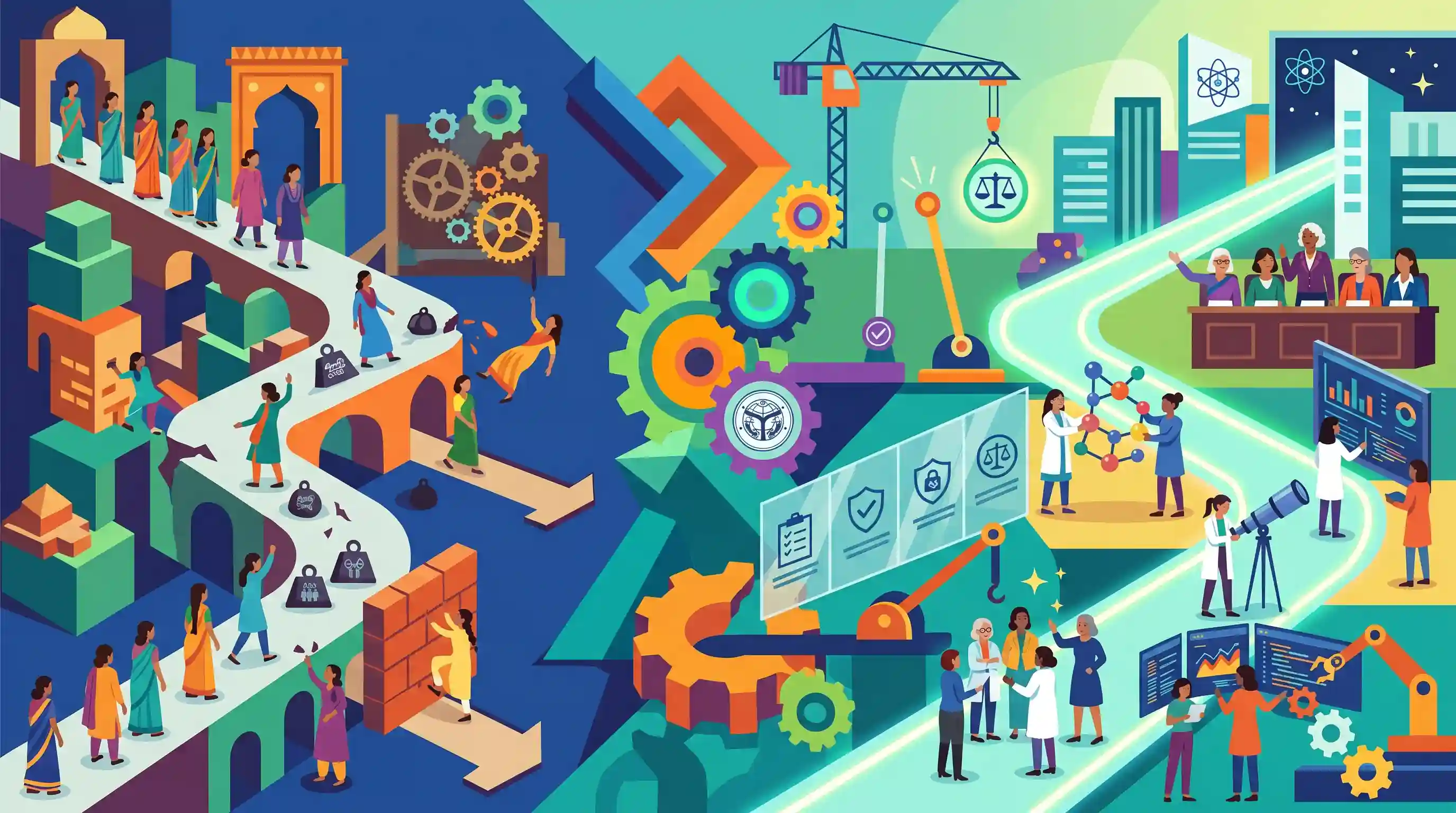
The article emphasizes that retaining women in Science, Technology, Engineering, and Mathematics (STEM) in India requires more than just individual empowerment or educational access; it demands systemic political and institutional change. It highlights the 'leaky pipeline' phenomenon where women drop out of scientific careers due to structural barriers, entrenched patriarchal attitudes, and a lack of supportive infrastructure. The piece advocates for robust policy interventions, institutional accountability, and structural reforms to dismantle these barriers and foster a truly equitable environment for women scientists.
Key Points
- India faces a significant gender gap in STEM (Science, Technology, Engineering, Mathematics), particularly at higher research and institutional leadership levels.
- Individual empowerment and educational schemes are insufficient without systemic and political changes to address structural barriers.
- Patriarchal attitudes, implicit biases, lack of mentorship, and work-life balance challenges contribute to the high attrition rate of women in science (the 'leaky pipeline').
- Robust policy interventions, institutional accountability, and gender budgeting in R&D are essential to retain women scientists and ensure equitable opportunities.
Important Terms
GATI (Gender Advancement for Transforming Institutions)

A Department of Science and Technology (DST) pilot project that encourages Indian research and higher education institutions to adopt gender-equitable practices and self-assessment frameworks to increase women’s representation in STEMM disciplines.
UPSC context
GS Paper II (Social Justice) and Paper III (S&T); evaluates institutional reforms for gender inclusivity in scientific careers.
KIRAN Scheme
A holistic initiative by the DST (now WISE-KIRAN) providing research grants, fellowships, and career-break support to women scientists. It aims to achieve gender parity through dedicated skill-building and funding programs.
UPSC context
GS Paper II (Govt. Schemes) and Paper III (S&T); addresses human resource development and structural barriers for women scientists.
Vigyan Jyoti
A DST flagship program targeting meritorious schoolgirls from Class 9 to 12. It provides mentoring, science camps, and institutional exposure to encourage them to pursue higher education and careers in underrepresented STEM fields.
UPSC context
GS Paper II (Social Justice/Education); focuses on grassroots interventions for gender parity in the future scientific workforce.
Department of Science and Technology (DST)
The central agency under the Ministry of Science and Technology responsible for formulating national policies and implementing specialized schemes to enhance female participation and leadership within India’s scientific and research ecosystem.
UPSC context
GS Paper III (Science & Tech); the primary authority for S&T governance and policy-led social empowerment in India.
Indian National Science Academy (INSA)
An apex body of top Indian scientists that advocates for gender diversity in academia through comprehensive reports, joint panels, and networking initiatives like the INSA Women Associates program for women researchers.
UPSC context
GS Paper III (Science & Tech); represents institutional leadership and professional standards within the Indian scientific community.
Prelims Trap
"India's low proportion of female STEM graduates is the primary reason for the low number of women in the STEM workforce."
India actually boasts one of the highest global proportions of female STEM graduates (~43%). The low workforce participation is due to systemic barriers and the 'leaky pipeline', creating a 'STEM Paradox'.
Static Concepts Connected
What are the key DST schemes promoting women in STEM?
- Vigyan Jyoti: Targets school girls (Class IX-XII) to handhold and motivate them to pursue higher education in underrepresented STEM fields.
- WISE-KIRAN: Provides opportunities, including re-entry fellowships and research grants, for women scientists returning after a career break due to family responsibilities.
- GATI: A pilot project grading higher education institutions on their commitment to gender equality, modeled on the UK's Athena SWAN charter.
How do the concepts of 'Leaky Pipeline' and 'Glass Ceiling' differ?
- Leaky Pipeline: The progressive attrition of women from career paths at various life stages (like marriage or maternity) before reaching senior roles.
- Glass Ceiling: The invisible, systemic organizational barriers that prevent women from rising to executive or leadership levels, despite having the necessary qualifications.
Cross-Topic Patterns
Women in STEM + Demographic Dividend
The 'STEM paradox' directly hampers India's demographic dividend. Without translating 43% female STEM graduates into the labor force, high-tech manufacturing goals (Make in India) will lack crucial skilled human capital.
Care Economy + Female LFPR in R&D
The 'leaky pipeline' heavily intersects with India's unrecognized care economy. The lack of institutional childcare and maternity support in R&D forces attrition, dragging down the overall Female Labour Force Participation Rate.

Mains GS1/GS2 will likely test the 'STEM Paradox'—why India's 43% female STEM graduation rate yields only a 14% workforce participation.
Linked PYQs · 4
Linked PYQs · 4
- 2024MainsGS1
Distinguish between gender equality, gender equity and women's empowerment. Why is it important to take gender concerns into account in programme design and implementation?
- 2019MainsGS1
What are the continued challenges for women in India against time and space?
- 2021MainsGS2
“Though women in post-Independent India have excelled in various fields, the social attitude towards women and feminist movement has been patriarchal." Apart from women education and women empowerment schemes, what interventions can help change this milieu?
- 2025MainsGS2
Women's social capital complements in advancing empowerment and gender equity. Explain.
