Structural Challenges and Need for a Unified Welfare State in India
Source:Indian Express ↗
આ શા માટે મહત્વનું છે
The article addresses critical governance and policy design issues regarding India's social safety net, making it directly relevant to questions on welfare administration, target efficiency, and inclusive growth in GS Paper II and III.
સારાંશ
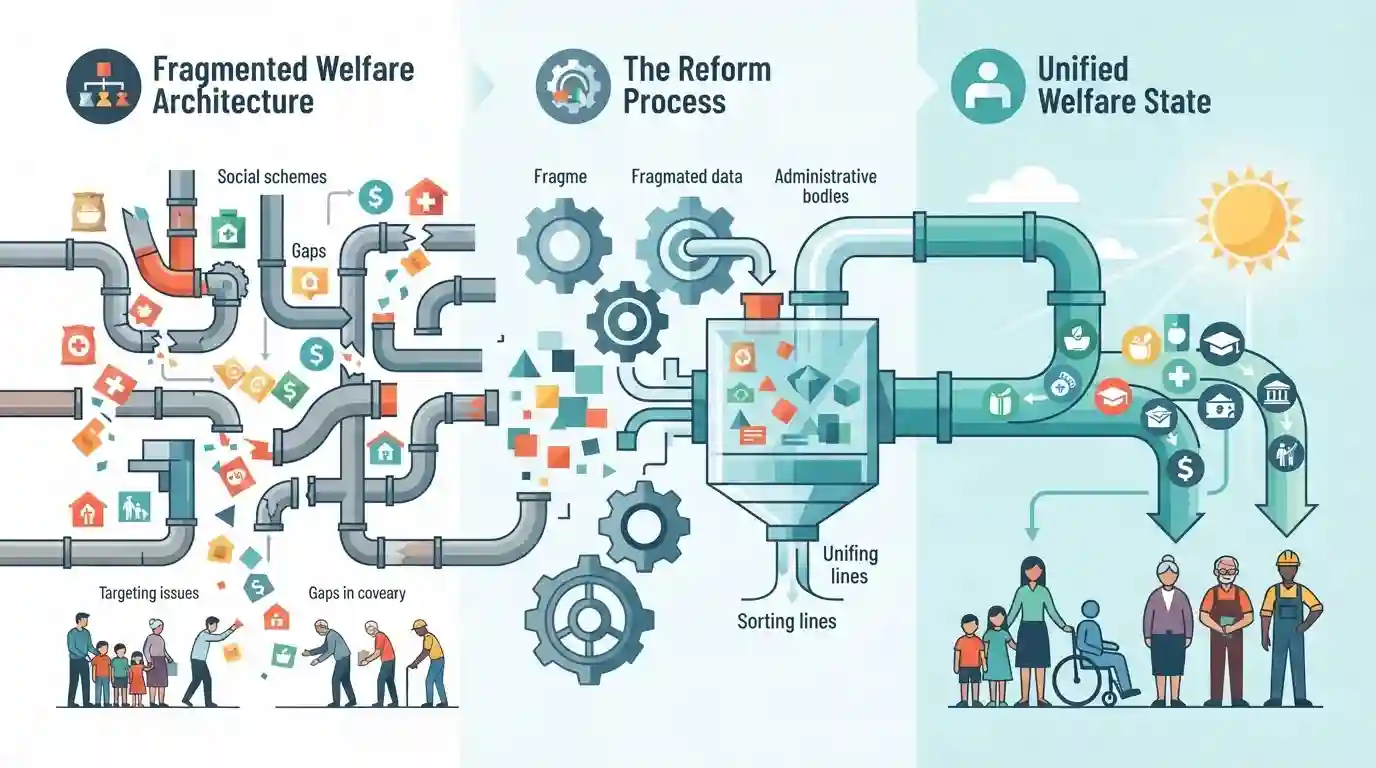
The article discusses the structural challenges plaguing India's social welfare architecture, highlighting fragmentation, leakages, and targeting issues. It argues for a transition toward a unified welfare state that can ensure comprehensive social security, administrative efficiency, and better targeting for vulnerable populations.
મુખ્ય મુદ્દા
- India's welfare architecture is highly fragmented across various central and state schemes, leading to inefficiencies, leakage, and exclusion errors.
- A unified welfare state framework can streamline delivery mechanisms, ensure portability of benefits, and rationalise resource allocation.
- Integrating digital infrastructure like JAM (Jan Dhan-Aadhaar-Mobile) trinity can serve as a backbone for a coherent, universalized social protection floor.
- Moving towards a unified framework requires addressing fiscal federalism concerns and matching cooperative federalism with administrative convergence.
પ્રિલિમ્સ ટ્રેપ
transition toward a unified welfare state implies replacing all state-specific welfare schemes with a single centralized program.
Aspirants often assume a 'unified welfare state' implies complete centralization, overlooking the constitutional mandate of welfare as a concurrent responsibility requiring cooperative federalism.
સંલગ્ન સ્થિર ખ્યાલો
What are the constitutional provisions and principles governing social welfare and social security in India?
- Article 38: Directive Principles mandate the State to secure a social order for the promotion of welfare of the people under Article 38.
- Article 41: Article 41 directs the State to secure the right to work, to education, and to public assistance in cases of undeserved want.
- Concurrent List: Economic and Social Planning falls under the Concurrent List (List III, Entry 20) of the Seventh Schedule, enabling both Centre and States to legislate.
આંતર-વિષય પેટર્ન
Digital Public Infrastructure & Fiscal Federalism
JAM Trinity and DBT implementation intersect with federal fiscal transfers, raising tensions between central conditionalities and state-level administrative autonomy in welfare delivery.
Social Security & Inter-state Migration
Welfare fragmentation disproportionately harms migrant workers, highlighting the structural tension between localized social entitlements and constitutional rights to freedom of movement.

Welfare fragmentation + JAM trinity + fiscal federalism is a high-yield theme for GS Paper II governance and policy design questions.
સંલગ્ન PYQ · 3
સંલગ્ન PYQ · 3
- 2019MainsGS2
Performance of welfare schemes that are implemented for vulnerable sections is not so effective due to absence of their awareness and active involvement at all stages of policy process. Discuss.
- 2023MainsGS2
“Development and welfare schemes for the vulnerable, by its nature, are discriminatory in approach.” Do you agree? Give reasons for your answer.
- 2024MainsGS3
Examine the pattern and trend of public expenditure on social services in the post-reforms period in India. To what extent this has been in consonance with achieving the objective of inclusive growth?
