Urgent Need for Comprehensive National Space Legislation in India
Source:The Hindu ↗
Why It Matters
India's space sector is undergoing rapid commercialization and privatization. Understanding the legal and regulatory vacuum—and the rationale for a national space law—is critical for GS-3 (Space Technology and economy) and GS-2 (International Treaties and Government Policies).
Summary
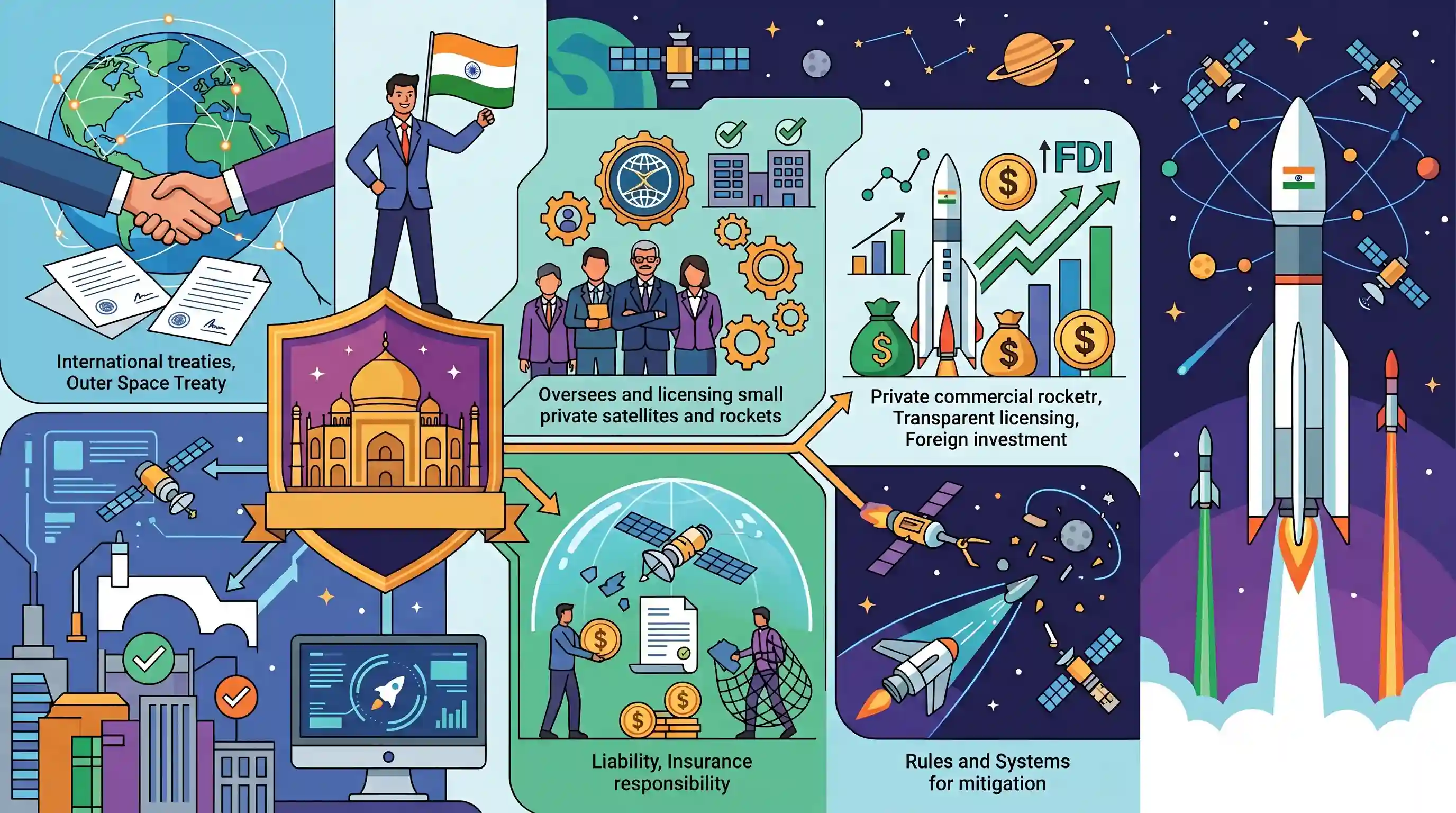
The article highlights the urgent necessity for India to enact a comprehensive national space law. While India has ratified key international space treaties such as the 1967 Outer Space Treaty, which holds States internationally responsible for space activities, it currently lacks the domestic legislation required to operationalize these obligations. A national space law is critical to provide statutory backing to regulatory bodies like IN-SPACe, establish transparent licensing and FDI frameworks for the booming private space sector, and mandate rules for third-party liability, insurance, and space debris mitigation. Such legislation would also bolster India's strategic positioning amidst growing geopolitical competition in outer space.
Key Points
- India is an active signatory to major UN space treaties like the Outer Space Treaty (1967) and the Liability Convention, which assign international responsibility and liability to States for their space activities.
- Currently, India lacks a comprehensive national space legislation. Crucial bodies like IN-SPACe are operating without formal statutory backing, creating regulatory uncertainty for the private sector.
- A national space law is urgently needed to provide statutory authority to IN-SPACe, lay down transparent licensing guidelines, specify FDI rules for satellite components, and implement a robust framework for third-party liability and space debris management.
- With space emerging as a domain of geopolitical contestation and militarization among major powers (US, Russia, China), having a clear domestic space law will strengthen India's voice in shaping global space governance and protecting its commercial and strategic interests.
Important Terms
Outer Space Treaty (1967)

A 1967 multilateral treaty forming the foundation of international space law. It prohibits weapons of mass destruction in space, mandates peaceful use, and holds states responsible for national space activities.
UPSC context
GS Paper 2 (International Treaties) and GS Paper 3 (Space Tech). Tests knowledge of global governance and India's legal obligations.
Liability Convention (1972)
A 1972 treaty elaborating on Article VII of the OST. It establishes absolute liability for launching states for damage on Earth and fault-based liability for damage in space.
UPSC context
GS Paper 3 (Space Technology). Relevant for discussions on third-party insurance and domestic liability frameworks for private startups.
Registration Convention (1975)
A 1975 treaty requiring states to maintain a registry of objects launched into space and furnish details to the UN to assist in identification and traffic management.
UPSC context
GS Paper 3 (Space Technology). Essential for understanding space debris mitigation and international transparency in satellite deployment.
IN-SPACe
An autonomous single-window nodal agency under the Department of Space. It promotes, authorizes, and regulates space activities of non-governmental entities (NGEs) in India.
UPSC context
GS Paper 3 (Economy/Science). Tests understanding of institutional reforms to democratize the space sector and the need for statutory backing.
ISRO
India's primary agency for space research and development. In the evolving regulatory landscape, its role is shifting toward advanced R&D and deep-space missions rather than commercial regulation.
UPSC context
GS Paper 3 (Science and Technology). Key for tracing the evolution of India's space program from state-led to private-partnership models.
UNOOSA
The UN office responsible for promoting international cooperation in the peaceful use of outer space and maintaining the Register of Objects Launched into Outer Space.
UPSC context
GS Paper 2 (International Institutions). Tests knowledge of the global administrative bodies that oversee the implementation of international space treaties.
Prelims Trap
IN-SPACe is a statutory regulatory body established by Parliament to oversee the private space sector in India.
IN-SPACe currently lacks statutory backing and operates as an autonomous agency under the Department of Space. A space law is needed to grant it statutory status.
Static Concepts Connected
What are the core principles of the UN Outer Space Treaty (1967)?
- No WMDs: Prohibits placing nuclear weapons or other weapons of mass destruction in Earth's orbit or on celestial bodies.
- Non-appropriation: Outer space and celestial bodies cannot be claimed by any sovereign nation through occupation, use, or any other means.
- State Responsibility: Nations bear international responsibility for all domestic space activities, making the State liable even for launches conducted by private companies.
What are the key terms and initiatives related to space debris mitigation?
- Kessler Syndrome: A theoretical scenario where the density of debris in Low Earth Orbit triggers cascading collisions, rendering the orbit completely unusable for satellites.
- Project NETRA: ISRO's early warning Space Situational Awareness (SSA) system, designed to detect space debris and operational hazards to Indian satellites.
- Zero Debris 2030: India's official commitment to ensure that all future Indian space missions leave zero orbital debris by the year 2030.
Cross-Topic Patterns
Space Commercialization + FDI Rules
Recent liberalized policies allow up to 100% FDI for satellite manufacturing. A robust national space law is required to effectively manage these capital inflows while protecting strategic interests.
Global Commons + Treaty Obligations
Outer space joins the High Seas and Antarctica as 'Global Commons'. Regulating them requires reconciling broad UN conventions with specific domestic legislation to handle private sector liabilities.

Expect a multi-statement Prelims question testing IN-SPACe's non-statutory status against India's obligations under the 1967 Space Treaty.
Linked PYQs · 1
Linked PYQs · 1
- 2016MainsGS3
Discuss India's achievements in the field of Space Science and Technology. How the application of this technology has helped India in its socio-economic development?
