Macroeconomic Drivers Behind Strong India GDP Growth Performance
Source:Indian Express ↗
हे का महत्त्वाचे आहे
Aspirants need to understand macroeconomic indicators, GDP estimation methodologies, and growth drivers to analyze economic performance and policy effectiveness in GS Paper III.
सारांश
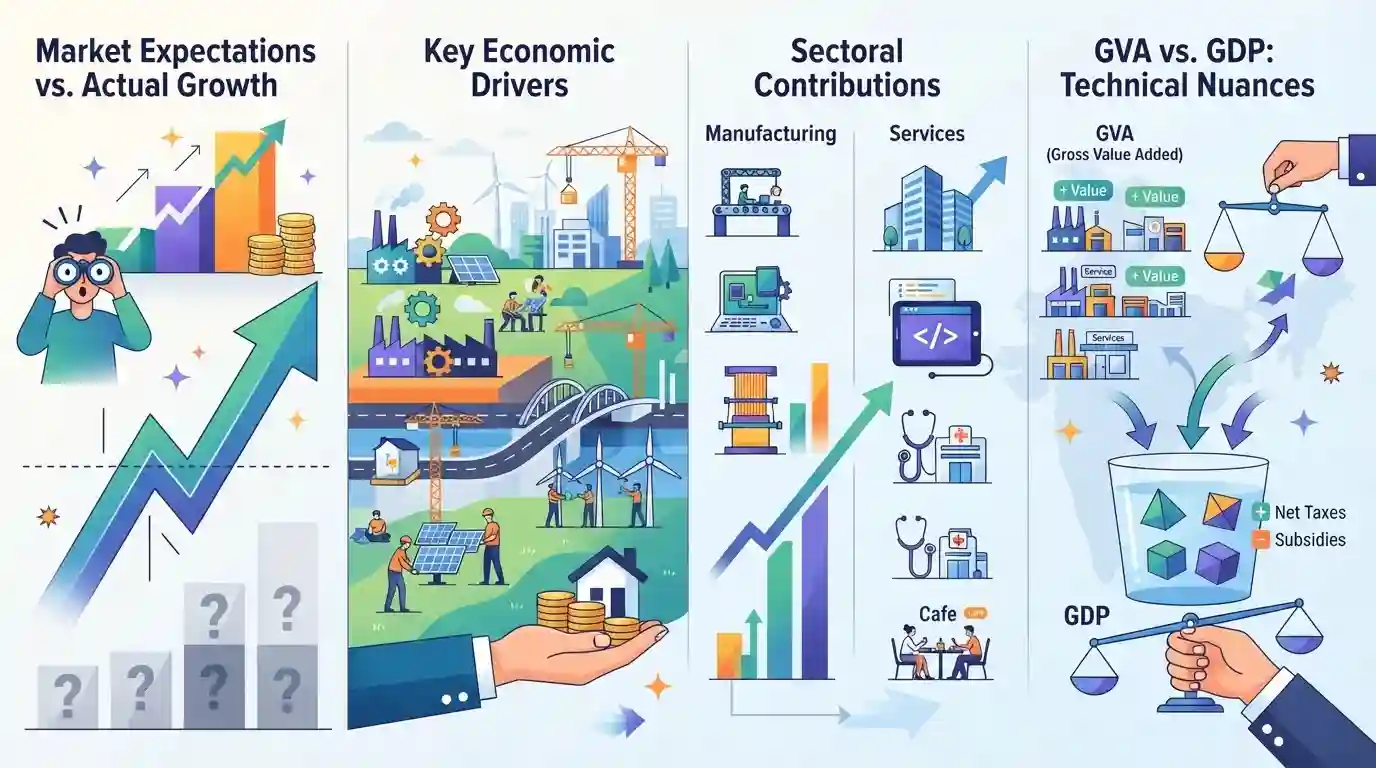
The article breaks down the reasons behind India's GDP growth outperforming market expectations, analyzing the underlying growth drivers, sectoral contributions (such as manufacturing and services), and the technical nuances between Gross Value Added (GVA) and Gross Domestic Product (GDP) numbers.
मुख्य मुद्दे
- India's GDP growth rate significantly overshot market and institutional expectations, driven by strong performance across key sectors.
- Discrepancies and growth drivers between Gross Value Added (GVA) and Gross Domestic Product (GDP) highlight important shifts in tax collections and subsidies.
- Robust industrial, manufacturing, and service sector activity contributed to the surprise upside in economic performance.
- Understanding the nuances of macroeconomic data releases helps evaluate the resilience and structural dynamics of the Indian economy.
महत्त्वाच्या संज्ञा
Ministry of Statistics and Programme Implementation (MoSPI)

The nodal ministry of the Government of India responsible for collecting, compiling, and disseminating official statistical data, including national accounts like GDP and GVA, and monitoring major infrastructure projects.
UPSC context
Relevant for GS Paper III (Indian Economy - Growth & Data Statistics). Tests understanding of institutional mechanisms behind macroeconomic data releases.
Reserve Bank of India (RBI)
India's central banking institution that regulates the monetary policy, issues currency, manages foreign exchange reserves, and provides growth projections and credit data for the economy.
UPSC context
Crucial for GS Paper III (Indian Economy - Banking, Monetary Policy, and Inflation). Evaluates the role of central banking in macroeconomic forecasting and financial stability.
संबंधित स्थिर संकल्पना
What is the fundamental macroeconomic difference between Gross Value Added (GVA) and Gross Domestic Product (GDP)?
- GVA Perspective: Measures economic output from the supply-side (producer perspective) as the value of output minus intermediate consumption.
- GDP Calculation: Represents total economic activity from the demand side, derived by adding Net Taxes (Taxes minus Subsidies on products) to GVA.
- Growth Divergence: A higher GDP growth over GVA growth typically signals strong indirect tax collections or lower subsidy burdens.
आंतर-विषय नमुने
GDP-GVA Divergence and Fiscal Consolidation Linkages
Higher tax buoyancy combined with reduced subsidy outlays drives a wedge between GVA and GDP growth, connecting national income accounting with fiscal deficit management.
Investment Demand and Capital Expenditure Momentum
Robust Gross Fixed Capital Formation (GFCF) highlights how public infrastructure capex crowds in private investment, linking macroeconomic data with budget capital outlays.

Expect a statement-based prelims question testing the exact mathematical relationship between GVA, Net Indirect Taxes, and GDP.
संबंधित PYQ · 3
संबंधित PYQ · 3
- 2023MainsGS3
Faster economic growth requires increased share of the manufacturing sector in GDP, particularly of MSMEs. Comment on the present policies of the Government in this regard.
- 2018PrelimsGS1
Increase in absolute and per capita real GNP do not connote a higher level of economic development, if
- 2024PrelimsGS1
With reference to the sectors of the Indian economy, consider the following pairs: Economic activity | Sector 1. Storage of agricultural produce | Secondary 2. Dairy farm | Primary 3. Mineral exploration | Tertiary 4. Weaving cloth | Secondary How many of the pairs given above are correctly matched?
