India Role in Global Financial Order and Digital Public Infrastructure
Source:The Hindu ↗
આ શા માટે મહત્વનું છે
India's evolving role in global economic governance intersects multiple UPSC themes, including macroeconomic stability (currency internationalisation), technological diplomacy (exporting DPI), and international relations (MDB reforms). Grasping these dynamics is essential for analyzing India's foreign policy trajectory and its structural integration into the 21st-century global economy.
સારાંશ
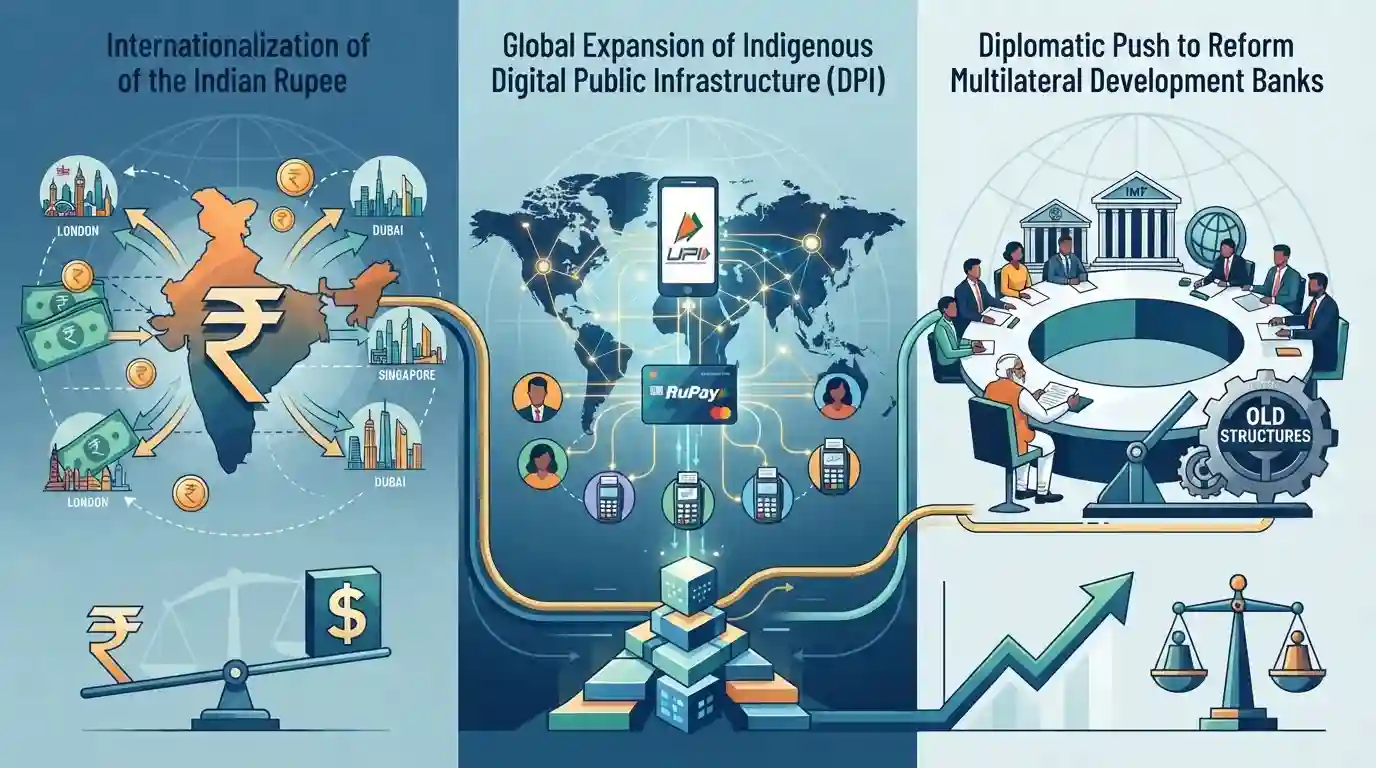
The article discusses India's strategic initiatives to shape the emerging global financial order. It highlights three primary pillars of this transformation: the push for the internationalisation of the Indian Rupee to counter dollar hegemony, the global expansion of its indigenous Digital Public Infrastructure (DPI) such as UPI and RuPay, and a strong diplomatic push to reform outdated multilateral development banks like the IMF and World Bank. By championing these causes, India is asserting its leadership in the Global South and working to establish a more equitable, multipolar economic governance framework that reflects contemporary geopolitical realities.
મુખ્ય મુદ્દા
- India is spearheading the internationalisation of the Rupee through bilateral trade settlements and currency swap agreements, aiming to reduce reliance on the US Dollar and shield its economy from external currency shocks.
- The global export of India's Digital Public Infrastructure (DPI), particularly the UPI and RuPay, is creating alternative, cost-effective cross-border payment ecosystems in countries like the UAE, Singapore, and France.
- Building on its recent G20 presidency, India is actively advocating for the reform of Bretton Woods institutions (IMF and World Bank) to ensure greater representation and adequate climate and development finance for the Global South.
- By leveraging both technological innovation and diplomatic engagement, India is positioning itself as a bridge between developed nations and the Global South, facilitating a transition towards a multipolar and democratised global financial architecture.
મહત્વપૂર્ણ શબ્દો
Unified Payments Interface (UPI)

A real-time, mobile-first payment system developed by the National Payments Corporation of India (NPCI). It enables instant peer-to-peer and peer-to-merchant inter-bank transactions using a single identifier like a UPI ID or QR code.
UPSC context
GS3: Indian Economy. Tests digital public infrastructure, digital economy growth, and technological models for financial inclusion.
National Payments Corporation of India (NPCI)
An umbrella organization incorporated as a not-for-profit Section 8 company, established by the RBI and IBA. It operates and manages retail payment and settlement systems across India, including UPI, RuPay, and IMPS.
UPSC context
GS3: Indian Economy. Tests the institutional framework of retail payment systems, digital payments ecosystem, and financial inclusion.
RuPay
India's indigenous card payment network launched by the NPCI. It serves as a low-cost, open-loop domestic alternative to international card schemes like Visa and Mastercard, promoting cashless transactions and financial inclusion.
UPSC context
GS3: Indian Economy. Tests domestic payment mechanisms, reducing reliance on foreign networks, and monetary system autonomy.
Open Network for Digital Commerce (ONDC)
A government-backed initiative established by the DPIIT as a non-profit Section 8 company. It democratizes e-commerce by transitioning from platform-centric models to an open, interoperable network using open-source protocols.
UPSC context
GS3: Indian Economy. Tests digital commerce reforms, e-commerce regulations, MSME empowerment, and anti-monopolistic market structures.
Reserve Bank of India (RBI)
India's central bank and monetary authority, established under the RBI Act, 1934. It regulates currency issuance, formulates monetary policy to maintain price stability, manages foreign exchange, and supervises the financial system.
UPSC context
GS3: Indian Economy. Tests central banking, monetary policy tools, inflation targeting, and financial sector regulation.
BRICS
An intergovernmental organization representing major emerging economies. Originally comprising Brazil, Russia, India, China, and South Africa, it expanded to foster economic cooperation, champion South-South dialogue, and promote a multipolar world order.
UPSC context
GS2: International Relations. Tests multilateral groupings, global economic governance reforms, and India's leadership in the Global South.
પ્રિલિમ્સ ટ્રેપ
Special Rupee Vostro Accounts (SRVAs) are accounts maintained by Indian banks in foreign nations.
Vostro means 'your money with us.' An SRVA is held by a foreign bank with an authorized dealer bank in India, denominated in Rupees, not abroad.
સંલગ્ન સ્થિર ખ્યાલો
What are Nostro, Vostro, and Loro accounts in cross-border banking?
- Nostro Account: An Indian bank's account maintained with a foreign bank in a foreign currency (i.e., 'our money with you').
- Vostro Account: A foreign bank's account maintained with an Indian bank in domestic currency/Rupees (i.e., 'your money with us').
- Loro Account: A third-party bank referring to an existing Nostro or Vostro account of another bank (i.e., 'their money with them').
How do the IMF and World Bank differ in their core Bretton Woods mandates?
- IMF Mandate: Focuses on macroeconomic stability, managing exchange rates, and providing short-term financing to resolve Balance of Payments (BoP) crises.
- World Bank Mandate: Provides long-term loans and grants for capital projects, infrastructure development, and poverty reduction.
- Quota System: Both institutions allocate voting power based on financial quotas, heavily favoring developed nations—a key target for Global South reforms.
આંતર-વિષય પેટર્ન
DPI as Strategic Soft Power
Exporting UPI acts as technological diplomacy, contrasting with China's capital-heavy Belt and Road Initiative by offering scalable, non-debt-trap open-source solutions to the Global South.
De-dollarisation and Geopolitics
Rupee internationalisation through SRVA gained momentum post-Ukraine war, as western sanctions on Russia exposed the strategic vulnerability of dollar-dependent global supply chains.

Expect a Prelims question interlinking the mechanics of Special Rupee Vostro Accounts (SRVA) with India's global DPI footprint.
સંલગ્ન PYQ · 4
સંલગ્ન PYQ · 4
- 2025PrelimsGS1
Consider the following countries : I. United Arab Emirates II. France III. Germany IV. Singapore V. Bangladesh How many countries amongst the above are there other than India where international merchant payments are accepted under UPI?
- 2019MainsGS2
‘The long-sustained image of India as a leader of the oppressed and marginalised nations has disappeared on account of its new found role in the emerging global order.’ Elaborate.
- 2023MainsGS3
What is the status of digitalization in the Indian economy? Examine the problems faced in this regard and suggest improvements.
- 2026PrelimsGS1
Which one of the following statements about Unified Payments Interface (UPI) and Central Bank Digital Currency (Digital Rupee) is not correct ?
