Human Rating and Safety Standards in Gaganyaan Mission
Source:The Hindu ↗
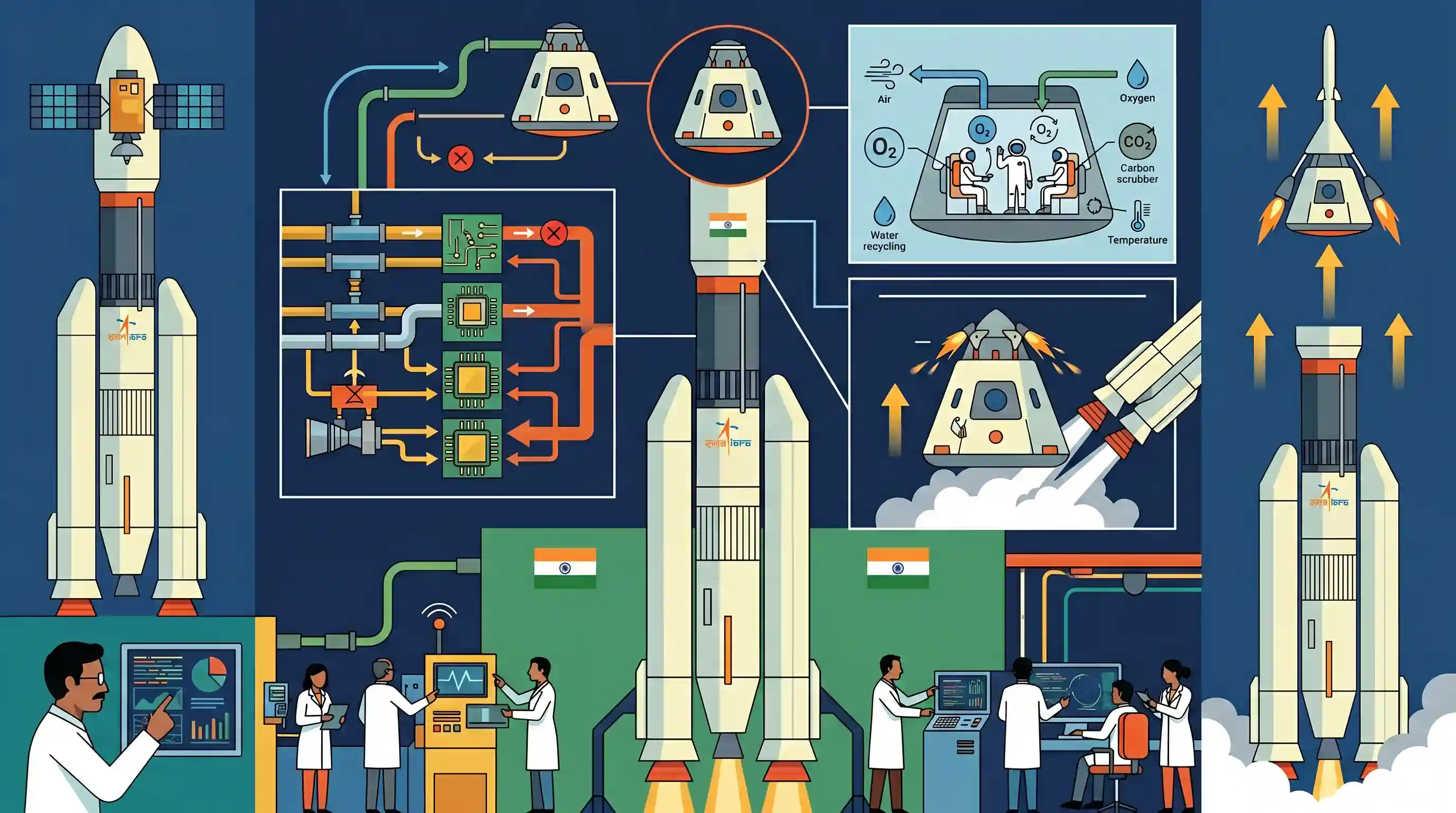
Why It Matters
Gaganyaan is a flagship national project. Understanding the technical requirements for human spaceflight, such as human rating, LVM3 modifications, and life support systems, is essential for GS-3 Space Technology questions and Prelims MCQs regarding ISRO's evolving capabilities.
Summary
The article details the critical process of 'human rating' as the Indian Space Research Organisation (ISRO) prepares for its inaugural crewed spaceflight program, Gaganyaan. Human rating involves modifying existing launch vehicles—specifically the LVM3—to meet extreme safety and reliability standards necessary for human passengers. This includes eliminating single-point failures through system redundancy, implementing an Environmental Control and Life Support System (ECLSS) to simulate Earth-like conditions, and adding a Crew Escape System (CES) to rapidly pull astronauts to safety during an anomaly. The piece underscores the extensive testing and technological maturation required to transition from launching satellites to safely transporting humans into orbit.
Key Points
- Human rating is the rigorous certification process to ensure launch vehicles and spacecraft are safe for transporting astronauts, demanding much higher reliability than uncrewed missions.
- ISRO is adapting its LVM3 rocket into the Human-rated LVM3 (HLVM3) specifically for the Gaganyaan mission.
- The process involves building in redundancies so that no single-point failure can compromise the mission, along with stringent quality assurance protocols.
- Critical human-rating technologies include the Crew Escape System (CES) for emergency extraction and the Environmental Control and Life Support System (ECLSS) to sustain the crew in space.
- Validation requires extensive testing, including static tests, pad abort tests, and uncrewed orbital test flights to prove system safety before astronauts board.
Important Terms
Gaganyaan Mission

India's maiden human spaceflight program aiming to send a three-member crew to Low Earth Orbit (400 km) for three days and bring them back safely via sea splashdown.
UPSC context
GS Paper III (Science & Tech); tests knowledge of indigenous space achievements and India's entry into the elite group of human-spacefaring nations.
Human Rating
The comprehensive engineering and certification process to ensure a spacecraft or launch vehicle can safely transport humans, involving enhanced system redundancy and fault tolerance.
UPSC context
GS Paper III (Science & Tech); tests technical understanding of safety protocols and risk management in complex aerospace missions.
Launch Vehicle Mark-3 (LVM3)
ISRO's heaviest, three-stage rocket designed to carry 4-ton class satellites. Its human-rated variant (HLVM3) will serve as the primary launch vehicle for the Gaganyaan mission.
UPSC context
GS Paper III (Science & Tech); relevant for India's launch capabilities, self-reliance (Atmanirbhar Bharat), and heavy-lift logistics.
Environmental Control and Life Support System (ECLSS)
A critical subsystem responsible for maintaining habitable conditions (oxygen, temperature, water recycling) inside the pressurized crew module, simulating Earth-like environment for astronaut survival.
UPSC context
GS Paper III (Science & Tech); tests awareness of biological and technical survival requirements in extreme space environments.
Crew Escape System (CES)
A safety mechanism with high-burn solid motors designed to rapidly pull the crew module away from the launch vehicle during an emergency or launch abort.
UPSC context
GS Paper III (Science & Tech); highlights critical mission safety technologies and the "fail-safe" philosophy in human space exploration.
Prelims Trap
"The Gaganyaan Crew Escape System (CES) utilizes liquid propellants for precise trajectory control during emergency extraction."
CES uses high-burn solid rocket motors, not liquid. Solid motors are chosen because they provide the instantaneous high thrust required to rapidly eject the crew module away from the rocket.
Static Concepts Connected
What is the stage-wise fuel architecture of the LVM3 (GSLV Mk-III)?
- First Stage (Solid): Two S200 solid rocket boosters provide the massive initial thrust required for liftoff.
- Second Stage (Liquid): The L110 core stage is powered by two Vikas engines utilizing liquid fuel (unsymmetrical dimethylhydrazine and nitrogen tetroxide).
- Third Stage (Cryogenic): The C25 upper stage utilizes highly efficient liquid oxygen and liquid hydrogen to provide final orbital velocity.
Why are crewed missions like Gaganyaan placed in Low Earth Orbit (LEO)?
- Radiation Protection: LEO remains below the Van Allen radiation belts, utilizing Earth's magnetic field to shield astronauts from severe cosmic radiation.
- Logistical Feasibility: Lower altitude requires less energy (fuel) to reach and allows for much faster emergency return windows to Earth's surface.
- Communication Latency: Proximity to Earth ensures minimal latency in critical telemetry, data, and voice communications with ground control stations.
Cross-Topic Patterns
Re-entry heat and advanced material science
The physics of orbital re-entry requires advanced ablative materials and carbon-carbon composites to manage extreme heat, linking space missions directly to broader syllabus applications in metallurgy and advanced material sciences.
Tech denial and indigenous strategic innovation
Critical components like ECLSS were historically subject to international tech denial or high import costs, positioning Gaganyaan as a flagship case study for Atmanirbhar Bharat in strategic sectors.

Expect a 2026 multi-statement question pairing Gaganyaan's ECLSS/CES solid-motor tech with the specific stage architecture of the HLVM3.
Linked PYQs · 3
Linked PYQs · 3
- 2016MainsGS3
Discuss India's achievements in the field of Space Science and Technology. How the application of this technology has helped India in its socio-economic development?
- 2025PrelimsGS1
Consider the following space missions : I. Axiom-4 II. SpaDeX III. Gaganyaan How many of the space missions given above encourage and support micro-gravity research?
- 2018PrelimsGS1
With reference to India's satellite launch vehicles, consider the following statements: 1. PSLVs launch the satellites useful for Earth resources monitoring whereas GSLVs are designed mainly to launch communication satellites. 2. Satellites launched by PSLV appear to remain permanently fixed in the same position in the sky, as viewed from a particular location on Earth. 3. GSLV Mk III is a four-staged launch vehicle with the first and third stages using solid rocket motors; and the second and fourth stages using liquid rocket engines. Which of the statements given above is/are correct?
