Himachal Apple Economy Climate Vulnerabilities and Horticulture Policy
Source:indianarrative ↗
Why It Matters
Apples are the mainstay of Himachal Pradesh's rural economy. Understanding the climatic and structural vulnerabilities of this sector is vital for aspirants studying state-specific economic development and environmental challenges in the Himalayas.
Summary
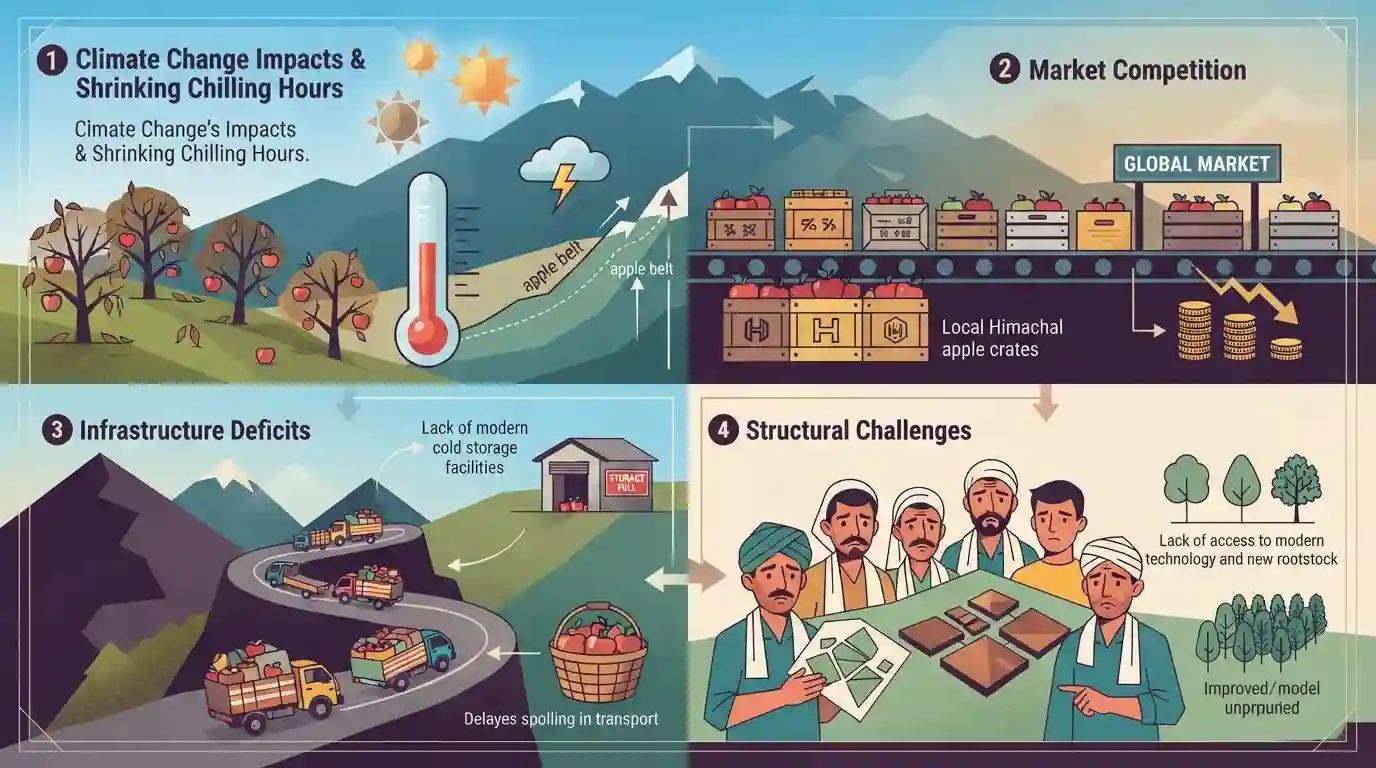
The article discusses the structural and environmental challenges confronting Himachal Pradesh's apple economy, highlighting how climate change, shrinking chilling hours, market competition, and infrastructure deficits are undermining the state's premier horticultural sector.
Key Points
- Himachal Pradesh's apple economy is facing severe challenges including climate change, shifting weather patterns, and reduced chilling hours critical for apple cultivation.
- Competitiveness is impacted by global imports, lack of adequate modern cold storage infrastructure, and marketing issues faced by local orchardists.
- There is an urgent need for crop diversification, adoption of high-density orcharding, and improved policy support to sustain the state's horticultural backbone.
Important Terms
Chilling Hours

The number of cumulative winter hours with temperatures below 7°C, which are critical for breaking apple bud dormancy and ensuring normal flowering and fruit set.
UPSC context
HPAS GS Paper III (Agriculture & Environment): Tests understanding of climate change impacts on horticulture and changing agro-climatic requirements in hilly regions.
Altitudinal Shift of Orchards
The gradual upward migration of apple orchards from lower and mid-hills (1,200–1,500m) to higher altitudes (above 2,000m) in search of colder temperatures.
UPSC context
HPAS GS Paper I (Geography) & Paper III (Economy): Tests spatial adaptation strategies of hill agriculture under global warming pressures.
Himachal Pradesh Horticulture Development Project (HPHDP)
A major multi-lateral initiative launched to modernize Himachal Pradesh's fruit industry through improved planting material, cold-chain infrastructure, and market linkages.
UPSC context
HPAS GS Paper III (State Economy & Schemes): Evaluates institutional interventions and World Bank-assisted projects in transforming regional horticulture.
Prelims Trap
Global warming has increased the required chilling hours for traditional apple varieties in Himachal Pradesh.
Traditional varieties need 1,200-1,600 hours, but warming has dropped this to 500-600 hours, forcing the shift—not increasing it.
Static Concepts Connected
What are the major agro-climatic zones and horticultural belts of Himachal Pradesh?
- Sub-tropical Zone: Zone I (Sub-tropical, sub-mountain): Low hills suited for citrus, mango, and litchi cultivation.
- Temperate Mid-Hills: Zone II (Sub-temperate to temperate wet): Mid-hills ideal for stone fruits and early apple varieties.
- Alpine Dry Zone: Zone III (Temperate dry to alpine): High-altitude belts including Kinnaur and Lahaul-Spiti famous for high-quality late apples.
Cross-Topic Patterns
Horticulture Shifting + Himalayan Ecology
Climate shifts pushing apple cultivation to higher altitudes mirrors traditional nomadic migration patterns and hydro-project ecological pressures across the fragile Himalayan belt.
Agri-Infrastructure Deficit + Supply Chain Bottlenecks
The 68% cold-storage deficit directly exposes how inadequate post-harvest supply chain infrastructure defeats national Agri-Export Zone and PM-KISAN objectives at the state level.

Expect statements linking climate chilling-hour deficits in mid-hills to altitudinal shifts in apple belts and high-density planting.
Linked PYQs · 3
Linked PYQs · 3
- 2024HPAS_PRELIMSGS1
Arrange the following climatic zones of Himachal Pradesh according to rainfall amount from lowest to highest : (1) Frigid aridic zone (2) Wet temperate zone (3) Humid sub-tropical zone (4) Sub-humid sub-tropical zone Choose the correct answer from the options given below :
- 2023HPAS_PRELIMSGS1
Consider the following statements : (1) The rainiest district in Himachal Pradesh is Kangra. (2) Rainfall in the Alpine region of Himachal Pradesh varies between 300-600 mm. (3) Winter season in Himachal Pradesh extends from October to March. (4) Mandi is the hottest place in Himachal Pradesh. Choose the correct answer from the options given below :
- 2024HPAS_PRELIMSGS1
Consider the following statements : (1) Travancore agrobiodiversity Hot spot pertain to Rajasthan. (2) Konkan agrobiodiversity Hot spot is in Maharashtra and Goa. (3) National Herbarium of cultivated plants is at New Delhi. (4) Triveni agrobiodiversity Hot spot pertain to Assam. Choose the correct answer from the options given below :
