West Bengal land clearance for BSF border outposts
Source:The Hindu ↗
কেন এটি গুরুত্বপূর্ণ
It underscores the practical aspects of India's border management strategies, the role of Central Armed Police Forces (CAPFs), and the interplay of Centre-State relations when dealing with national security threats stemming from neighboring political instability.
সারসংক্ষেপ
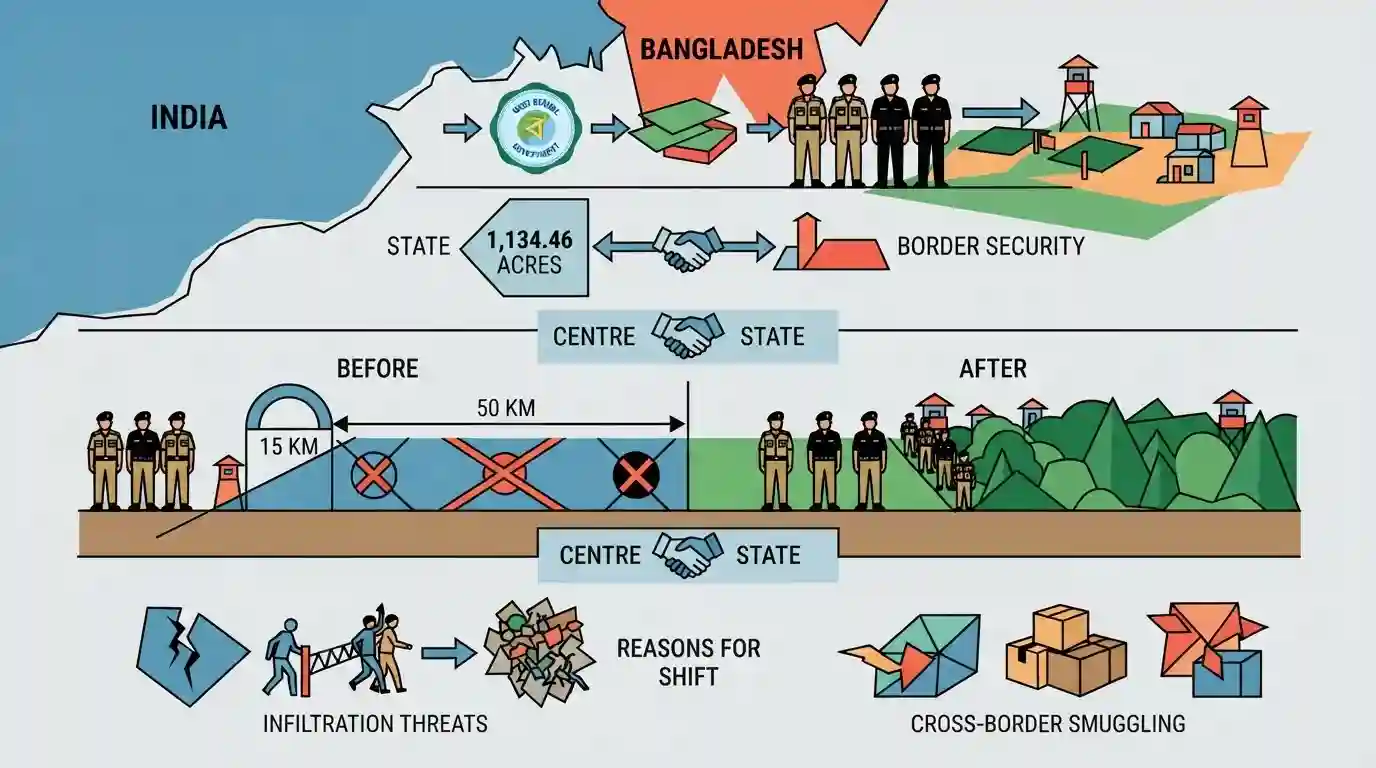
The West Bengal government recently cleared the transfer of 1,134.46 acres of land to the Border Security Force (BSF) to establish border outposts (BOPs) along the India-Bangladesh border. This decision signifies a notable shift, given the Trinamool Congress government's previous strong opposition to the 2021 expansion of BSF's jurisdiction from 15 km to 50 km within the state. The move is prompted by rising internal security concerns, including increased threats of infiltration and cross-border smuggling, following the political instability and ouster of the Sheikh Hasina government in neighboring Bangladesh. The land transfer reflects a pragmatic approach to Centre-State relations concerning critical national security and border management issues.
মূল বিষয়
- The West Bengal government recently approved the transfer of over 1,134 acres of land to the Border Security Force (BSF) for setting up border outposts (BOPs).
- This move marks a shift in the state's stance, as the TMC government had previously opposed the Centre's 2021 decision to expand the BSF's operational jurisdiction from 15 km to 50 km inside state borders.
- The land clearance is driven by heightened security concerns following the fall of the Sheikh Hasina government in Bangladesh, which increased risks of cross-border infiltration and smuggling.
- Establishing new BOPs will strengthen border management, curb human trafficking, and check cross-border crimes along the porous eastern frontier.
- The decision illustrates the dynamic nature of Centre-State relations in India, where political differences are set aside for imperative national and internal security interests.
গুরুত্বপূর্ণ শব্দ
Border Security Force (BSF)

A Central Armed Police Force (CAPF) established in 1965 under the Ministry of Home Affairs. It serves as India's primary border guarding organization, securing the international borders with Pakistan and Bangladesh against trans-border crimes and infiltration.
UPSC context
GS Paper 3 (Internal Security); tests knowledge of CAPF mandates, border management strategies, and India's security architecture.
Ministry of Home Affairs (MHA)
The central government ministry responsible for India's internal security, domestic policy, and border management. It exercises administrative control over Central Armed Police Forces and plays a key role in managing Centre-State relations.
UPSC context
GS Paper 2 & 3; crucial for understanding India's internal security governance, federal dispute mechanisms, and CAPF administration.
Border Outposts (BOPs)
Permanent, self-contained operational bases established along international borders. Manned by border guarding forces, they provide crucial infrastructure for surveillance, anti-smuggling patrols, and rapid response operations to deter trans-border criminals and infiltrators.
UPSC context
GS Paper 3 (Border Management); tests understanding of border infrastructure, surveillance networks, and anti-infiltration strategies.
BSF Jurisdiction Expansion
A 2021 MHA notification that increased the BSF's area of operation from 15 km to 50 km inside the borders of Punjab, West Bengal, and Assam to counter modern smuggling threats, prompting debates over federalism.
UPSC context
GS Paper 2 & 3; tests Centre-State relations, the constitutional distribution of police powers, and border security policies.
প্রিলিমস ফাঁদ
The expansion of BSF jurisdiction grants the force exclusive policing and investigative powers within 50 km of the border.
BSF jurisdiction is concurrent, not exclusive. Crucially, the BSF cannot register FIRs or investigate cases; apprehended suspects and seized contraband must be handed over to the local state police.
সংযুক্ত স্থির ধারণা
How is the jurisdiction of the Border Security Force (BSF) determined?
- Statutory backing: Governed by the BSF Act, 1968, which empowers the Central Government to notify and modify the operational limits of the force without requiring state consent.
- Concurrent powers: The BSF possesses powers of search, seizure, and arrest within its jurisdiction, operating concurrently alongside the state police machinery.
- Border mandate: Under the 'One Border, One Force' policy, the BSF is exclusively responsible for the Indo-Pakistan and Indo-Bangladesh borders.
How does CIBMS secure complex, riverine borders?
- Smart fencing: Replaces unviable physical fences with an invisible electronic wall using thermal imagers, infrared sensors, and radars in difficult terrains like riverine stretches.
- BOLD-QIT: Project BOLD-QIT (Border Electronically Dominated QRT Interception Technique) is a key CIBMS component, acting as a virtual fence on rivers like the Brahmaputra.
আন্তঃবিষয় প্যাটার্ন
Regime change altering border policies
Political instability in Bangladesh echoes the Myanmar coup, where domestic upheaval forced India to harden borders, deploy technology, and alter local frameworks like the Free Movement Regime (FMR).
Federal friction over internal security
Jurisdictional overlap between CAPFs and state police links to broader GS2 themes on the centralisation of the security apparatus, mirroring debates around the NIA's expanding mandate.

Expect a GS3 Mains question linking neighbourhood political instability (Bangladesh/Myanmar) to India's border management strategies.
সংযুক্ত PYQ · 4
সংযুক্ত PYQ · 4
- 2015WBCS_PRELIMSGS1
West Bengal has international boundaries on
- 2020WBCS_PRELIMSGS1
How many Indian States have touched the border of West Bengal?
- 2024WBCS_PRELIMSGS1
Which of the following correctly describes the relationship between the Union and the States under the Constitution of India?
- 2022WBCS_PRELIMSGS1
The 'Radcliffe Line' lies between
