US Deployment of Space Capabilities and Weaponization Risks
Source:The Hindu ↗
हे का महत्त्वाचे आहे
Understanding the weaponization and militarization of space is critical for analyzing modern geopolitics, international security, defense strategy, and the evolution of global space governance frameworks.
सारांश
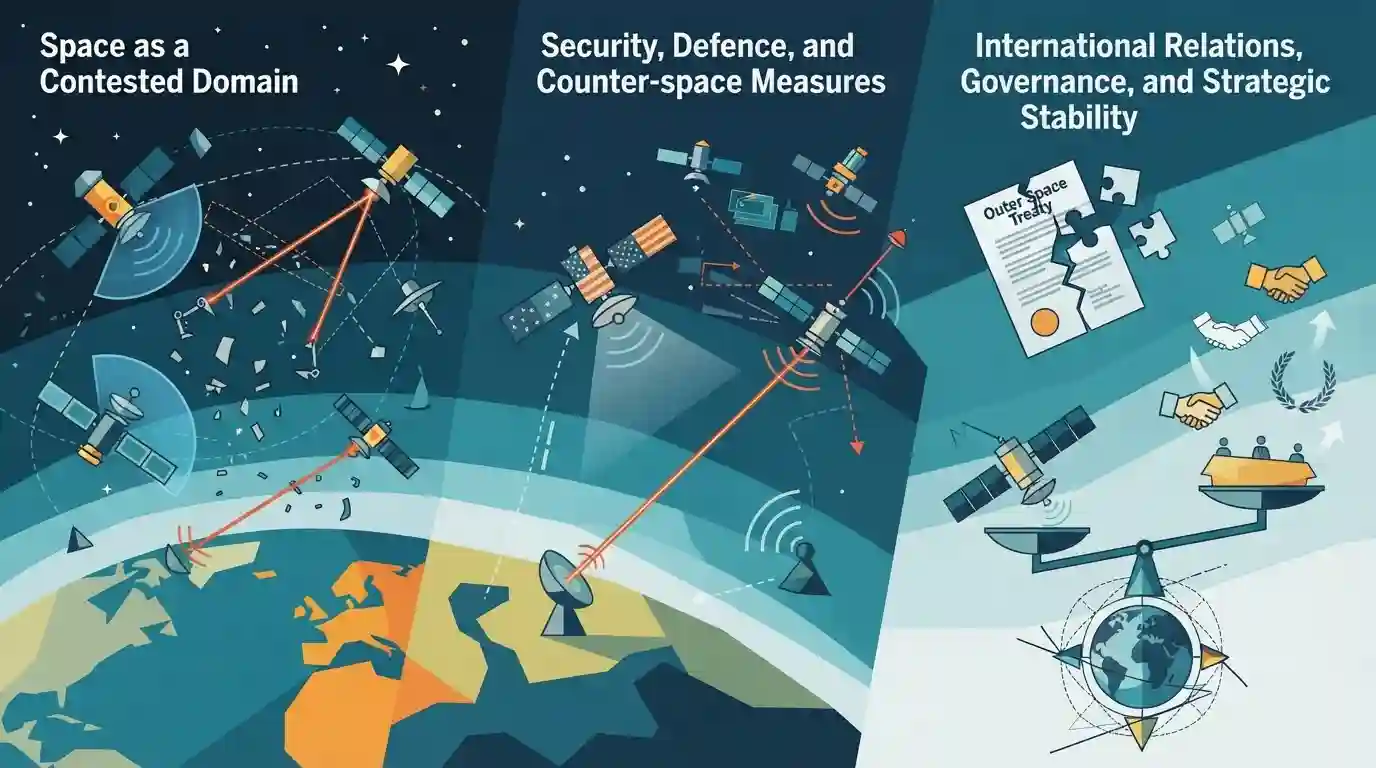
The article explains the context, rationale, and implications behind the deployment of capabilities and counter-space measures by the United States in space. It explores how outer space is transforming into a contested operational domain, raising concerns about international legal frameworks like the Outer Space Treaty and global strategic stability.
मुख्य मुद्दे
- The U.S. deployment of capabilities or counter-space measures in orbit highlights the growing weaponization of space.
- Outer Space Treaty of 1967 governs the peaceful use of celestial bodies and prohibits weapons of mass destruction in orbit, but leaves grey areas regarding conventional or electronic warfare capabilities.
- Space assets have become critical infrastructure for modern communication, navigation, intelligence, and military operations, making them prime strategic targets.
- The increasing militarization of space poses severe implications for global strategic stability and escalates the risk of a space arms race.
महत्त्वाच्या संज्ञा
Outer Space Treaty

A 1967 international treaty establishing the foundational principles of space law, which bans the placement of nuclear and weapons of mass destruction in orbit and mandates that celestial bodies be used solely for peaceful purposes.
UPSC context
UPSC GS Paper-II (International Relations/Global Governance) and GS Paper-III (Security & Defence): evaluates international legal frameworks governing space security.
U.S. Space Force
The sixth branch of the United States Armed Forces, established in 2019 to protect U.S. interests in space, deter aggression, and conduct counter-space and operational missions in an increasingly militarized domain.
UPSC context
UPSC GS Paper-III (Security and Defence / Science & Technology): tests understanding of space weaponization, militarization of outer space, and shifting global strategic dynamics.
United Nations
An international organization established in 1945 to maintain global peace and security, whose bodies like UNCOPUOS formulate multilateral space laws and advocate for the peaceful, sustainable use of outer space.
UPSC context
UPSC GS Paper-II (International Relations / International Bodies): tests the role of multilateral institutions in global governance, disarmament, and space regulations.
संबंधित स्थिर संकल्पना
What are the core legal obligations and loopholes under the 1967 Outer Space Treaty?
- WMD Ban: Article IV explicitly bans placing nuclear weapons or WMDs in Earth's orbit or on celestial bodies.
- Celestial Bodies: The treaty restricts the Moon and other celestial bodies exclusively to peaceful purposes, while being less absolute regarding Earth orbit.
- Legal Loophole: It does not ban conventional weapons, electronic jamming, or kinetic ASAT missiles, creating a major legal loophole.
आंतर-विषय नमुने
Space Security + International Disarmament Law
The weaponization of orbital domains challenges traditional sovereignty principles and weapon-of-mass-destruction-only disarmament frameworks like the Outer Space Treaty.

Outer Space Treaty loopholes + ASAT weaponization likely tested in a multi-statement prelims question on arms control law.
