Astrophysics Debates and Scientific Validation of Dark Matter
Source:The Hindu ↗
Why It Matters
The search for dark matter is one of the most profound quests in modern physics. For UPSC aspirants, understanding the fundamental concepts of the universe (like dark matter, dark energy, and gravitational waves) is crucial for the Science & Technology section of GS Paper 3, as well as Prelims. Knowing why scientific discoveries face rigorous scrutiny highlights the process of scientific validation and global scientific collaboration.
Summary
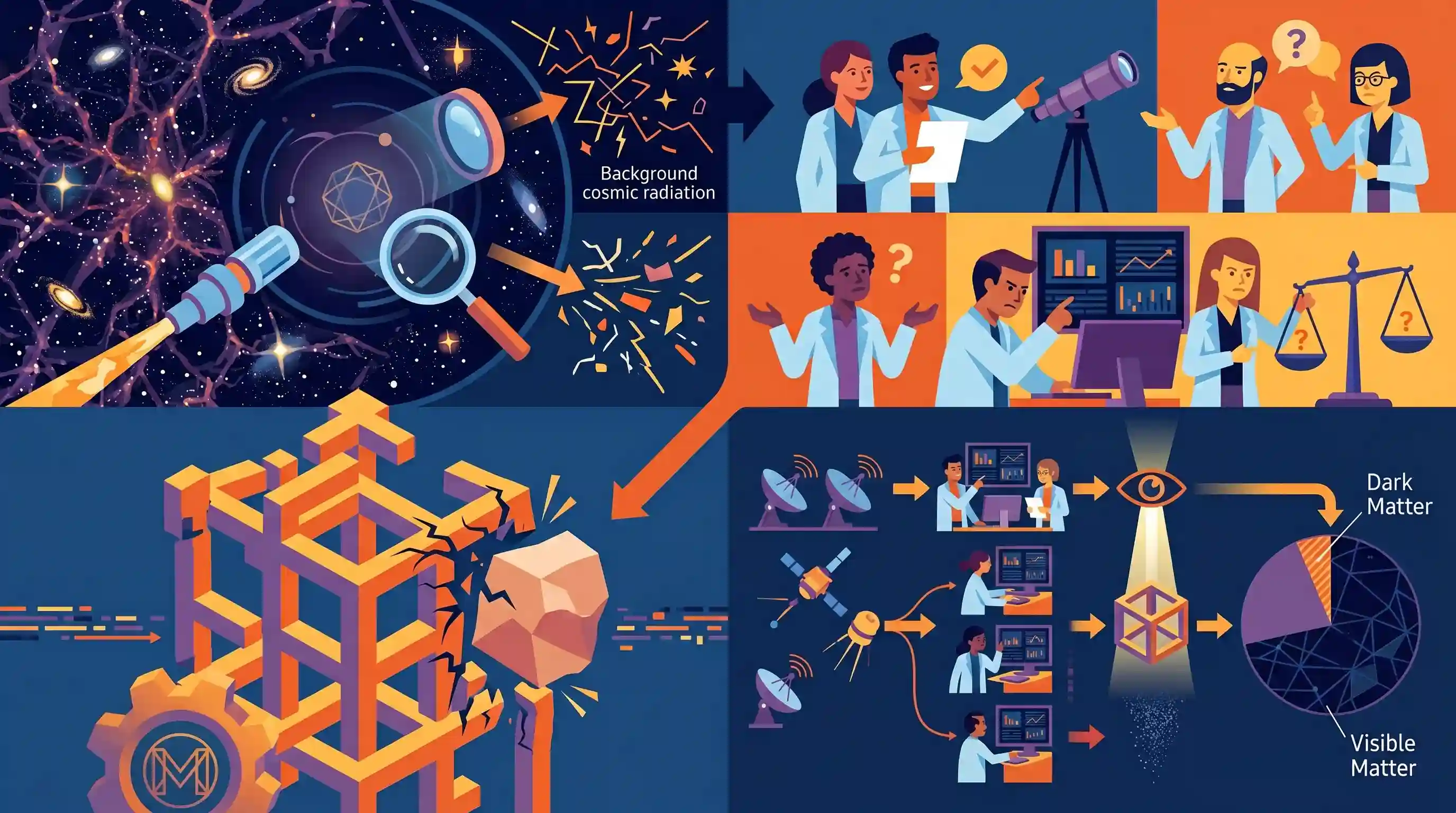
The article explores recent scientific claims regarding the possible discovery of dark matter and details why the international astrophysics community has responded with caution and debate. It highlights the immense difficulty in separating potential dark matter signals from background cosmic radiation, pointing to the stringent requirements for independent verification. Furthermore, it touches upon how such a groundbreaking discovery would challenge the current Standard Model of particle physics, emphasizing the rigorous scientific process required before confirming a phenomenon that constitutes a major portion of the universe's mass.
Key Points
- Dark matter makes up roughly 27% of the universe's mass-energy composition but remains completely invisible because it does not interact with the electromagnetic force.
- Recent claims of detecting a definitive dark matter signature have sparked debate and skepticism among the global astrophysics community.
- The caution stems from methodological challenges, background cosmic noise that often mimics dark matter signals, and the historical precedent of false positives in detecting Weakly Interacting Massive Particles (WIMPs).
- Scientific rigor demands independent corroboration from multiple, distinct observatories before a discovery of this magnitude can be formally accepted.
- A confirmed dark matter discovery would fundamentally transform cosmology and necessitate significant extensions to the Standard Model of particle physics.
Important Terms
Dark Matter

A hypothetical, invisible form of matter that does not emit or reflect light, making up roughly 27% of the universe and detectable only through its gravitational pull on visible objects.
UPSC context
GS Paper III (Science & Technology); critical for cosmology topics and understanding the universe's composition beyond ordinary matter.
Standard Model of Particle Physics
The theoretical framework describing all known elementary particles and three fundamental forces (electromagnetic, weak, and strong), excluding gravity and failing to account for dark matter or dark energy.
UPSC context
GS Paper III (S&T); represents the frontier of particle physics and tests the completeness of modern scientific theories.
Weakly Interacting Massive Particles (WIMPs)
Hypothetical subatomic particles that are leading candidates for dark matter; they interact only through gravity and the weak nuclear force, making them extremely difficult to detect.
UPSC context
GS Paper III (S&T); central to discussions on dark matter detection experiments like XENON1T or Fermi-LAT observations.
Baryonic Matter
Ordinary matter composed of protons and neutrons (atoms) that makes up stars, planets, and humans; it accounts for only about 5% of the total mass-energy of the universe.
UPSC context
GS Paper III (S&T); used to distinguish between visible and invisible matter in astrophysical studies.
Cosmic Microwave Background (CMB)
The faint, relic electromagnetic radiation remaining from the early universe (Big Bang) that fills all space and provides a snapshot of the cosmos's infancy.
UPSC context
GS Paper III (S&T); foundational evidence for the Big Bang theory and a tool for mapping dark matter distribution.
Gravitational Lensing
A phenomenon where a massive object's gravity bends light from a distant source behind it, acting as a cosmic magnifying glass to reveal invisible mass like dark matter.
UPSC context
GS Paper III (S&T); a primary observational method for inferring the presence and distribution of dark matter in space.
Prelims Trap
"Dark matter drives the accelerated expansion of the universe and interacts with electromagnetic radiation."
Dark energy drives the accelerated expansion of the universe, while dark matter exerts a gravitational pull holding galaxies together. Furthermore, dark matter does not interact with electromagnetic forces.
Static Concepts Connected
How does dark matter interact with the fundamental forces?
- Electromagnetic Force: Dark matter does not interact with it, meaning it neither emits, absorbs, nor reflects light, making it completely invisible to standard telescopes.
- Gravitational Force: It interacts primarily via gravity. Its presence is inferred through gravitational lensing, where its massive gravity bends light from background galaxies.
- Weak Nuclear Force: Theoretical candidates like WIMPs (Weakly Interacting Massive Particles) are hypothesized to interact via the weak nuclear force, which is how scientists hope to detect them.
What are the key limitations of the Standard Model of Particle Physics?
- Missing Gravity: The model successfully describes electromagnetic, weak, and strong nuclear forces, but completely fails to incorporate gravity (General Relativity).
- Ignores Dark Universe: It only accounts for ordinary observable matter (approx. 5% of the universe), offering no elementary particle candidate for dark matter or dark energy.
- Neutrino Mass: The model originally assumed neutrinos were massless, but neutrino oscillation discoveries proved they have a tiny mass, requiring model extensions.
Cross-Topic Patterns
Space observation: Waves vs. Lensing
UPSC frequently tests observation tech. Gravitational waves (LIGO) measure ripples in spacetime from massive collisions, whereas gravitational lensing maps invisible dark matter by observing bent background light.
Deep space observatories and Indian missions
The search for dark matter candidates directly connects to the deployment of advanced space telescopes like JWST and India's own astrophysics observatories (e.g., AstroSat and its successors).

Expect a 2026 multi-statement question contrasting the gravitational pull of Dark Matter with the repulsive expansion of Dark Energy.
Linked PYQs · 3
Linked PYQs · 3
- 2022MainsGS3
Launched on 25th December, 2021, James Webb Space Telescope has been much in the news since then. What are its unique features which make it superior to its predecessor Space Telescopes ? What are the key goals of this mission ? What potential benefits does it hold for the human race?
- 2023PrelimsGS1
Consider the following pairs: Objects in space Description 1. Cepheids: Giant clouds of dust and gas in space 2. Nebulae: Stars which brighten and dim periodically 3. Pulsars: Neutron stars that are formed when massive stars run out of fuel and collapse How many of the above pairs are correctly matched?
- 2019PrelimsGS1
Recently, scientists observed the merger of giant 'blackholes' billions of light-years away from the Earth. What is the significance of this observation?
