Direct benefit transfer reforms for agricultural fertilizer subsidies
Source:Indian Express ↗
Why It Matters
The transition from price subsidies to DBT in agriculture is a classic GS3 theme. It highlights governance reforms to plug leakages, enhance subsidy targeting, and improve the overall efficiency of public expenditure in the farm sector.
Summary
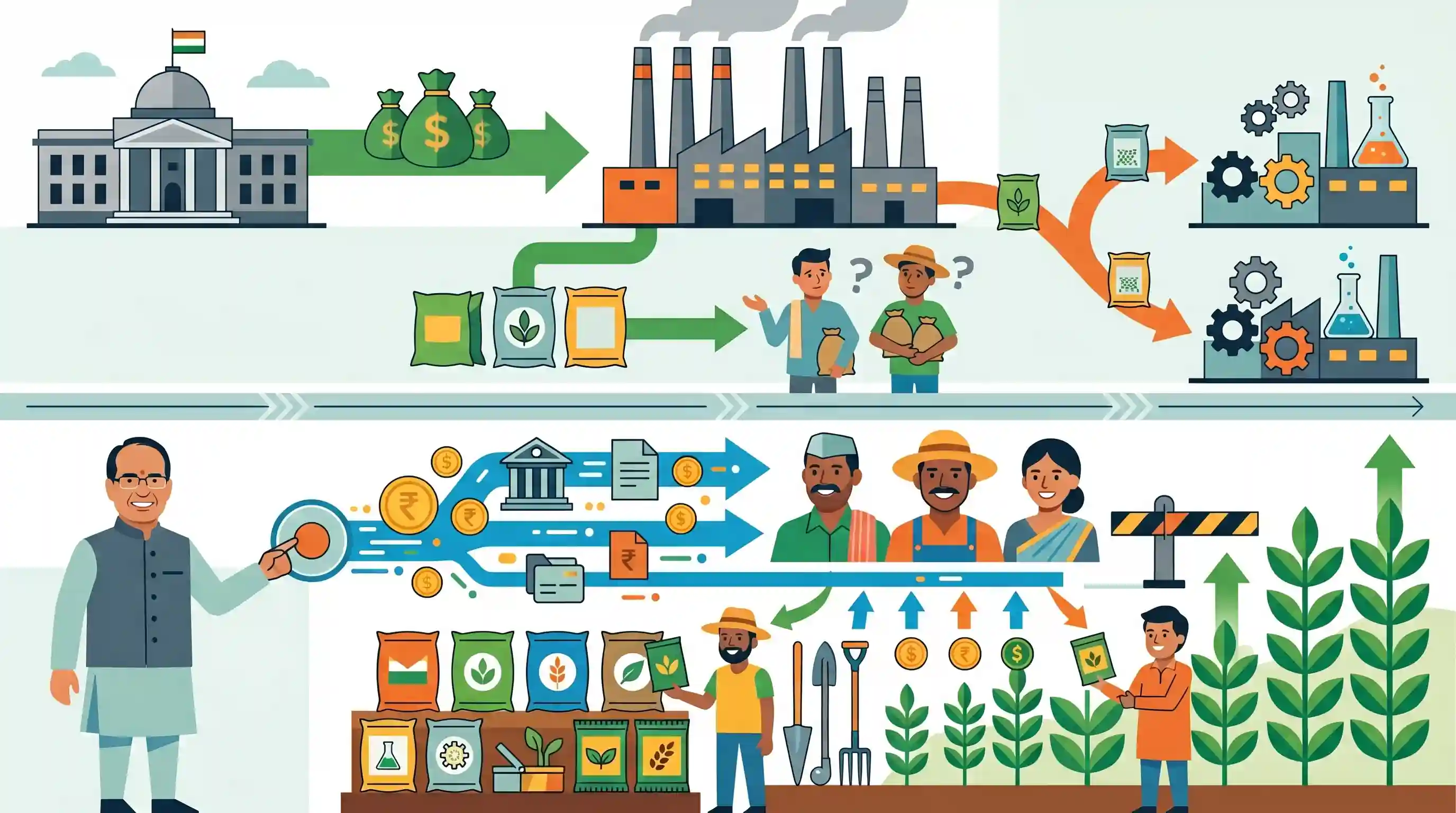
Union Agriculture Minister Shivraj Singh Chouhan has suggested moving away from the current system of paying fertiliser subsidies to manufacturing companies, advocating instead for a Direct Benefit Transfer (DBT) directly to farmers. This proposed reform aims to empower farmers with purchasing choices, improve the efficiency of subsidy targeting, and prevent the illegal diversion of subsidised fertilisers (such as urea) to industrial sectors. The transition from indirect price subsidies to direct income support for farmers has been a long-standing recommendation for agricultural and fiscal reform in India.
Key Points
- Union Agriculture Minister Shivraj Singh Chouhan proposed transitioning the fertiliser subsidy mechanism to a Direct Benefit Transfer (DBT) model.
- Under the proposed DBT system, the subsidy amount would be transferred directly to farmers' bank accounts rather than being paid to fertiliser companies.
- The move is intended to empower farmers, giving them the choice to buy fertilizers based on their specific needs and preferences.
- Implementing DBT for fertilisers aims to reduce leakages, curb the diversion of subsidised agricultural urea for industrial purposes, and improve fiscal targeting.
Important Terms
Direct Benefit Transfer (DBT)

A mechanism transferring government subsidies directly to beneficiaries' bank accounts via Aadhaar-linked IDs. In fertilizers, proposed reforms aim to shift payments from manufacturing companies directly to farmers.
UPSC context
GS-3: Farm subsidies and e-technology. Essential for understanding fiscal reforms, leakages, and digital governance in the agricultural sector.
Fertilizer Subsidy
Financial aid bridging the gap between high production/import costs and low regulated prices for farmers. It is India's second-largest fiscal expenditure after food subsidies.
UPSC context
GS-3: Direct and indirect farm subsidies. Tests knowledge of fiscal burden, food security, and government budgeting priorities.
Urea Diversion
The illegal use of subsidized agricultural urea in industrial sectors (e.g., chemicals, plywood). This causes fiscal leakages and artificial shortages for farmers.
UPSC context
GS-3: Challenges in subsidy targeting. Tests understanding of policy failures and the need for neem-coating or DBT interventions.
Nutrient-Based Subsidy (NBS)
A policy providing a fixed subsidy per kilogram based on nutrient content (N, P, K, S). While P&K fertilizers are covered, urea remains under price control.
UPSC context
GS-3: Soil health and farm inputs. Relevant for discussing imbalanced NPK ratios and the need for urea pricing reforms.
AgriStack
A digital infrastructure comprising a national farmers' registry, land records, and crop-sown data. It facilitates precise, data-driven delivery of services and subsidies.
UPSC context
GS-2/GS-3: E-governance and technology in aid of farmers. Crucial for discussing modernization of agricultural administration and transparency.
Prelims Trap
"Under the current DBT scheme for fertilizers, the subsidy amount is transferred directly to the farmer's bank account."
The current 'DBT' in fertilizers (since 2018) is a partial model. Subsidies are paid to manufacturing companies after Aadhaar-authenticated sales, not to farmers' bank accounts.
Static Concepts Connected
How does the Nutrient Based Subsidy (NBS) differ from the Urea subsidy regime?
- Urea (Non-NBS): It remains heavily price-controlled. The government fixes a low Maximum Retail Price (MRP), reimbursing manufacturers for the higher cost of production.
- P&K fertilizers (NBS): Subsidy is fixed per kg of nutrient (N, P, K, S). MRP is deregulated, allowing companies to price it based on market dynamics minus the fixed subsidy.
Why was 100% Neem-coated Urea mandated and why does diversion persist?
- Original Objective: It acts as a nitrification inhibitor, slowing nitrogen release to improve crop uptake efficiency and initially making it unfit for industrial use.
- Persistent Diversion: The massive price gap between subsidized agricultural urea and market rates incentivizes industries (like plywood) to chemically 'de-coat' the urea for illicit use.
Cross-Topic Patterns
Fertilizer subsidies and soil desertification
Heavily subsidized urea skews the N:P:K ratio (11:4:1 vs ideal 4:2:1), directly linking a fiscal price-control policy to long-term environmental degradation and groundwater nitrate pollution.
PM-KISAN as a template for True DBT
Transitioning to cash-based fertilizer DBT will likely piggyback on the PM-KISAN database and JAM trinity infrastructure to identify legitimate farmers and execute direct cash transfers.

Expect a multi-statement prelims question contrasting the current 'PoS-based company subsidy' with NBS mechanism and its impact on the NPK ratio.
Linked PYQs · 2
Linked PYQs · 2
- 2015MainsGS3
In what way could replacement of price subsidy with Direct Benefit Transfer (DBT) change the scenario of subsidies in India ? Discuss.
- 2023MainsGS3
What are the direct and indirect subsidies provided to farm sector in India? Discuss the issues raised by the World Trade Organization (WTO) in relation to agricultural subsidies.
