GDP Calculation Methodology Revision and Producer Price Index
Source:Indian Express ↗
આ શા માટે મહત્વનું છે
Understanding changes in GDP calculation methodology, PPI, and double deflation is critical for analyzing macroeconomic indicators, fiscal policy planning, and economic growth data in India.
સારાંશ
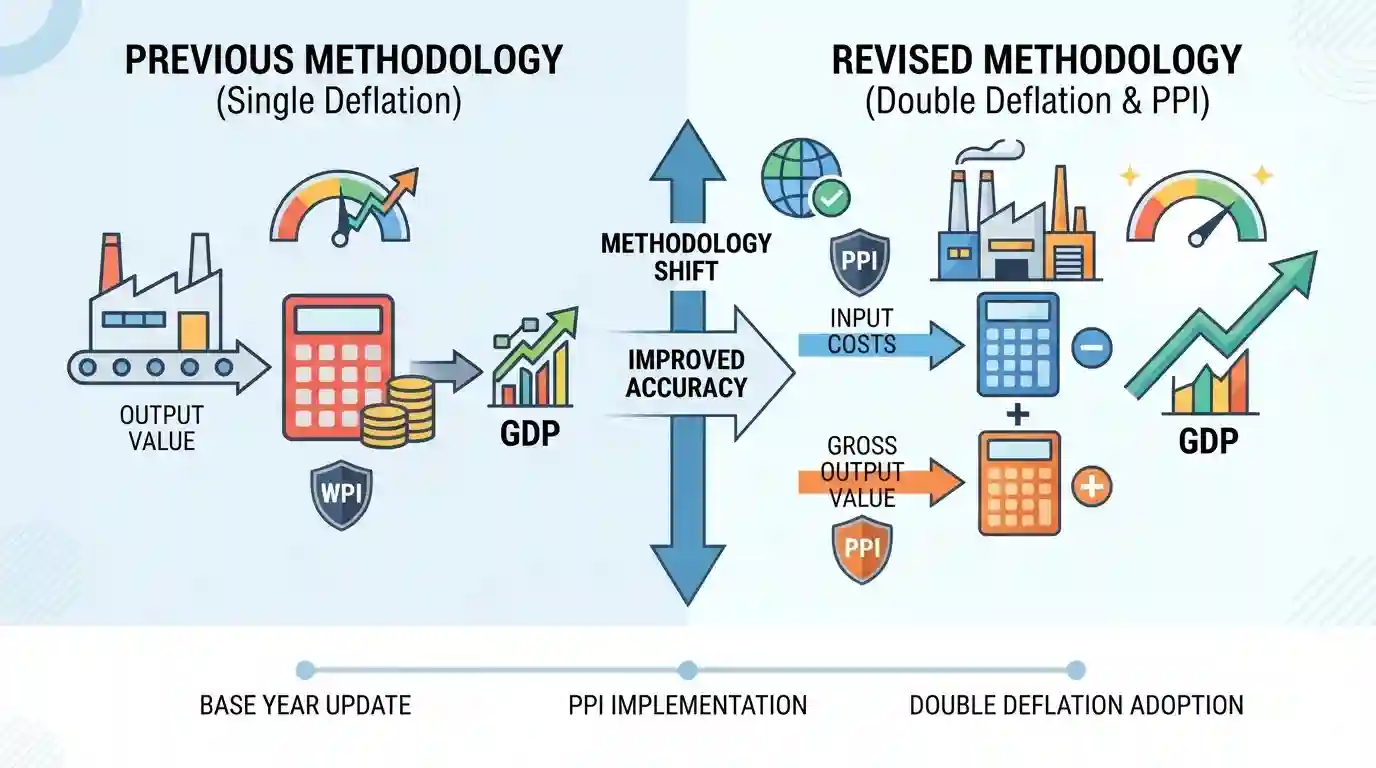
The article explains proposed changes in India's Gross Domestic Product (GDP) data revision methodology, focusing on the shift towards Producer Price Index (PPI) and the implementation of double deflation. These changes aim to improve the accuracy of measuring real value addition and economic growth by accounting for input costs separately from output values, aligning India with global standards.
મુખ્ય મુદ્દા
- India is considering major revisions to its GDP calculation methodology, including the adoption of the Producer Price Index (PPI) and double deflation techniques.
- The Producer Price Index (PPI) tracks price changes from the perspective of producers/manufacturers rather than consumers, avoiding distortions caused by taxes, subsidies, and retail margins.
- Double deflation involves separately deflating gross output and intermediate consumption using specific price indices to compute accurate real value addition.
- These proposed methodological changes aim to align India's national accounts with global best practices, leading to more accurate macroeconomic and growth tracking.
મહત્વપૂર્ણ શબ્દો
Double Deflation

A statistical method used in GDP estimation where intermediate inputs and total output are deflated separately using specific price indices to measure real value addition accurately.
UPSC context
UPSC GS Paper III (Indian Economy): Tests understanding of GDP computation methodology, national income accounting, and economic growth measurement.
Producer Price Index PPI
An index measuring the average change in prices received by domestic producers for their output at the factory gate, excluding taxes and trade margins.
UPSC context
UPSC GS Paper III (Indian Economy): Essential for topics related to inflation indices, data revision, and macroeconomic indicators.
Ministry of Statistics and Programme Implementation MoSPI
The nodal ministry responsible for the collection, compilation, and dissemination of official macroeconomic statistics, including national accounts and GDP estimates in India.
UPSC context
UPSC GS Paper III (Indian Economy): Important for institutional framework of economic planning and statistical data governance.
Reserve Bank of India
India's central banking institution that controls monetary policy, regulates the banking system, and manages currency reserves and price stability.
UPSC context
UPSC GS Paper III (Indian Economy): Crucial for monetary policy, inflation targeting, and financial sector regulation.
પ્રિલિમ્સ ટ્રેપ
PPI is identical to WPI with a different name, tracking wholesale commodity prices including indirect taxes and distribution margins.
Aspirants often confuse PPI with WPI or CPI. Unlike WPI, PPI includes services and excludes indirect taxes/trade margins at the factory gate.
સંલગ્ન સ્થિર ખ્યાલો
What is the difference between Single Deflation and Double Deflation in national accounts?
- Single Deflation: Single deflation applies one price index (like WPI) to both gross output and intermediate inputs to find real GVA.
- Double Deflation: Double deflation separately deflates gross output and intermediate consumption using specific distinct indices, accurately capturing changing input-output margins.
- Distortion Correction: It prevents distortions during supply shocks when input costs and output prices diverge sharply.
How does the Producer Price Index (PPI) differ from the Wholesale Price Index (WPI) and CPI?
- Factory Gate Pricing: Factory gate pricing measures prices received by domestic producers, excluding retail/wholesale trade margins and transportation costs.
- Service Sector Coverage: Unlike WPI, PPI explicitly includes service sector output in addition to manufacturing and mining.
- Net Taxes Excluded: Excludes taxes and subsidies, tracking pure producer price movements rather than market prices.
આંતર-વિષય પેટર્ન
National Accounts Revision & Macroeconomic Management
Changes in base years and statistical methodologies directly impact fiscal deficit ratios, debt-to-GDP metrics, and RBI's inflation targeting parameters.
GDP Methodology & Global Statistical Standards
Adopting UN System of National Accounts (SNA) recommendations brings India closer to OECD standards, strengthening international credit ratings and FDI analytics.

MoSPI's shift to PPI and double deflation is ripe for a multi-statement conceptual prelims question or a mains critique on GVA accuracy.
સંલગ્ન PYQ · 1
સંલગ્ન PYQ · 1
- 2021MainsGS3
Explain the difference between computing methodology of India's Gross Domestic Product (GDP) before the year 2015 and after the year 2015.
