GDP Calculation Methodology Revision and Producer Price Index
Source:Indian Express ↗
Why It Matters
Understanding GDP revisions, PPI, and double deflation is critical for aspirants studying macroeconomic indicators, national income accounting, and inflation measurement methodologies in India.
Summary
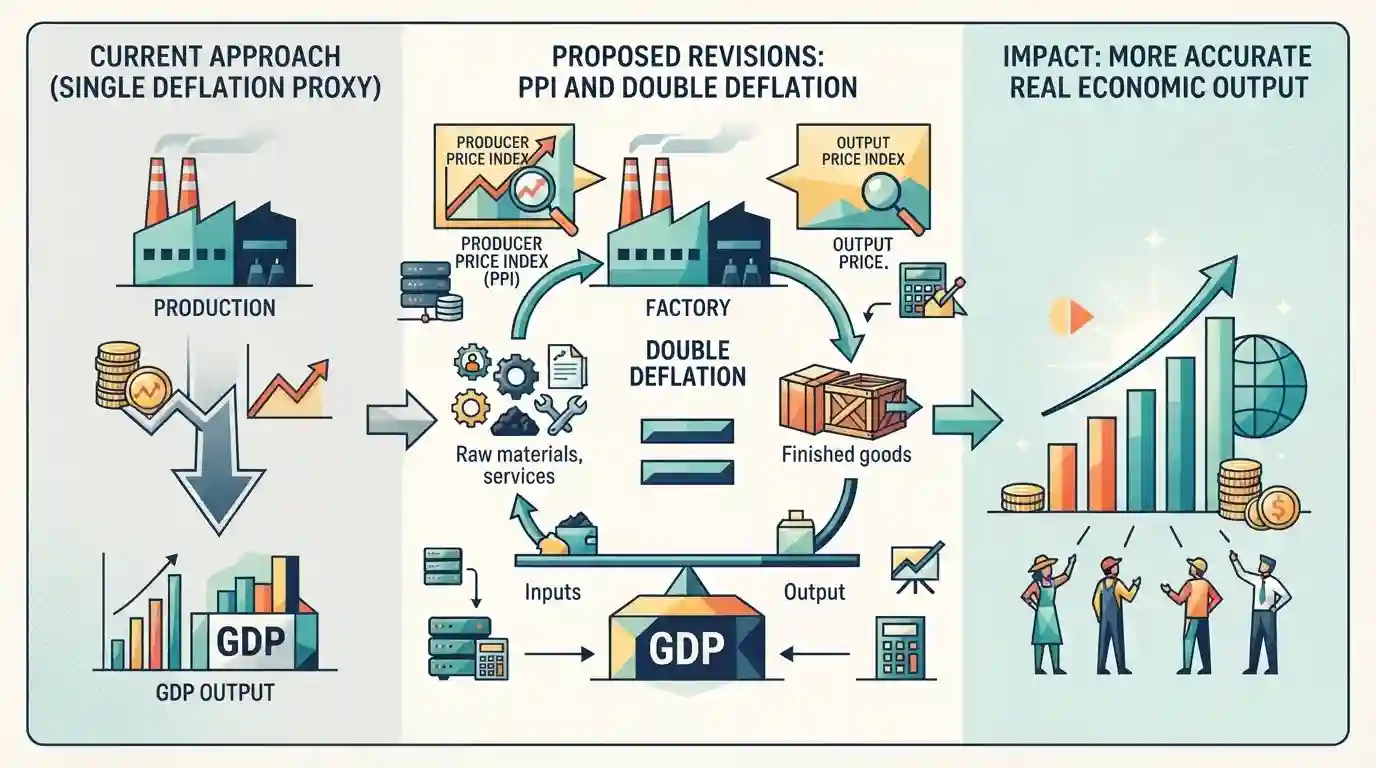
The article discusses proposed structural and methodological revisions to India's Gross Domestic Product (GDP) data computation, including the shift towards a Producer Price Index (PPI) and the implementation of double deflation techniques to measure real economic output more accurately.
Key Points
- India is considering major revisions to its GDP data computation methodology, focusing on accuracy in measuring economic growth.
- The introduction of the Producer Price Index (PPI) is proposed to replace or complement the Wholesale Price Index (WPI) to better capture price movements at the factory/producer level.
- Double deflation technique is being evaluated for computing real GDP by separately deflating gross output and intermediate consumption, improving accuracy compared to single deflation.
- These changes aim to address statistical discrepancies, account for structural transformation in the economy, and align national accounts with global best practices.
Important Terms
Producer Price Index

An index that measures the average change over time in the prices received by domestic producers for their output, capturing factory-gate prices excluding indirect taxes and trade margins.
UPSC context
UPSC GS Paper III (Indian Economy): Important for topics related to inflation measurement, GDP compilation, and economic reforms.
Wholesale Price Index
An index that tracks the changes in the price of goods sold and traded in bulk by wholesale markets, historically used in India to measure inflation.
UPSC context
UPSC GS Paper III (Indian Economy): Tests understanding of inflation indices, monetary policy inputs, and macroeconomic indicators.
Reserve Bank of India
India’s central banking institution which controls monetary policy, currency issuance, and regulates the banking system to ensure price stability alongside economic growth.
UPSC context
UPSC GS Paper III (Indian Economy): Essential for monetary policy, financial sector regulation, and central banking functions.
Ministry of Statistics and Programme Implementation
The nodal central ministry responsible for coordinating statistical activities in India, overseeing the collection, compilation, and dissemination of macroeconomic data like GDP and inflation.
UPSC context
UPSC GS Paper III (Indian Economy): Key institutional body for national income accounting, data reliability, and statistical governance.
Static Concepts Connected
What is the difference between Single Deflation and Double Deflation in National Accounts?
- Single Deflation:: Only gross output is deflated using a single price index to arrive at real GVA, assuming input and output prices move in tandem.
- Double Deflation:: Both gross output and intermediate consumption (inputs) are separately deflating using specific price indices, yielding a much more accurate real GVA measure.
- Major Advantage:: It eliminates distortions caused by shifting margins between raw material costs and finished goods prices, especially during commodity price shocks.
How does the Producer Price Index (PPI) differ from the Wholesale Price Index (WPI)?
- PPI Focus:: Measures price changes at the factory/producer gate level, including services, before taxes, transport, and retail markups are added.
- WPI Limitation:: Measures price changes at the wholesale trade level and historically lacked adequate coverage of the services sector in India.
- Global Standard:: Globally recommended by international bodies like the IMF to capture true inflationary pressures originating in the production sector.
Cross-Topic Patterns
GDP Revision + Fiscal Deficit + RBI Monetary Policy
Changes in base years and deflation techniques directly impact fiscal deficit calculations, debt-to-GDP ratios, and the RBI's inflation-targeting framework under the flexible inflation targeting (FIT) mandate.
National Accounting Standards + Global Best Practices
Adopting the Producer Price Index (PPI) and double deflation aligns India's national accounting SNA-2008 standards with OECD and IMF global best practices.

PPI shift + double deflation will likely feature as a statement-based Prelims question on National Accounts or a Mains question on GDP accuracy.
Linked PYQs · 2
Linked PYQs · 2
- 2021MainsGS3
Explain the difference between computing methodology of India's Gross Domestic Product (GDP) before the year 2015 and after the year 2015.
- 2020PrelimsGS1
Consider the following statements: 1. The weightage of food in Consumer Price Index (CPI) is higher than that in Wholesale Price Index (WPI). 2. The WPI does not capture changes in the prices of services, which CPI does. 3. Reserve Bank of India has now adopted WPI as its key measure of inflation and to decide on changing the key policy rates. Which of the statements given above is/are correct?
