Why Europe warms faster: Aerosol loss and Arctic amplification
Source:Indian Express ↗
Why It Matters
The phenomenon highlights the complex, interconnected nature of Earth's climate system. It is vital for UPSC aspirants to understand concepts like the 'aerosol masking effect' and 'Arctic amplification' to analyze how localized environmental policies (like reducing air pollution) can have paradoxical short-term impacts on global warming, which frequently appears in Geography and Environment questions.
Summary
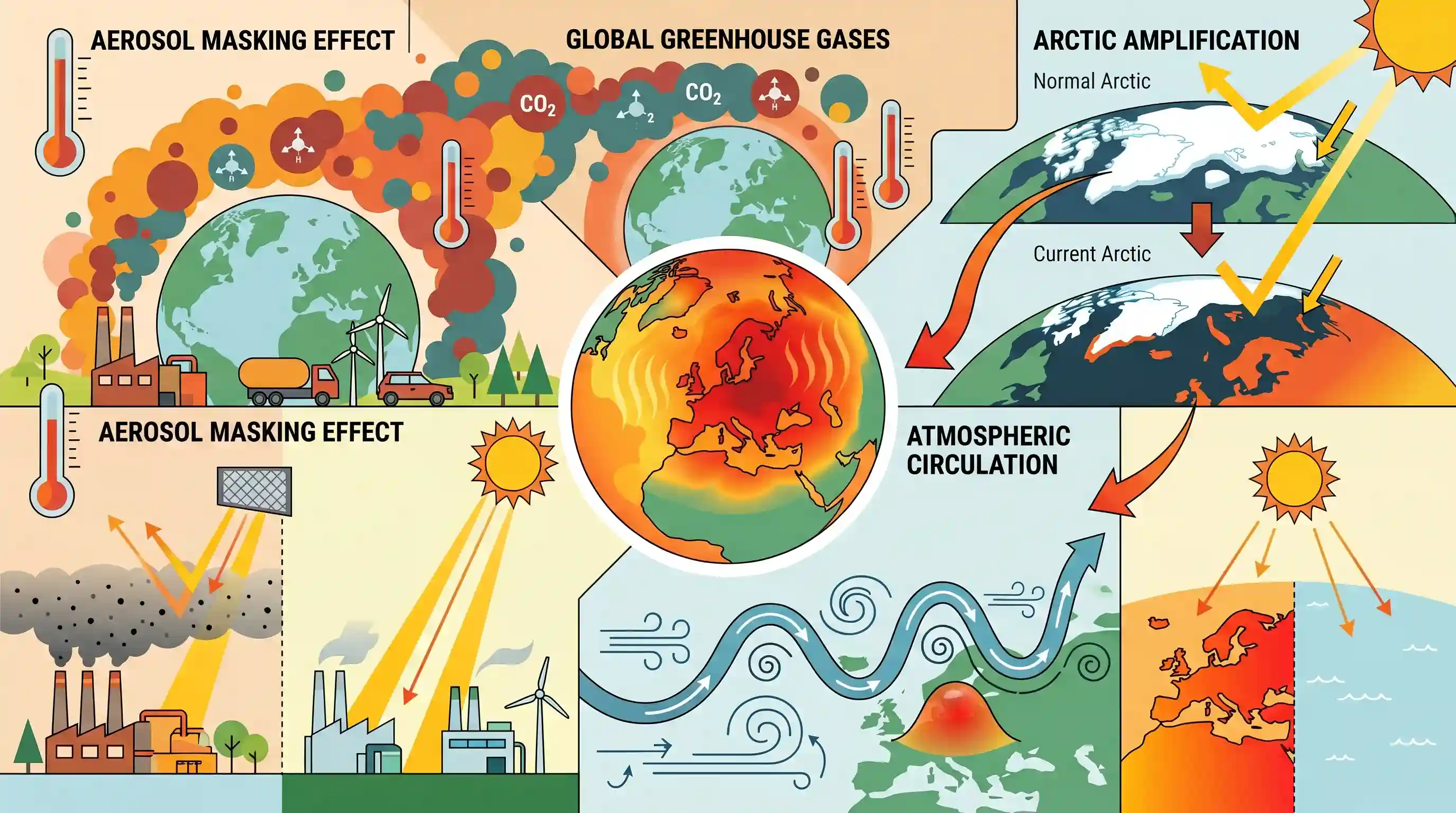
The article explains the geographical and atmospheric paradox of why Europe is warming faster than any other continent. While global greenhouse gas emissions drive overall climate change, regional factors exacerbate the warming in Europe. A primary driver is the loss of the 'aerosol masking effect'; as Europe drastically reduced its air pollution, the reflective particles (aerosols) that previously deflected sunlight and caused 'global dimming' dissipated, leading to rapid temperature increases. Additional factors include 'Arctic amplification', where severe ice loss in the nearby Arctic disrupts the jet stream and regional weather patterns, as well as the fundamental geographical reality that landmasses warm faster than oceans.
Key Points
- Europe is currently warming at approximately twice the global average rate, making it the fastest-warming continent on Earth.
- Aerosol Masking Effect: Ironically, successful policies to reduce air pollution (like sulfur dioxide) have removed a 'cooling shield' of reflective aerosols, thereby accelerating regional warming as more solar radiation reaches the surface.
- Arctic Amplification: The rapid melting of Arctic sea ice reduces the region's albedo (reflectivity), leading to increased heat absorption which subsequently impacts and warms the neighboring European continent.
- Land-ocean warming contrast: Continents inherently heat up faster than oceans due to lower heat capacity, and Europe's vast landmass contributes to its steeper temperature rise.
- Changes in atmospheric circulation, including a weakened and meandering jet stream, are causing prolonged high-pressure systems (blocking patterns) over Europe, leading to more frequent and intense heatwaves.
Important Terms
Arctic Amplification

The phenomenon where the Arctic warms at a rate significantly higher (often double or more) than the global average, primarily due to feedback loops like sea-ice loss.
UPSC context
GS Paper 1 (Geography) and Paper 3 (Climate Change); essential for understanding polar feedbacks and their global weather impacts.
Aerosol Masking Effect
A cooling effect where atmospheric particles (aerosols) reflect sunlight, "masking" greenhouse-driven warming. Reducing pollution dissipates this effect, leading to a sudden acceleration in temperature rise.
UPSC context
GS Paper 3 (Environment); relevant for analyzing the trade-off between air quality improvements and accelerated regional warming.
World Meteorological Organization (WMO)
A specialized United Nations agency that coordinates international cooperation on atmospheric science and climatology. It publishes authoritative annual reports on the "State of the Global Climate."
UPSC context
GS Paper 2 (International Organizations); vital for monitoring global climate standards and environmental policy-making frameworks.
Copernicus Climate Change Service (C3S)
An EU flagship program that provides authoritative global climate data. It uses satellite and in-situ sensors to monitor temperature records, sea levels, and greenhouse gas concentrations.
UPSC context
GS Paper 3 (Science and Technology); represents advanced Earth observation systems used for tracking global warming and adaptation strategies.
Jet Stream
High-altitude, fast-flowing air currents that drive global weather. Warming-induced disruptions can cause these streams to become "wavy," trapping weather systems and leading to prolonged heatwaves.
UPSC context
GS Paper 1 (Climatology); a core concept for explaining shifting weather patterns and the intensification of extreme climate events.
Global Dimming
The gradual reduction in sunlight reaching Earth's surface due to atmospheric pollutants. Its reversal, called "global brightening," has contributed to the rapid warming observed in Europe.
UPSC context
GS Paper 3 (Environment); relevant to discussions on atmospheric pollutants, solar radiation management, and unintended climate consequences.
Prelims Trap
"Decreasing atmospheric aerosol emissions, such as sulfur dioxide, directly reduces regional surface temperatures."
Removing sulfate aerosols actually increases surface warming because they reflect sunlight (aerosol masking). Aspirants often conflate air-quality improvement with climate-change mitigation.
Static Concepts Connected
How do atmospheric aerosols influence Earth's radiation budget?
- Direct Scattering: Aerosols like sulfates reflect incoming solar radiation back into space, creating a net cooling effect known as global dimming.
- Direct Absorption: Black carbon and soot absorb solar radiation, warming the middle atmosphere but often cooling the immediate surface below.
- Cloud Albedo Effect: Aerosols act as cloud condensation nuclei (CCN), increasing cloud droplet numbers and making clouds brighter and more reflective.
What causes atmospheric blocking and the formation of heat domes?
- Weakened Jet Stream: Rapid Arctic warming reduces the temperature gradient between the poles and the equator, causing the polar jet stream to slow down and meander.
- Stationary High Pressure: Meandering Rossby waves form persistent, stationary high-pressure systems that stall over a specific region for weeks.
- Air Subsidence: Sinking air within these high-pressure zones compresses and warms, trapping heat near the surface and preventing cloud formation or rain.
Cross-Topic Patterns
The Clean Air vs. Climate Paradox
Linking NCAP (National Clean Air Programme) with net-zero goals: reducing SO2/PM2.5 improves public health but removes the aerosol cooling shield, temporarily accelerating localized surface warming.
Arctic Melt & Indian Monsoon Variability
Arctic amplification doesn't just bake Europe; altered mid-latitude circulations and meandering Rossby waves are increasingly linked to late-season extreme rainfall and variability in the Indian Summer Monsoon.

Expect a 2026 multi-statement question linking the "aerosol masking effect" with Arctic amplification and changing jet stream dynamics.
Linked PYQs · 3
Linked PYQs · 3
- 2021MainsGS1
How do the melting of the Arctic ice and glaciers of the Antarctic differently affect the weather patterns and human activities on the Earth? Explain.
- 2022MainsGS3
Discuss global warming and mention its effects on the global climate. Explain the control measures to bring down the level of greenhouse gases which cause global warming, in the light of the Kyoto Protocol, 1997.
- 2019PrelimsGS1
In the context of which of the following do some scientists suggest the use of cirrus cloud thinning technique and the injection of sulphate aerosol into stratosphere?
