Energy Shocks and Decoupling of Global Food Prices
Source:Indian Express ↗
Why It Matters
Understanding the linkage (and current decoupling) between global energy shocks and food inflation is critical for UPSC aspirants. It highlights the complexities of macroeconomic management, the role of buffer stocks, the 'food vs. fuel' debate, and how geopolitical crises in the Middle East impact India's energy and food security.
Summary
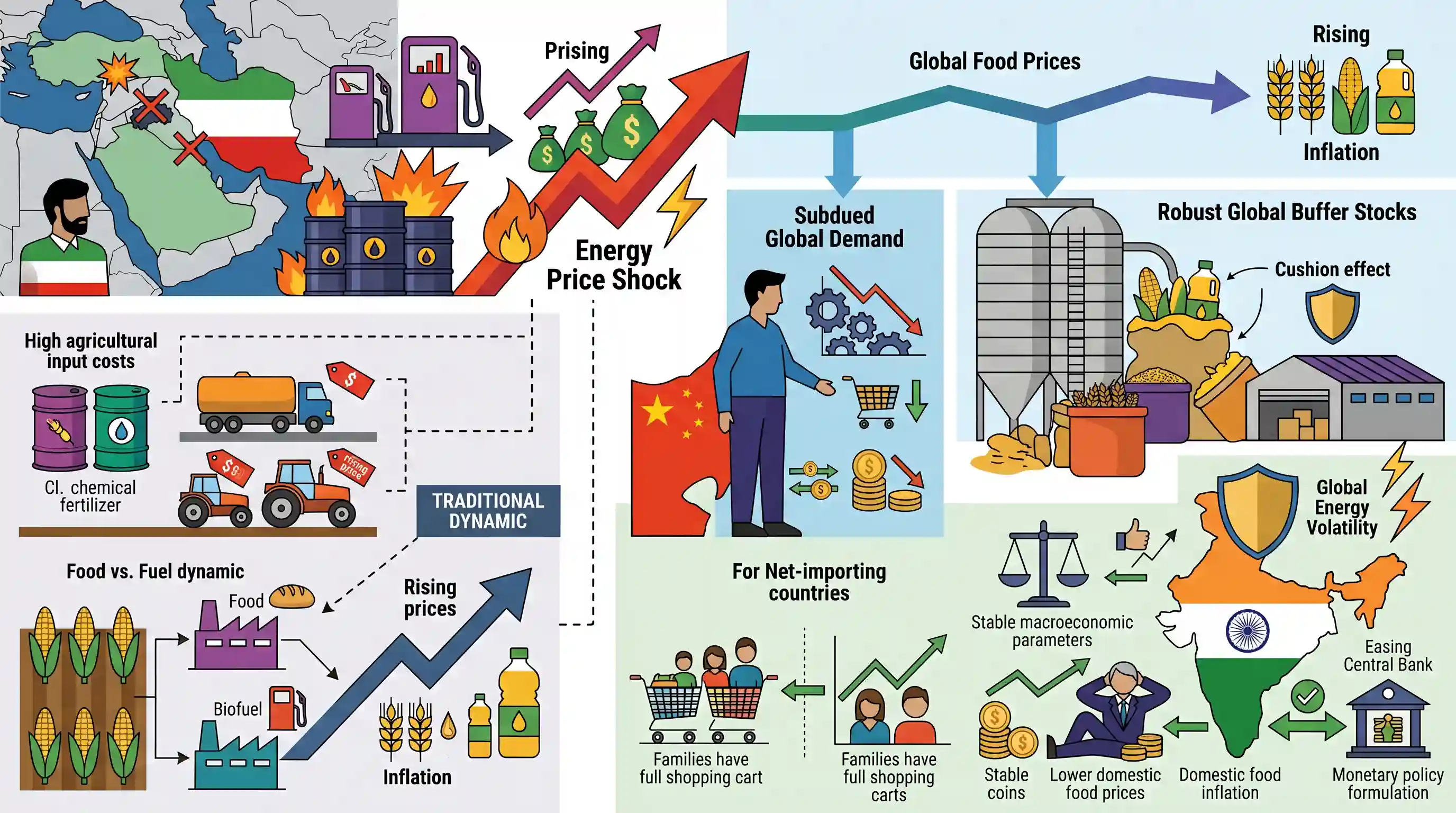
The article explores the phenomenon of why recent energy price shocks, triggered by geopolitical conflicts involving Iran in the Middle East, have not translated into global food inflation. Traditionally, high crude oil prices drive up agricultural input costs—such as fertilizers, diesel, and transportation—and encourage the diversion of food crops to biofuel production (the 'food vs. fuel' dynamic). However, this historical correlation has been disrupted recently. The resilience of global food prices is largely attributed to subdued global demand, particularly the economic slowdown in large importing countries like China, alongside robust global buffer stocks of key cereals and edible oils that have absorbed the shock. This decoupling offers significant relief to net-importing countries like India, stabilizing macroeconomic parameters and easing the burden on monetary policy formulation by insulating domestic food inflation from external energy volatility.
Key Points
- Historically, spikes in crude oil prices lead to food inflation through two main channels: increased input costs (fertilizers, diesel, and freight) and the diversion of food crops (like corn, sugarcane, and edible oils) towards biofuel production.
- Despite recent geopolitical tensions and energy shocks stemming from the Iran conflict, global food prices have remained insulated and relatively stable.
- A primary reason for this decoupling is subdued global demand, notably driven by the economic slowdown in major commodity-importing nations such as China.
- Ample global buffer stocks of staple cereals and vegetable oils have provided a strong cushion, preventing panic buying and absorbing minor supply chain disruptions.
- For India, the lack of pass-through from global energy shocks to food prices is crucial for macroeconomic stability, aiding the RBI in managing domestic inflation targets.
Important Terms
Ethanol Blending Programme

A government initiative blending ethanol with petrol to reduce crude oil imports and emissions. India aims for 20% blending (E20) by the 2025-26 Ethanol Supply Year.
UPSC context
GS3 (Economy/Energy) — evaluates energy security, import bill reduction, and the 'food vs. fuel' dynamic in sustainable development.
Minimum Support Price (MSP)
A floor price at which the government purchases 22 mandated crops from farmers, providing a safety net against price crashes and ensuring remunerative returns for agricultural produce.
UPSC context
GS3 (Agriculture) — tests understanding of agricultural pricing, food security, and government market intervention strategies.
Reserve Bank of India (RBI)
India's central bank and monetary authority. It targets inflation (4% ± 2% range), manages the money supply, and regulates the banking system to ensure macroeconomic stability.
UPSC context
GS3 (Economy) — focuses on monetary policy tools, inflation management (CPI), and the central bank's role in economic growth.
Food and Agriculture Organization (FAO)
A specialized UN agency leading global efforts to defeat hunger and improve nutrition. It monitors world food prices and agricultural security through the FAO Food Price Index.
UPSC context
GS2 (IR) — covers international organizations, global food security mandates, and indices monitoring world agricultural commodity prices.
OPEC
An intergovernmental organization of oil-exporting nations that coordinates petroleum policies to stabilize markets. Its decisions on production quotas significantly influence global crude oil prices.
UPSC context
GS2 (IR) — analyzes the geopolitics of energy, its impact on India's fiscal deficit, and global cartel behavior.
Prelims Trap
A rise in global crude oil prices inevitably causes a proportional spike in global food inflation.
This historical correlation can entirely decouple due to counter-forces like strong global buffer stocks or subdued demand (e.g., China's economic slowdown).
Static Concepts Connected
What is the 'food vs. fuel' dynamic in biofuel production?
- Price Catalyst: High global crude oil prices make the production of biofuels increasingly profitable compared to fossil fuels.
- Crop Diversion: First-generation biofuels divert staple food crops (like corn, sugarcane, and edible oils) away from the food supply chain.
- Policy Mitigation: India's National Policy on Biofuels promotes 2G and 3G biofuels (using agricultural waste and algae) to explicitly mitigate this food security risk.
How do global energy shocks structurally transmit to domestic agricultural inflation?
- Input Costs: Increased crude and natural gas prices inflate the cost of diesel for farm mechanization and freight transport.
- Fertilizer Link: Natural gas is the primary feedstock for urea. Costlier gas immediately inflates fertilizer production and import costs.
- MSP Upward Pressure: Rising input costs increase the A2+FL cost base, which subsequently forces the government to hike the Minimum Support Price (MSP).
Cross-Topic Patterns
Fertilizer subsidies and fiscal deficit
High global natural gas prices inflate India's urea import bill. This swells the fertilizer subsidy burden, directly threatening fiscal deficit targets under the FRBM Act even if retail food prices remain stable.
Biofuel blending vs. food security
India's Ethanol Blending Programme relies heavily on sugarcane and surplus rice. A global shift towards biofuels during energy shocks directly pits renewable energy commitments against domestic food security.

Expect a 2026 Prelims statement question testing the transmission channels between global crude volatility, FAO indices, and India's CPI.
Linked PYQs · 5
Linked PYQs · 5
- 2024MainsGS3
What are the causes of persistent high food inflation in India? Comment on the effectiveness of the monetary policy of the RBI to control this type of inflation.
- 2024MainsGS3
Elucidate the importance of buffer stocks for stabilizing agricultural prices in India. What are the challenges associated with the storage of buffer stock? Discuss.
- 2020PrelimsGS1
Consider the following statements: 1. The weightage of food in Consumer Price Index (CPI) is higher than that in Wholesale Price Index (WPI). 2. The WPI does not capture changes in the prices of services, which CPI does. 3. Reserve Bank of India has now adopted WPI as its key measure of inflation and to decide on changing the key policy rates. Which of the statements given above is/are correct?
- 2025MainsGS2
"Energy security constitutes the dominant kingpin of India's foreign policy, and is linked with India's overarching influence in Middle Eastern countries.” How would you integrate energy security with India's foreign policy trajectories in the coming years?
- 2017MainsGS2
The question of India's Energy Security constitutes the most important part of India's economic progress. Analyze India's energy policy cooperation with West Asian countries.
