Junglemahal human-elephant conflict and forest corridor fragmentation
Source:thestatesman ↗
Why It Matters
Important for WBCS Prelims as it covers critical environmental issues specific to West Bengal's geography (Junglemahal, Jhargram), forest composition challenges, and regional wildlife conservation dynamics.
Summary
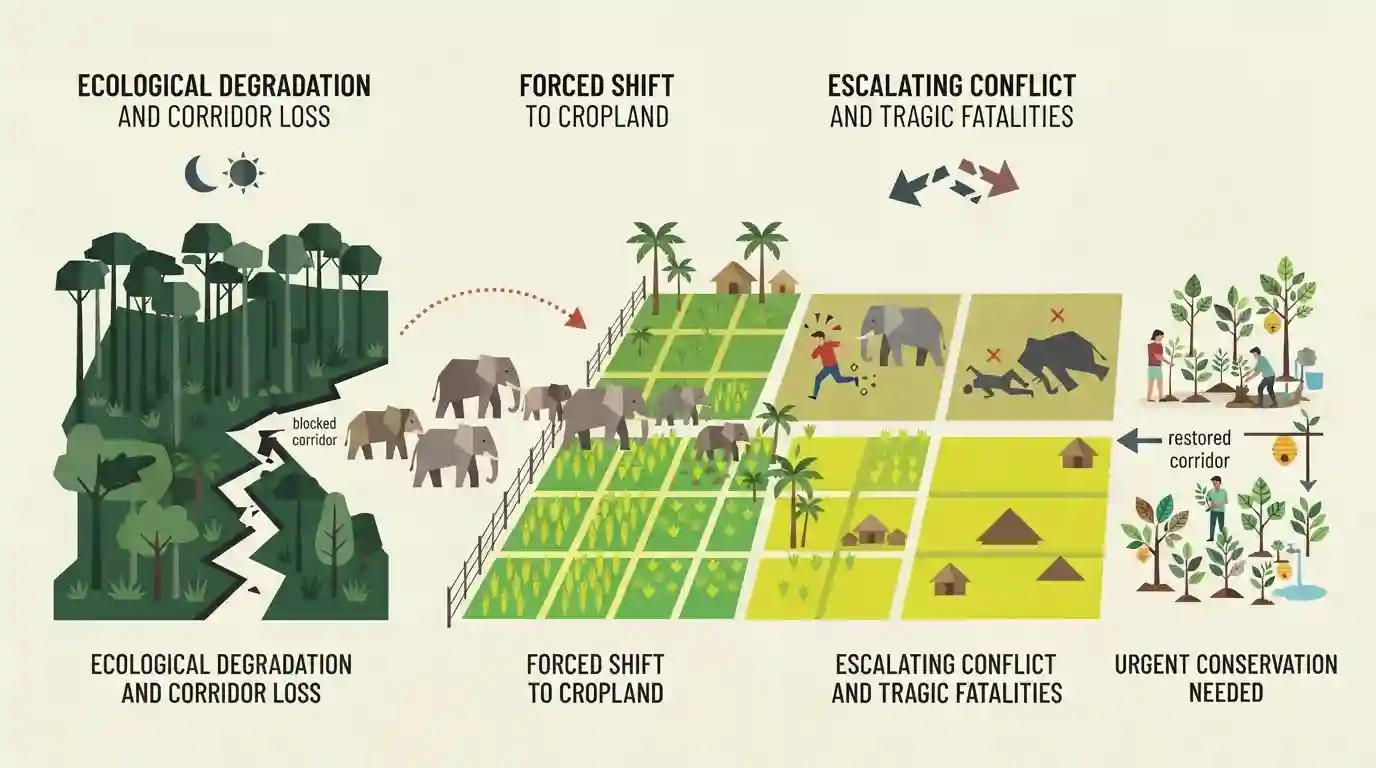
The article highlights the escalating human-elephant conflict in West Bengal's Junglemahal region, driven by the loss of traditional elephant corridors and ecological degradation. Regenerated forests, overly dominated by sal trees, no longer provide the necessary multi-tiered vegetation, forcing elephants to rely heavily on agricultural crops for sustenance. This shift into human-dominated landscapes has resulted in tragic fatalities for both humans and elephants, prompting experts to call for urgent corridor restoration and shifts in local agricultural practices.
Key Points
- Habitat fragmentation and vanishing forest corridors in Bengal's Junglemahal region are escalating severe human-elephant conflicts.
- Regenerated forests, increasingly dominated by sal trees, lack the three-tier food system necessary for elephants, driving them toward farmland.
- Agricultural crops now account for about 54% of recorded elephant food intake, increasing encounters in human-dominated areas.
- Between 2019 and 2025, 148 people were killed by elephants across regional forest divisions, while at least 15 elephants died since 2007 from unnatural causes.
- Experts recommend corridor restoration and incentivizing farmers to grow less elephant-attractive crops, such as citrus and spices, along forest edges.
Important Terms
Elephant Corridor

A narrow strip of land, often forested, that connects larger elephant habitats, facilitating safe seasonal migration, genetic exchange, and long-term survival.
UPSC context
GS Paper 3 (Environment): tests understanding of habitat fragmentation, wildlife conservation strategies, and Project Elephant.
Human-Wildlife Conflict
Struggles arising when wildlife requirements overlap with human needs, leading to crop raiding, property damage, livestock loss, and injuries or deaths of both humans and animals.
UPSC context
GS Paper 3 (Environment/Disaster Management): tests mitigation strategies, ecological balance, and environmental policy interventions.
World Elephant Day
An international annual event observed on August 12 dedicated to the preservation and protection of the world's elephants, raising awareness of threats like poaching and habitat loss.
UPSC context
GS Paper 3 (Environment): tests awareness of global conservation initiatives and international species protection milestones.
Junglemahal
A forested, undulating geographical region in western West Bengal spanning Purulia, Bankura, Jhargram, and Midnapore, characterized by red soil, sal forests, and a significant tribal population.
UPSC context
GS Paper 1 & 3 (Geography/Internal Security): tests regional geographical features, tribal demographics, and local conservation conflicts.
Animal Resources Development Department
A state-level administrative body in West Bengal responsible for formulating and implementing policies related to livestock, poultry development, veterinary healthcare, and animal welfare.
UPSC context
GS Paper 2 & 3 (Governance/Agriculture): tests state welfare policies, livestock governance, and inter-departmental wildlife mitigation.
Raja Narendralal Khan Women's College
An autonomous higher education institution in Midnapore, West Bengal, whose faculty actively conducts field research on local human-elephant conflict trends and ecological conservation.
UPSC context
GS Paper 3 (Environment): tests the role of academic institutions and regional studies in informing biodiversity policies.
Prelims Trap
The Indian state with the highest wild elephant population also contains the largest number of identified elephant corridors.
While Karnataka has the largest wild elephant population, West Bengal actually hosts the highest number of identified elephant corridors (26) according to official reports.
Static Concepts Connected
What are the key biological traits and conservation status of the Indian Elephant?
- Protection Status: Listed as Endangered on the IUCN Red List, Schedule I of the Wildlife (Protection) Act, 1972, and Appendix I of CITES.
- Social Structure: They live in highly social, matriarchal societies led by the oldest female; adult males live in temporary bachelor groups or are solitary.
- Gestation Period: They possess the longest gestation period of any land mammal, lasting between 18 to 22 months.
What is Project RE-HAB and how does it address human-wildlife conflict?
- Implementing Agency: Stands for Reducing Elephant-Human Attacks using Bees; it is an initiative of the Khadi and Village Industries Commission (KVIC).
- Mechanism: It places bee boxes along forest edges to create a natural deterrent barrier, as elephants fear bee stings and their buzzing sound.
- Benefits: It acts as a cost-effective, non-lethal alternative to electric fencing while simultaneously boosting rural apiculture income.
Cross-Topic Patterns
Monoculture forestry vs. Biodiversity targets
Colonial-era timber silviculture (like Sal monoculture) directly clashes with modern multi-tiered forest restoration and India's biodiversity targets under the Kunming-Montreal Global Biodiversity Framework.
Cropping patterns + Conflict mitigation
Promoting alternative, non-palatable cash crops like ginger and citrus along forest fringes links crop diversification policies with landscape-level wildlife management.

Elephant reproductive biology, geographic corridor distribution, and Project RE-HAB are likely to be integrated into a multi-statement question.
Linked PYQs · 2
Linked PYQs · 2
- 2023WBCS_PRELIMSGS1
Forests having no free entry by people in India —
- 2024WBCS_PRELIMSGS1
Which one of the following is not located in West Bengal?
