Evolutionary genetics and brain lateralization in human traits
Source:The Hindu ↗
Why It Matters
Understanding the genetic and evolutionary basis of human traits is relevant for UPSC General Science. It provides foundational knowledge on how genetic variants and evolutionary pressures shape human biology, which frequently appears in Prelims science questions.
Summary
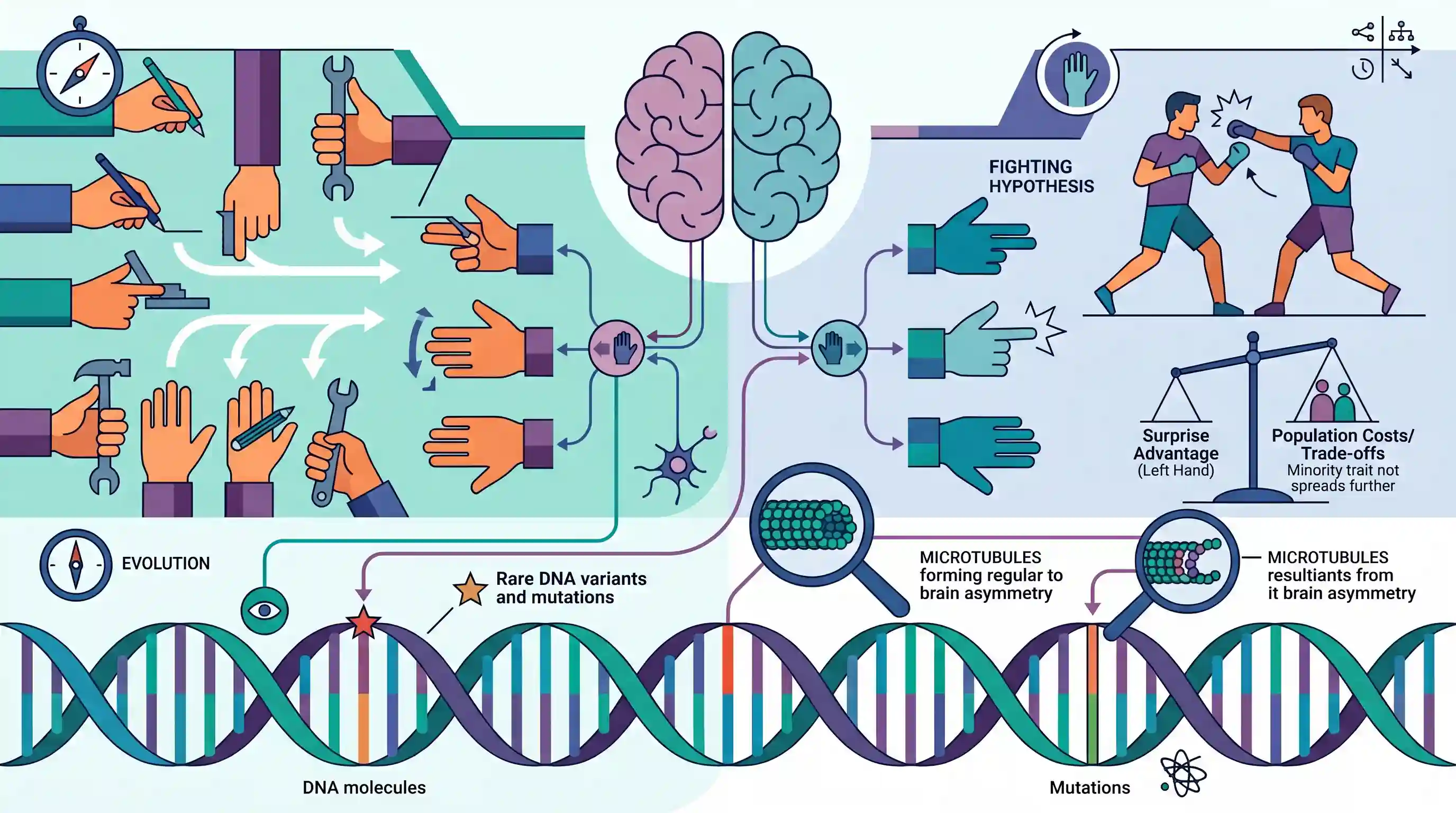
The article examines the biological and evolutionary reasons why only about 10% of the human population is left-handed, rather than a 50-50 split. It explores the 'fighting hypothesis', which posits that left-handedness persists because it offers a surprise advantage in physical combat, but remains a minority trait due to evolutionary trade-offs. The phenomenon is also deeply rooted in brain lateralization and human genetics. Recent research highlights how rare DNA variants, such as those affecting the TUBB4B gene and microtubule formation, play a role in determining left-handedness, showcasing the complex interplay between genetic mutation and human development.
Key Points
- Roughly 10% of the human population is left-handed, a statistic that has remained stable throughout evolutionary history.
- The 'fighting hypothesis' suggests left-handedness persists because it provides a surprise advantage in combat and competitive interactions.
- This evolutionary advantage is kept in check by potential biological trade-offs, preventing a 50-50 split in the population.
- Handedness is fundamentally linked to brain lateralization and asymmetry, where the left hemisphere typically dominates language and right-side motor control.
- Recent scientific studies have identified specific rare genetic variants, such as in the TUBB4B gene involving microtubules, that strongly correlate with left-handedness.
Prelims Trap
"The left hemisphere of the human brain controls the left side of the body and is responsible for left-handedness."
UPSC frequently tests biological reversals. Motor control is contralateral: the right hemisphere controls the left side of the body, meaning left-handed individuals rely on right-hemisphere motor pathways.
Static Concepts Connected
What are the primary functions of microtubules in eukaryotic cells?
- Cytoskeleton framework: They provide essential structural support and maintain the physical shape of eukaryotic cells.
- Cell division: They assemble into the mitotic spindle, orchestrating the separation of chromosomes into daughter cells during mitosis and meiosis.
- Intracellular transport: They act as microscopic intracellular highways, facilitating the movement of organelles and vesicles via motor proteins.
What is negative frequency-dependent selection in evolutionary biology?
- Rarity advantage: A biological trait becomes more advantageous—and thus evolutionarily favored—precisely because it is rare in the population.
- Equilibrium maintenance: It prevents a single trait from completely taking over, thereby maintaining genetic diversity and stable minority populations.
Cross-Topic Patterns
Evolutionary trade-offs & survival traits
Similar to sickle-cell traits offering malaria resistance, the 'fighting hypothesis' illustrates how minority genetic traits persist in human populations through unexpected evolutionary survival advantages.
Microtubules in health and disease
Beyond handedness, microtubules are crucial targets for anti-cancer drugs, which halt tumor growth by disrupting the mitotic spindle during cell division.

Expect a Prelims statement linking basic cell components like microtubules to recent genetic discoveries in human traits or diseases.
Linked PYQs · 3
Linked PYQs · 3
- 2023PrelimsGS1
'Microsatellite DNA' is used in the case of which one of the following?
- 2016PrelimsGS1
In the context of the developments in Bioinformatics, the term 'transcriptome', sometimes seen in the news, refers to
- 2021PrelimsGS1
Bollgard I and Bollgard II technologies are mentioned in the context of
