Coriolis Effect and Atmospheric Circulation in Wildfire Smoke
Source:The Hindu ↗
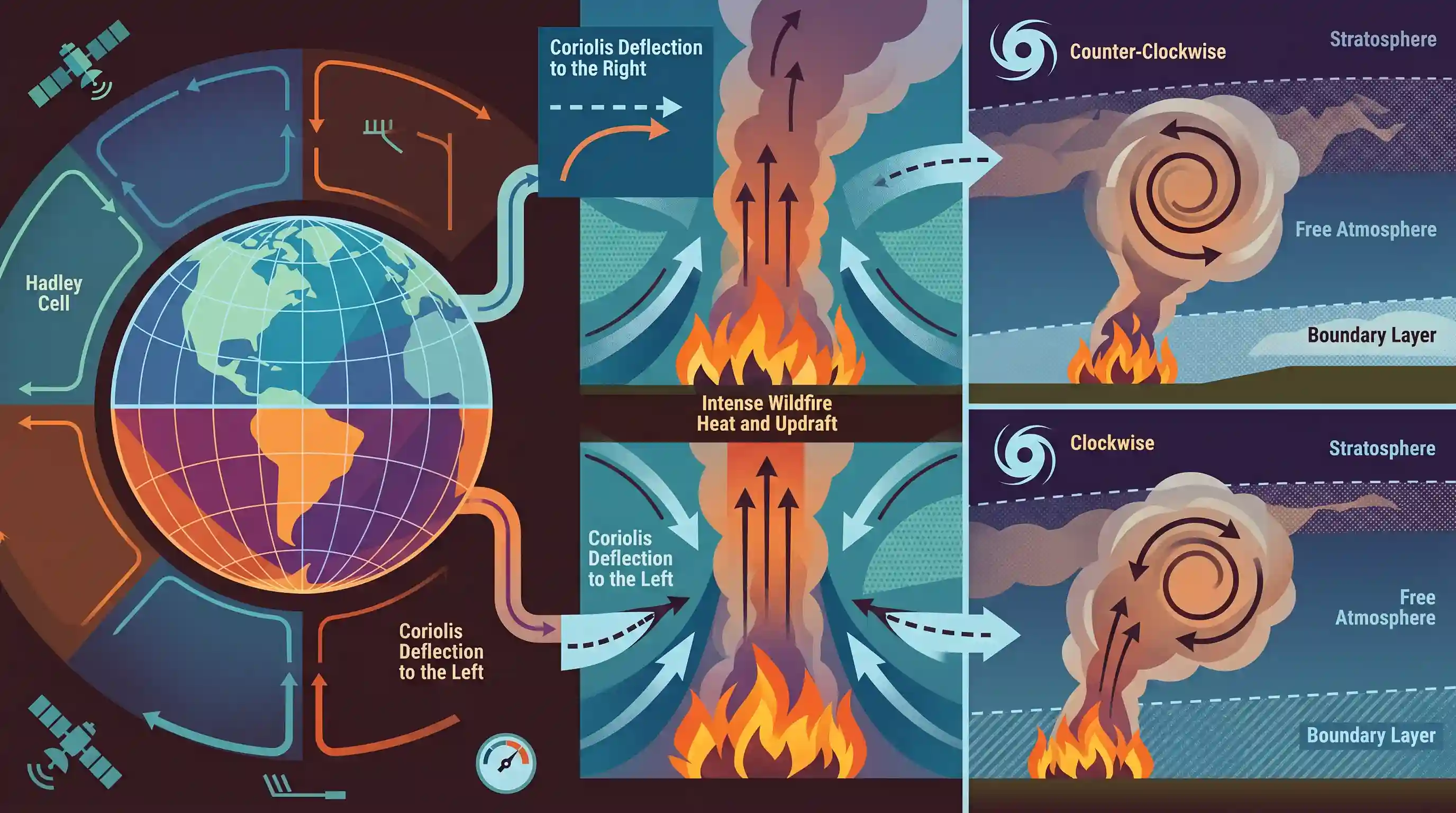
Why It Matters
Understanding the Coriolis effect and its impact on both micro and macro atmospheric phenomena (from wildfire smoke to tropical cyclones) is a foundational concept in Physical Geography for the UPSC exam.
Summary
The article explains the atmospheric physics behind why large wildfire smoke plumes tend to swirl in a consistent direction. This phenomenon is primarily driven by the intense heat of the fire creating rapid updrafts and localized low pressure. As surrounding air is drawn in, the Earth's rotation exerts the Coriolis force on the moving air mass, causing it to deflect. Consequently, smoke plumes—much like cyclones—rotate counter-clockwise in the Northern Hemisphere and clockwise in the Southern Hemisphere.
Key Points
- Large wildfires generate intense heat, causing rapid updrafts and creating localized low-pressure areas at the surface.
- As surrounding air rushes in to fill the low-pressure zone, it is deflected by the Coriolis effect, an inertial force caused by the Earth's rotation.
- This deflection causes the rising smoke plumes and associated pyrocumulonimbus clouds to swirl counter-clockwise in the Northern Hemisphere and clockwise in the Southern Hemisphere.
- The underlying physical mechanism is identical to the one that dictates the rotational direction of large-scale weather systems like tropical cyclones.
Prelims Trap
"The Coriolis force initiates the movement of air, causing the wildfire smoke to rise and swirl."
Coriolis is an apparent force that only deflects air already set in motion by the pressure gradient force; it cannot initiate air movement or create the low pressure itself.
Static Concepts Connected
What determines the magnitude and impact of the Coriolis force on wind systems?
- Latitude dependence: It is directly proportional to the angle of latitude, being maximum at the poles and zero at the equator.
- Velocity factor: The amount of deflection is directly proportional to the wind velocity; faster winds experience greater deflection.
- Directional deflection: It deflects moving air to the right in the Northern Hemisphere and left in the Southern Hemisphere (Ferrel's Law).
What are Pyrocumulonimbus (flammagenitus) clouds?
- Formation mechanism: They are dense, towering clouds created by rapid atmospheric convection and updrafts driven by extreme surface heat from wildfires or volcanoes.
- Secondary hazards: They can generate severe turbulence, strong downdrafts, and dry lightning storms, which often spark new, secondary fires without bringing rain.
Cross-Topic Patterns
Cyclogenesis vs. localized fire weather
Both phenomena rely on intense surface heating creating low pressure, with Coriolis deflection driving rotation. This shows how micro-scale fire weather perfectly mimics macro-scale tropical cyclogenesis.
Climate change and dry lightning cycles
Rising global temperatures increase the frequency of extreme wildfires, leading to more pyrocumulonimbus clouds. These generate dry lightning, creating a dangerous positive feedback loop of secondary fires.

Expect a statement-based question linking fundamental Coriolis dynamics (e.g., zero at equator) to extreme localized pyrocumulonimbus events.
Linked PYQs · 2
Linked PYQs · 2
- 2010PrelimsGS1
What causes wind to deflect toward left in the Southern hemisphere?
- 2024MainsGS1
What is sea surface temperature rise? How does it affect the formation of tropical cyclones?
