Thwaites Glacier instability and global sea level rise
Source:The Hindu ↗
Why It Matters
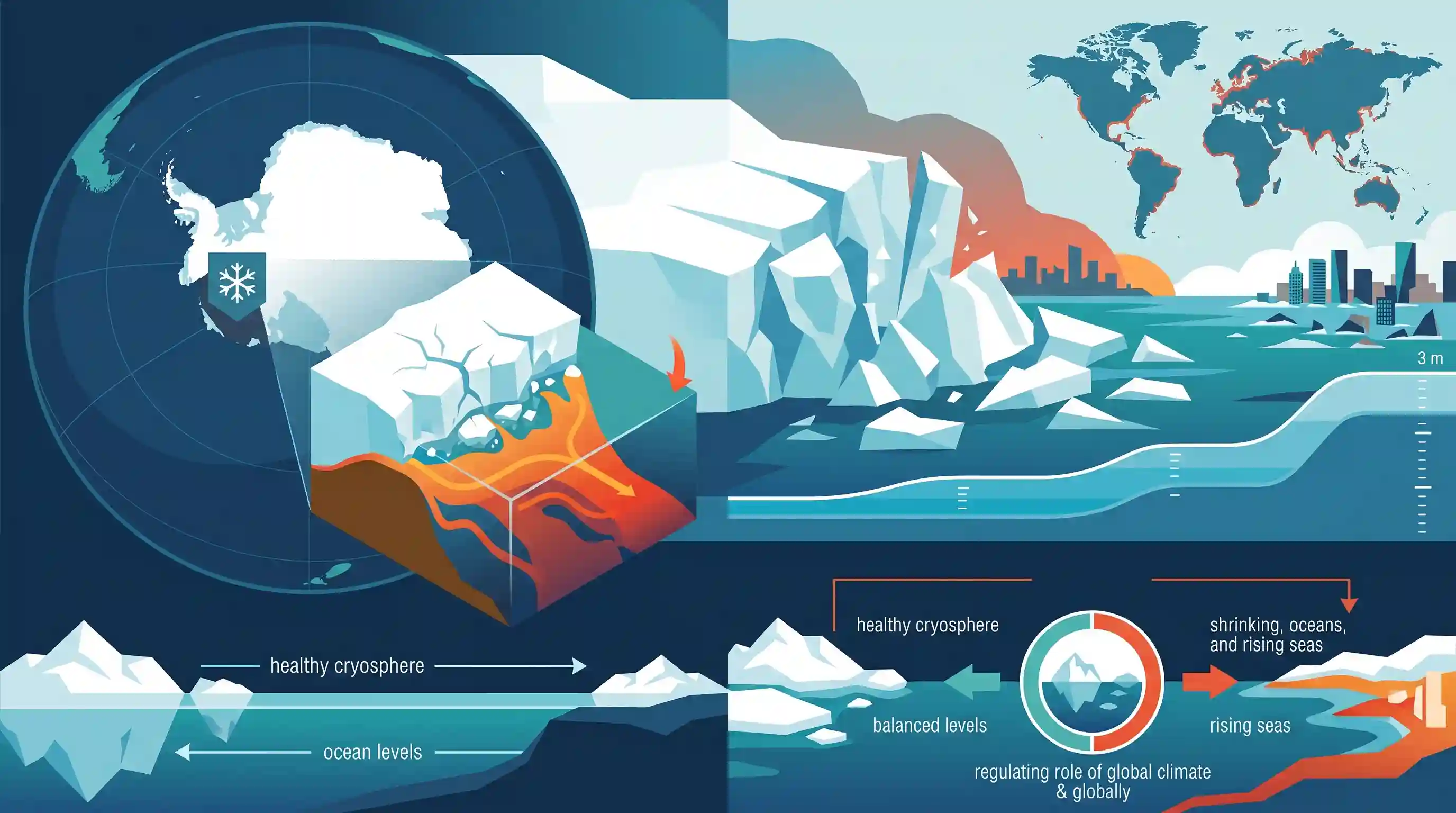
The Thwaites Glacier represents a critical tipping point in the global climate system. Its melting directly influences global sea-level rise, posing existential threats to coastal regions and island nations. It is highly relevant for UPSC questions regarding the cryosphere's role in global geography and the multi-dimensional impacts of climate change.
Summary
The Thwaites Glacier, commonly referred to as the 'Doomsday Glacier', is a massive ice formation in West Antarctica whose rapid melting poses a severe threat to global coastlines. Because it acts as a structural keystone for the larger West Antarctic Ice Sheet, its complete collapse could trigger a catastrophic global sea-level rise of over three meters. The glacier is particularly vulnerable to climate change as warm, deep ocean currents increasingly erode its base at the grounding line, highlighting the critical role of the cryosphere in regulating global climate and sea levels.
Key Points
- Thwaites Glacier, often called the 'Doomsday Glacier', is located in West Antarctica and is highly vulnerable to global warming.
- It acts as a keystone for the West Antarctic Ice Sheet; its complete collapse could raise global sea levels by over 3 meters.
- Warm ocean currents (Circumpolar Deep Water) are melting the glacier from below, destabilizing its grounding line.
- Its accelerated melting poses existential threats to coastal cities and island nations globally, while also contributing to mass redistribution affecting Earth's rotation.
Prelims Trap
"Melting of Antarctica's floating sea ice directly causes the massive sea-level rise associated with the Doomsday Glacier."
Floating ice melting doesn't significantly raise sea levels (Archimedes' principle). The true danger is land-based glacial ice sliding into the ocean after protective ice shelves collapse.
Static Concepts Connected
What drives Marine Ice Sheet Instability (MISI) in West Antarctica?
- Grounding Line: The boundary where a glacier leaves continental bedrock and begins to float on the ocean.
- Basal Melting: Warm, deep ocean currents (Circumpolar Deep Water) that erode the glacier from underneath, causing the grounding line to retreat inland.
- Retrograde Bedrock: The bedrock beneath Thwaites slopes downward inland. As the grounding line retreats, thicker ice is exposed to the ocean, accelerating collapse.
How does massive glacial melt affect Earth's rotation?
- Mass Redistribution: As ice at the poles melts and flows into the global ocean, mass is shifted toward the equator.
- Length of Day: This equatorial mass accumulation slightly increases Earth's moment of inertia, slowing its rotation and lengthening the day.
- Polar Motion: The shift in mass distribution alters Earth's axis of rotation, contributing to a phenomenon known as polar wander.
Cross-Topic Patterns
Cryosphere + Earth's geophysical properties
UPSC is shifting from basic climate impacts to geophysical consequences, like how mass redistribution from melting polar ice alters Earth's moment of inertia, slowing rotation and shifting its axis.
Climate tipping points + Global Commons
As the West Antarctic Ice Sheet destabilizes, the scientific footprint and strategic geopolitical positioning under the Antarctic Treaty System will intensify, bridging GS-1 Geography and GS-2 IR.

Expect a multi-statement question linking Antarctic glacier retreat mechanisms (MISI, grounding lines) with Earth's rotational changes.
Linked PYQs · 4
Linked PYQs · 4
- 2017MainsGS1
How does the cryosphere affect global climate?
- 2023MainsGS3
The Intergovernmental Panel on Climate Change (IPCC) has predicted a global sea level rise of about one metre by AD 2100. What would be its impact in India and the other countries in the Indian Ocean region?
- 2025MainsGS1
How are climate change and the sea level rise affecting the very existence of many island nations? Discuss with examples.
- 2025PrelimsGS1
Consider the following statements : Statement I: Scientific studies suggest that a shift is taking place in the Earth's rotation and axis. Statement II: Solar flares and associated coronal mass ejections bombarded the Earth's outermost atmosphere with tremendous amount of energy. Statement III : As the Earth's polar ice melts, the water tends to move towards the equator. Which one of the following is correct in respect of the above statements?
