Scientific reasons behind lunar geological asymmetry
Source:The Hindu ↗
Why It Matters
Space exploration is a high-yield topic in UPSC. Following the historic success of Chandrayaan-3 and international focus on the lunar far side (like China's sample return missions), aspirants must understand the fundamental scientific phenomena governing the Moon—such as tidal locking, the lunar dichotomy, and planetary formation—to answer both Prelims conceptual questions and GS3 Mains space technology questions.
Summary
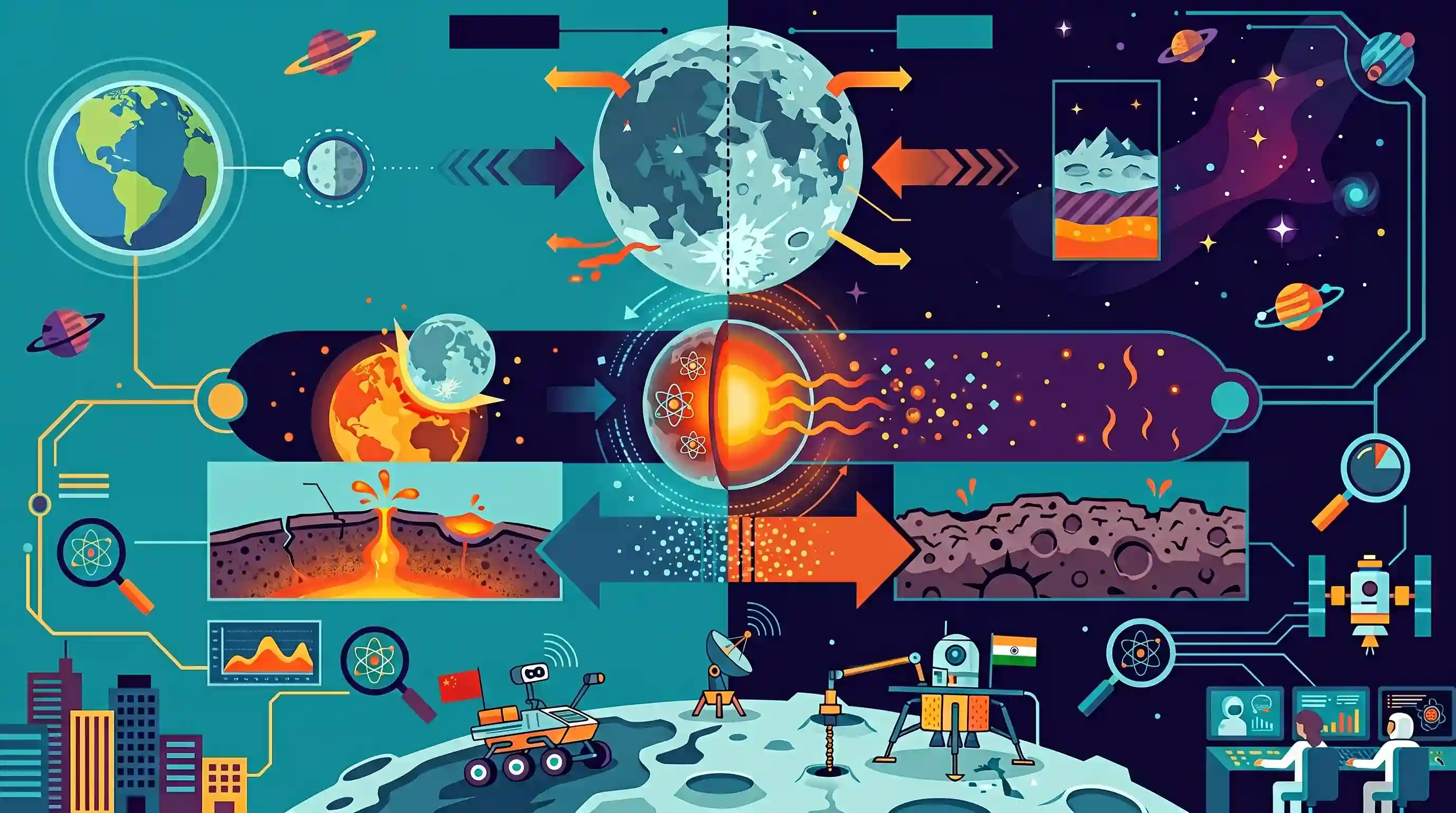
The article explores the 'lunar dichotomy,' the stark geological differences between the Moon's near and far sides. While the near side, permanently facing Earth due to tidal locking, features smooth, dark volcanic plains called maria, the far side is heavily cratered with a significantly thicker crust. This asymmetry is theorized to stem from the Moon's early formation after a giant impact, which unevenly distributed heat-producing radioactive elements to the near side, enabling extensive volcanic activity. Understanding these differences is currently the focal point of global space exploration, highlighted by missions like India's Chandrayaan-3 and China's Chang'e probes targeting the lunar south pole and far side to collect vital geological data.
Key Points
- The Moon exhibits a stark 'lunar dichotomy': the near side is covered by flat, dark volcanic plains known as maria, while the far side is rugged, heavily cratered, and possesses a much thicker crust.
- Due to 'tidal locking' (synchronous rotation), the Moon takes the same amount of time to rotate around its axis as it does to orbit Earth, meaning humanity only ever sees one face of the Moon.
- Scientific consensus suggests the dichotomy is a result of the Moon's early formation, potentially following a giant impact (the Theia hypothesis) that left the near side hotter and concentrated with heat-producing elements (KREEP: Potassium, Rare Earth Elements, Phosphorus), allowing easier magma flow to form the maria.
- Recent missions like India's Chandrayaan-3 (exploring near the lunar south pole) and China's Chang'e-4 and Chang'e-6 (focusing on the far side's South Pole-Aitken basin) are critical for unraveling the Moon's asymmetric geological history.
Important Terms
Chandrayaan Missions

India's lunar exploration program by ISRO. Chandrayaan-3 (2023) achieved a historic soft landing near the lunar south pole, confirming water ice presence.
UPSC context
GS Paper III: Science & Technology. Tests knowledge of India's indigenous space capabilities and recent scientific milestones.
Chang'e Missions
China's lunar exploration program. It includes landmark achievements like the first-ever far-side landing (Chang'e 4) and the first far-side sample return (Chang'e 6, 2024).
UPSC context
GS Paper III: Science & Technology. Relevant for comparative study of global space programs and international technological competition.
Lunar Dichotomy
The distinct geological asymmetry between the Moon's smooth, volcanic near side and its heavily cratered, thick-crusted far side.
UPSC context
GS Paper I: Geography / GS III: Space. Tests understanding of planetary geomorphology and the evolution of celestial bodies.
Lunar South Pole
A region of high scientific and strategic value containing permanently shadowed craters (cold traps) with water ice, crucial for future deep-space missions.
UPSC context
GS Paper III: Science & Technology. Focuses on the site of modern 'space races' and resource utilization for future colonization.
Tidal Locking
The gravitational phenomenon where a satellite's rotation period equals its orbital period, causing it to always show the same face to its planet.
UPSC context
GS Paper I: Physical Geography / GS III: Science. Fundamental concept for orbital mechanics and celestial observations.
Lunar Maria
Large, dark, basaltic plains on the Moon formed by ancient volcanic eruptions; they are much more prevalent on the near side than the far side.
UPSC context
GS Paper I: Physical Geography. Tests knowledge of lunar surface features and their volcanic origins.
ISRO (Indian Space Research Organisation)
India's premier space agency responsible for the Chandrayaan, Mangalyaan, and upcoming Gaganyaan missions, known for its cost-effective and successful space exploration.
UPSC context
GS Paper III: Science & Technology. Central to questions on institutional frameworks and India's achievements in space.
Prelims Trap
"Due to tidal locking, the far side of the Moon is permanently devoid of sunlight."
Tidal locking means the far side never faces Earth, but it still experiences a regular day-night cycle (approx 14 days of sunlight and 14 days of darkness).
Static Concepts Connected
What causes a celestial body to become 'tidally locked'?
- Synchronous Rotation: The body's rotation period perfectly matches its orbital period around its partner body.
- Gravitational Friction: Gravitational pull from the larger body creates bulges; orbital friction gradually slows the smaller body's spin until it locks into place.
- Hemispheric Visibility: As a result of this locking, only one hemisphere (the near side) is ever visible from the primary body (e.g., Earth).
What is the significance of the KREEP signature in lunar geology?
- Chemical Composition: An acronym denoting lunar rocks enriched with Potassium (K), Rare Earth Elements (REE), and Phosphorus (P).
- Heat Generation: These rocks contain radioactive elements like uranium and thorium, whose decay provided the crucial heat needed for ancient volcanic activity.
- Asymmetric Distribution: KREEP is heavily concentrated on the Moon's near side, explaining why smooth, flat volcanic plains (maria) are predominantly found facing Earth.
Cross-Topic Patterns
Lunar Geopolitics & Artemis Accords
The scientific push to map lunar asymmetry aligns with the strategic goals of the Artemis Accords and China's ILRS, turning lunar geology into a geopolitical domain for establishing permanent bases.
Extraterrestrial Mining & REE Security
The presence of high concentrations of Rare Earth Elements (via KREEP signatures) connects lunar exploration directly to critical mineral security and the evolving UN treaties on deep-space mining.

Expect a 2026 Prelims multi-statement question contrasting near-side 'maria' geology with the far-side crust, linked to tidal locking.
Linked PYQs · 3
Linked PYQs · 3
- 2023MainsGS3
What is the main task of India's third moon mission which could not be achieved in its earlier mission? List the countries that have achieved this task. Introduce the subsystems in the spacecraft launched and explain the role of the Virtual Launch Control Centre' at the Vikram Sarabhai Space Centre which contributed to the successful launch from Sriharikota.
- 2017MainsGS3
India has achieved remarkable successes in unmanned space missions including the Chandrayaan and Mars Orbitter Mission, but has not ventured into manned space missions. What are the main obstacles to launching a manned space mission, both in terms of technology and logistics? Examine critically.
- 2017PrelimsGS1
The terms 'Event Horizon', 'Singularity', 'String Theory' and 'Standard Model' are sometimes seen in the news in the context of
