Methodology Shifts and Credibility Debates Surrounding Indian GDP Data
Source:The Hindu ↗
Why It Matters
Understanding the controversies surrounding GDP estimation is vital for GS3 aspirants as it touches upon core macroeconomic indicators, data credibility, and the mechanics of measuring national growth and development in India.
Summary
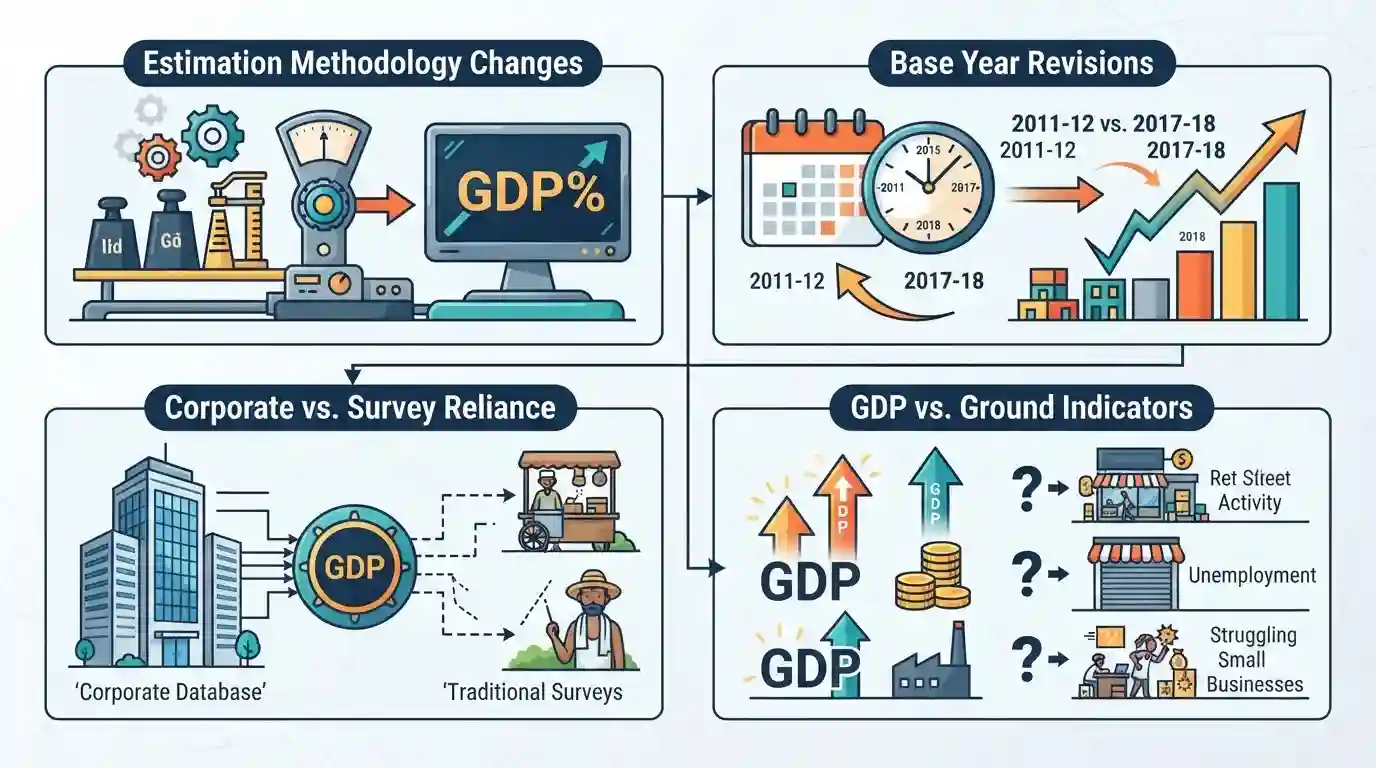
The article examines why Gross Domestic Product (GDP) figures often face controversy in India, focusing on changes in estimation methodology, base year revisions, reliance on corporate databases over traditional surveys, and discrepancies between GDP data and ground-level economic indicators.
Key Points
- GDP figures in India frequently face controversies regarding methodology changes, data accuracy, and divergence between growth metrics (such as GVA vs GDP).
- Changes in base years and shifts from the Annual Survey of Industries (ASI) data to corporate database filings (like MCA-21) have raised questions about corporate sector representation and informal sector coverage.
- Discrepancies between official GDP growth numbers and high-frequency indicators (like electricity consumption, vehicle sales, or credit growth) often fuel debates among economists regarding real economic distress versus reported growth.
- Reliable and transparent national income accounting is crucial for evidence-based policymaking, inflation targeting, and maintaining investor confidence.
Important Terms
Ministry of Statistics and Programme Implementation (MoSPI)

The central government ministry in India responsible for coordinating statistical activities, formulating national statistical policies, and compiling macroeconomic aggregates like GDP through its attached office, the National Statistical Office (NSO).
UPSC context
UPSC Prelims/Mains (GS Paper III - Economy): Evaluates the institutional framework of national income accounting and state machinery for economic data release.
Central Statistics Office (CSO)
The erstwhile statistical body (merged in 2019 into the National Statistical Office) responsible for coordinating statistical standards and releasing national accounts statistics including GDP and IIP data in India.
UPSC context
UPSC Prelims: Important for institutional history of India's statistical agencies and evolution of national income estimation.
Reserve Bank of India (RBI)
India's central banking institution that regulates the monetary policy, currency issuance, and financial system, while frequently analyzing discrepancies between official GDP figures and ground-level economic activity.
UPSC context
UPSC Prelims/Mains (GS Paper III - Economy): Tests knowledge of monetary policy transmission, macroeconomic indicators, and interaction between fiscal-monetary data.
Prelims Trap
GDP computation in India exclusively relies on physical output sample surveys of the unorganized and organized manufacturing sectors.
Aspirants often assume GDP is purely calculated using physical output surveys; however, post-2015 methodologies rely heavily on corporate regulatory filings (MCA-21) and value addition at market prices rather than factor cost.
Static Concepts Connected
What are the key differences between GDP at Factor Cost and GDP at Market Prices under SNA 2008?
- Factor Cost Definition: Factor Cost measures output by valuing production at the cost of inputs (excluding indirect taxes and including subsidies).
- Market Price Definition: Market Prices value output at the actual price paid by consumers, incorporating net indirect taxes (Indirect Taxes minus Subsidies).
- SNA 2008 Standard: UN SNA 2008 alignment led India in 2015 to adopt GDP at Market Prices as the primary headline growth metric.
Cross-Topic Patterns
National Income Accounting vs E-Governance databases (MCA-21)
Shifting from sample surveys like ASI to administrative databases like MCA-21 highlights administrative capacity issues and the challenges of digitizing regulatory compliance across diverse business sectors.
GDP Methodology vs Informal Economy Distress Analytics
Controversies over GDP figures and informal sector coverage link directly to structural unemployment debates and the challenges of measuring distress in the unorganized economy.

Expect a multi-statement prelims question on MCA-21 database shift, base year revisions, and UN SNA 2008 alignment standards.
Linked PYQs · 2
Linked PYQs · 2
- 2021MainsGS3
Explain the difference between computing methodology of India's Gross Domestic Product (GDP) before the year 2015 and after the year 2015.
- 2015PrelimsGS1
With reference to Indian economy, consider the following statements : 1. The rate of growth of Real Gross Domestic Product has steadily increased in the last decade. 2. The Gross Domestic Product at market prices (in rupees) has steadily increased in the last decade. Which of the statements given above is/are correct?
