Meteorological Factors Behind Persistent North Indian Winter Fog
Source:Indian Express ↗
Why It Matters
Understanding the formation of winter fog in North India is crucial for geography and environment syllabi. It highlights the intersection of natural meteorological phenomena (temperature inversion, Western Disturbances) with human-induced challenges (air pollution, smog), frequently tested in UPSC Prelims and Mains.
Summary
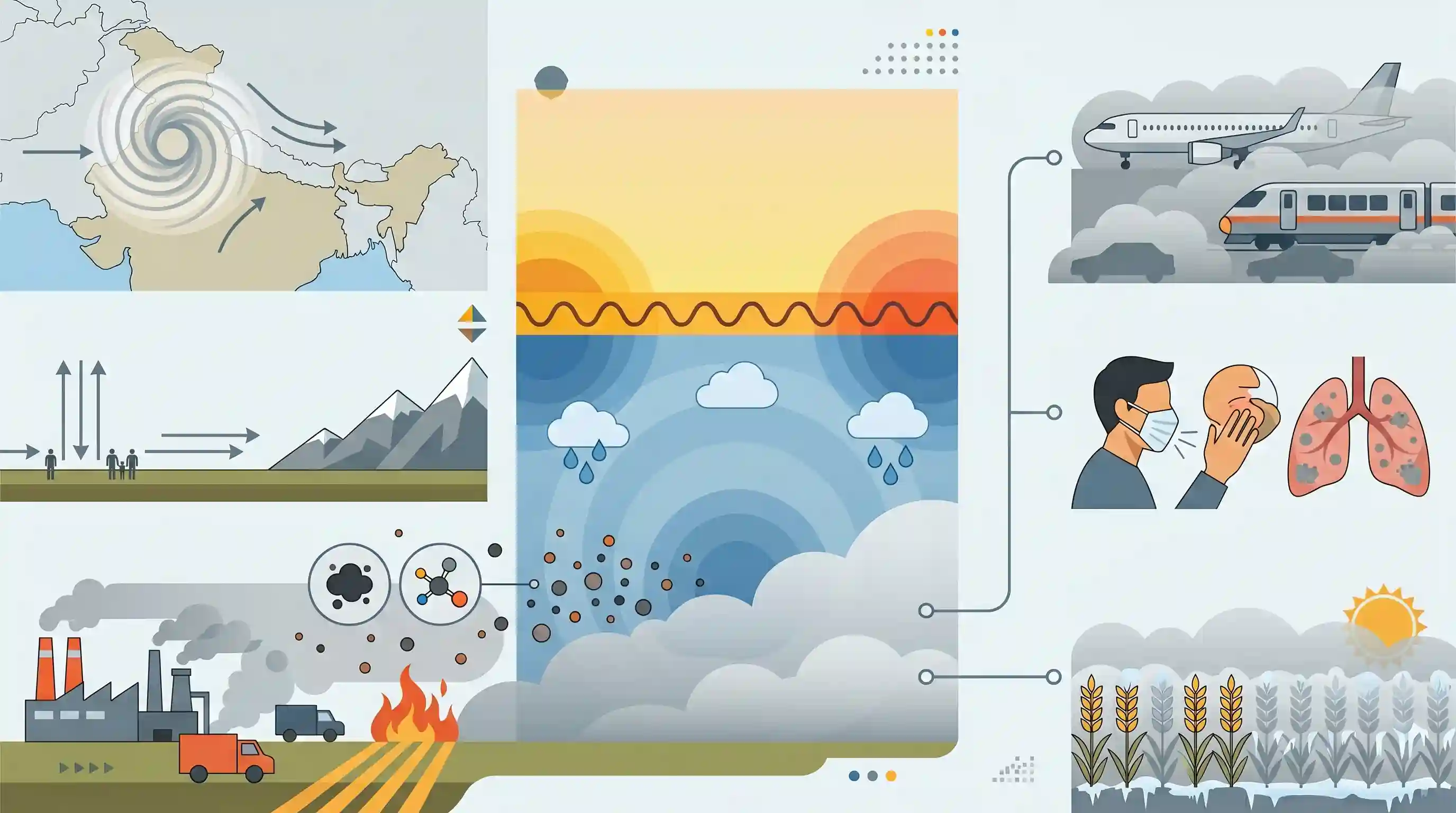
The article explores the meteorological and environmental factors causing an unusually prolonged and dense fog over Punjab, Haryana, and Chandigarh. The primary driver is a persistent temperature inversion that traps cold, moist air close to the ground. This natural winter phenomenon is exacerbated by the absence of active Western Disturbances, which typically bring strong winds to disperse stagnant air. The unique flat topography of the Indo-Gangetic Plains further prevents air circulation. Additionally, high levels of local air pollution provide aerosols that act as condensation nuclei, thickening the fog into smog. This extended spell disrupts transport networks, poses significant health risks due to poor air quality, and threatens winter crop cycles by severely limiting sunlight.
Key Points
- A persistent temperature inversion in the lower atmosphere has trapped cold, moisture-laden air near the surface across North-West India.
- The absence of active Western Disturbances has resulted in calm surface winds, failing to ventilate and clear the stagnant air mass.
- The trough-like topography of the Indo-Gangetic Plains, bounded by the Himalayas to the north, facilitates the accumulation of dense, cold air.
- High concentrations of anthropogenic aerosols act as abundant condensation nuclei, transforming regular winter fog into toxic, lingering smog.
- Prolonged dense fog severely disrupts transportation, poses respiratory health risks, and can reduce rabi crop yields by blocking crucial winter sunlight.
Important Terms
Temperature Inversion

A meteorological phenomenon where temperature increases with altitude, reversing the normal lapse rate. This traps a warm air layer above cooler air, leading to stagnant conditions and trapped surface pollutants.
UPSC context
GS Paper 1 (Climatology); essential for explaining atmospheric stability, fog formation, and winter air quality crises in North India.
Western Disturbances
Extratropical storms originating in the Mediterranean region that bring non-monsoonal winter precipitation to Northwest India. They are steered by the subtropical westerly jet stream and cause sudden rain/snow.
UPSC context
GS Paper 1 (Geography) and GS Paper 3 (Agriculture); crucial for Rabi crops like wheat and regional winter moisture.
National Clean Air Programme (NCAP)
A 2019 MoEFCC initiative targeting a 40% reduction in particulate matter (PM10 and PM2.5) by 2026 in 131 'non-attainment' cities through city-specific action plans and improved monitoring.
UPSC context
GS Paper 3 (Environment); central policy for air pollution mitigation, testing knowledge of targets, stakeholders, and urban governance.
India Meteorological Department (IMD)
The principal agency under the Ministry of Earth Sciences responsible for meteorological observations, weather forecasting, and seismology. It also acts as a Regional Specialized Meteorological Centre for tropical cyclones.
UPSC context
GS Paper 1 & 3; relevant for disaster management, monsoon forecasting, and climate change reporting.
Smog
A hazardous mixture of smoke and fog. Classical smog occurs in cool, moist air, while photochemical smog forms when nitrogen oxides and hydrocarbons react with sunlight.
UPSC context
GS Paper 3 (Environment); tested under air pollution types, health impacts, and mitigation measures like the Graded Response Action Plan.
Condensation Nuclei
Microscopic particles (aerosols) in the atmosphere, such as dust or pollutants, that provide a surface for water vapor to condense, forming fog or cloud droplets.
UPSC context
GS Paper 1 (Geography); links air pollution with meteorological phenomena like persistent winter fog.
Prelims Trap
Dense winter fog in North India is solely caused by the natural cooling of moisture-laden air.
This ignores the role of anthropogenic aerosols. Emissions provide hygroscopic Cloud Condensation Nuclei (CCN), which are essential for intensifying the fog into a lingering, dense smog.
Static Concepts Connected
What are the ideal conditions for a surface temperature inversion?
- Long winter nights: Allows maximum outgoing terrestrial radiation to cool the earth's surface significantly.
- Clear skies: Prevents the trapping of terrestrial heat, allowing uninterrupted and rapid surface cooling.
- Calm winds: Prevents the vertical mixing of warmer and cooler air layers, keeping the cold air trapped at the surface.
What characterizes Western Disturbances affecting the Indian subcontinent?
- Extratropical cyclones: They are extratropical storms originating over the Mediterranean Sea, bringing winter moisture.
- Subtropical Jet Stream: They are steered into northern India by the westerly Subtropical Jet Stream (STJ) in the upper troposphere.
- Ventilation effect: Active WDs bring strong winds that disperse stagnant air and smog, while weak WDs merely add moisture that worsens fog.
Cross-Topic Patterns
Fog dynamics + Rabi crop yields
Prolonged smog blocks Photosynthetically Active Radiation (PAR), stunting wheat maturation. This tightly links winter atmospheric stability to agricultural outputs and potential food inflation.
Topography + Air Pollution accumulation
The Himalayas and the trough-like Indo-Gangetic Plains create a physical basin. This geographical trap prevents horizontal dispersion of winter emissions, directly impeding National Clean Air Programme targets.

Expect a multi-statement Prelims question linking temperature inversion, aerosol concentration, and weak Western Disturbances to crop yields.
Linked PYQs · 3
Linked PYQs · 3
- 2013MainsGS1
What do you understand by the phenomenon of 'temperature inversion' in meteorology? How does it affect weather and the habitants of the place?
- 2025PrelimsGS1
Artificial way of causing rainfall to reduce air pollution makes use of
- 2020MainsGS3
What are the key features of the National Clean Air Programme (NCAP) initiated by the Government of India?
