Climate Education Integration as a Mitigation Strategy in Schools
Source:The Hindu ↗
Why It Matters
It provides a unique, non-technological perspective on climate change mitigation—focusing on human capital and behavioral shifts through education. This overlaps with GS-3 (Environmental Conservation/Mitigation) and GS-4 (Role of educational institutions in inculcating environmental values).
Summary
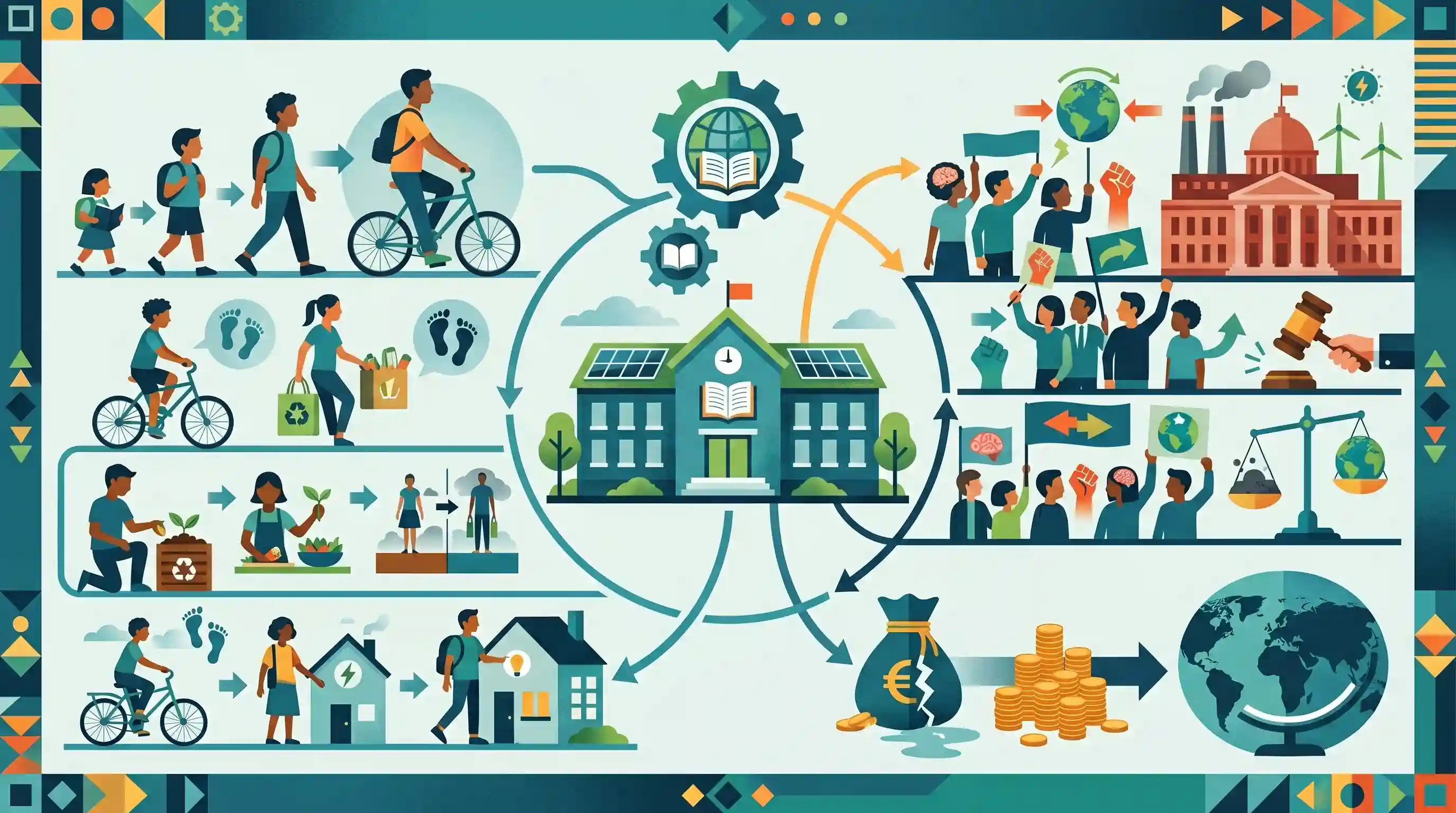
Integrating climate education into mainstream academic curricula is emerging as a critical, non-technological strategy for climate mitigation. Research indicates that educating the youth on climate issues fundamentally shifts long-term behavior, consumption patterns, and lifestyle choices, thereby influencing future emission pathways. Furthermore, a climate-literate population is better equipped for civic engagement to demand accountability from institutions regarding environmental goals. However, climate education remains significantly underfunded and absent from major global climate policy frameworks.
Key Points
- Mainstreaming climate education into regular school curriculums is proposed as a vital climate mitigation strategy, moving beyond mere co-curricular awareness activities.
- Research by Asar Social Impact Advisors highlights that education shapes long-term emissions pathways by directly influencing youth behavior, consumption patterns, and lifestyle choices.
- A climate-literate youth population can foster stronger civic engagement, holding governments and industries accountable for their environmental commitments.
- Despite its high potential impact, climate education is currently largely absent from mainstream climate policy and global climate financing mechanisms.
Important Terms
Asar Social Impact Advisors

A Bengaluru-based social impact firm that researches climate resilience and air quality. It collaborated with Tamil Nadu to develop climate literacy modules for over 11,000 government schools.
UPSC context
GS III: Environment and Education. Examines the role of non-governmental advisors in sub-national climate policy and experiential learning.
Climate Literacy
An individual’s understanding of human influence on climate and climate’s influence on society. It enables informed decision-making and responsible actions regarding environmental sustainability.
UPSC context
GS III: Environment. Tests awareness of non-technological mitigation strategies and the integration of environmental science into mainstream education.
Behavioral Economics
A method of economic analysis applying psychological insights to human behavior. In climate policy, it uses 'nudges' to shift consumer choices toward low-carbon lifestyles.
UPSC context
GS III/IV: Economy and Ethics. Relevant for questions on public policy tools (like Nudge theory) to achieve sustainable development goals.
Action for Climate Empowerment (ACE)
The UNFCCC mandate (Article 6) focused on six pillars: education, training, public awareness, public participation, public access to information, and international cooperation on climate change.
UPSC context
GS III: International Relations/Environment. Pertains to global climate frameworks and the mobilization of civil society for climate action.
Climate Change Mitigation
Human interventions aimed at reducing the sources or enhancing the sinks of greenhouse gases to limit the magnitude of global warming.
UPSC context
GS III: Environment. Fundamental concept for discussing strategies (technological vs. educational) to meet Paris Agreement targets.
Prelims Trap
Global climate financing mechanisms like the Green Climate Fund mandate specific funding quotas for mainstreaming climate education.
Aspirants might assume modern climate funds heavily back behavioral shifts, but the article explicitly notes education remains significantly underfunded and excluded from mainstream global climate financing mechanisms.
Static Concepts Connected
What is the 'Lifestyle for Environment' (LiFE) initiative?
- Origin: Introduced by India at COP26 (Glasgow) in 2021 as a mass movement to promote sustainable lifestyles.
- Core Philosophy: Focuses on 'mindful and deliberate utilization' rather than 'mindless and destructive consumption'.
- Nudge Theory: Relies on behavioral economics to shift individual choices toward climate-friendly alternatives, utilizing citizens as 'Pro-Planet People'.
How do Indian frameworks mandate environmental education?
- Supreme Court Directive: In the M.C. Mehta case (1991), the Court directed that environmental education must be a compulsory subject in schools and colleges.
- NEP 2020: Emphasizes the integration of environmental awareness, including climate change, pollution, and biodiversity, across all educational stages.
- Fundamental Duties: Article 51A(g) obligates every citizen to protect and improve the natural environment, establishing an ethical mandate for environmental literacy.
Cross-Topic Patterns
Nudge Theory and Climate Action
Linking behavioral economics to environmental goals is a growing trend, utilizing climate education to 'nudge' youth toward the LiFE movement and organically reduce aggregate demand for carbon-intensive goods.
Demographics and the Multiplier Effect
India's youth bulge means educational interventions carry a massive intergenerational multiplier effect. As World Bank data shows, educated youth can actively shift their parents' household consumption patterns.

Expect a Mains GS-3 or GS-4 question linking the LiFE movement, behavioral economics, and value-based environmental education for youth.
Linked PYQs · 3
Linked PYQs · 3
- 2022MainsGS3
Discuss global warming and mention its effects on the global climate. Explain the control measures to bring down the level of greenhouse gases which cause global warming, in the light of the Kyoto Protocol, 1997.
- 2024MainsGS4
“Ethics encompasses several key dimensions that are crucial in guiding individuals and organizations towards morally responsible behaviour.” Explain the key dimensions of ethics that influence human actions. Discuss how these dimensions shape ethical decision-making in the professional context.
- 2020MainsGS4
Discuss the role of ethics and values in enhancing the following three major components of Comprehensive National Power (CNP) viz. human capital, soft power (culture and policies) and social harmony.
