Climate Education Real-World Challenges and AC Demand Impact
Source:The Hindu ↗
આ શા માટે મહત્વનું છે
This article bridges the gap between environmental theory and actionable governance/education. For UPSC aspirants, it connects GS3 topics (climate change, HFCs, ICAP) with GS2 (NEP 2020) and GS1 (Urbanization and heat islands), demonstrating how policy and education must align to achieve behavioral change for sustainable development.
સારાંશ
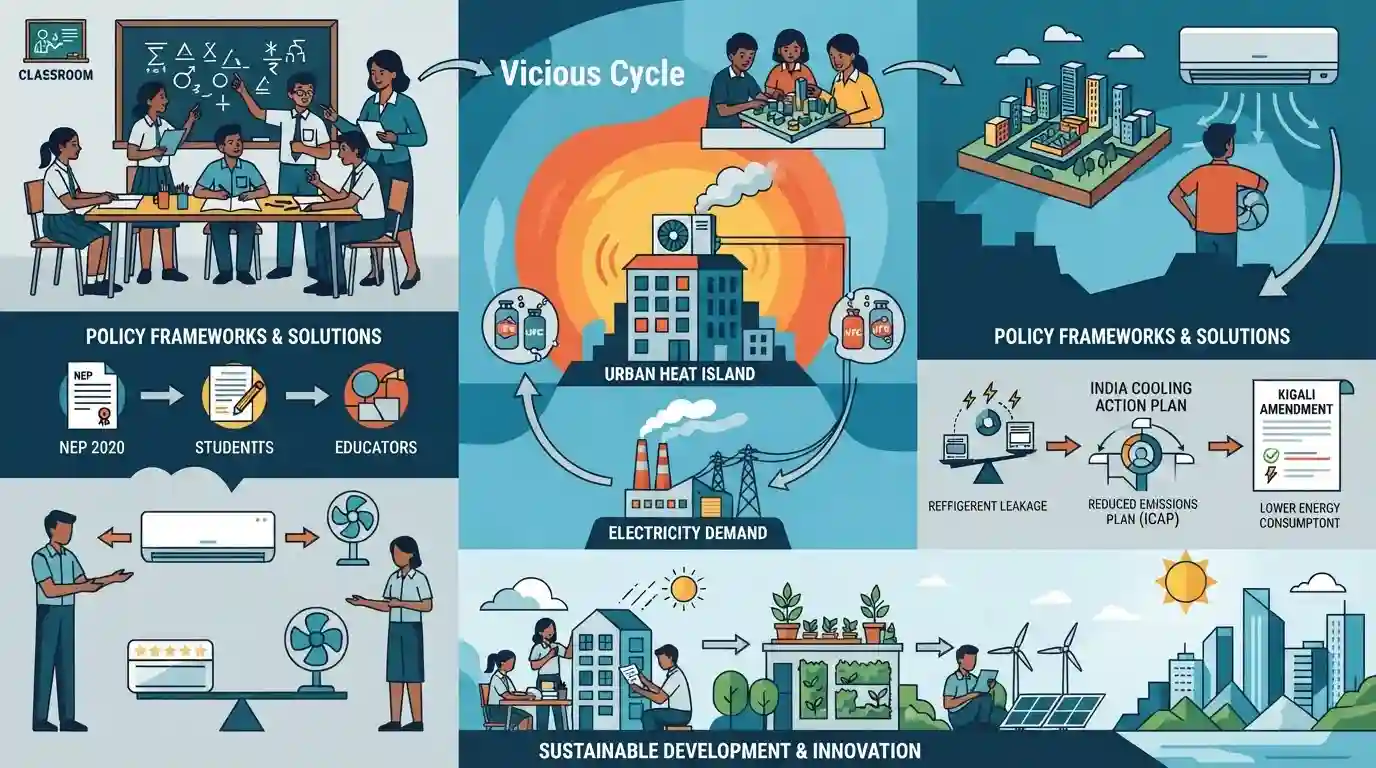
The article argues for a paradigm shift in climate education, advocating that it should move beyond theoretical concepts and focus on relatable, real-world challenges. It highlights the rising demand for Air Conditioners (ACs) as an ideal case study. AC usage creates a vicious cycle of global warming by consuming vast amounts of electricity, leaking potent greenhouse gases like Hydrofluorocarbons (HFCs), and worsening the Urban Heat Island effect. By leveraging the framework of the National Education Policy (NEP) 2020, educators can use such practical examples to foster genuine climate literacy. Connecting daily consumer choices to broader policies like the India Cooling Action Plan (ICAP) and the Kigali Amendment can inspire students to adopt sustainable behaviors and seek innovative solutions, making climate education more effective and action-oriented.
મુખ્ય મુદ્દા
- Traditional climate education often focuses on abstract concepts, which can fail to motivate personal behavioral change among students.
- The soaring demand for Air Conditioners (ACs) serves as a tangible, real-world example to teach the interconnectedness of consumer behavior and global warming.
- ACs contribute to a vicious cycle of climate change through high electricity consumption (often from fossil fuels), the emission of potent greenhouse gases like Hydrofluorocarbons (HFCs), and exacerbating the Urban Heat Island effect.
- The National Education Policy (NEP) 2020 emphasizes holistic environmental awareness, offering a framework to integrate practical climate challenges into school curricula.
- Educating students on sustainable cooling alternatives and policies like the India Cooling Action Plan (ICAP) can bridge the gap between climate theory and sustainable action.
મહત્વપૂર્ણ શબ્દો
India Cooling Action Plan (ICAP)

A 20-year integrated roadmap launched in 2019 to provide sustainable cooling across sectors, targeting a 20-25% reduction in cooling demand and a 25-40% reduction in cooling energy requirements by 2037-38.
UPSC context
GS Paper III (Environment/Energy Security); tests strategies for sustainable development, climate action, and resource efficiency.
Kigali Amendment to the Montreal Protocol
A legally binding 2016 amendment to the Montreal Protocol targeting a global phase-down of hydrofluorocarbons (HFCs)—potent greenhouse gases—to prevent up to 0.5°C of warming by 2100.
UPSC context
GS Paper III (Environment & Ecology); frequently tested in Prelims (international treaties) and Mains (global warming mitigation).
Urban Heat Island (UHI) Effect
A microclimatic phenomenon where urban areas experience significantly higher temperatures than nearby rural areas, driven by dense concrete structures, asphalt surfaces, low albedo, and anthropogenic heat.
UPSC context
GS Paper I (Geography) & GS Paper III (Urbanization/Environment); tests knowledge on urban microclimates, heatwaves, and mitigation strategies.
National Education Policy (NEP) 2020
India's comprehensive 21st-century education framework designed to restructure schooling (5+3+3+4 model) and higher education, emphasizing holistic, flexible, multidisciplinary learning, and universal access aligned with SDG 4.
UPSC context
GS Paper II (Social Justice/Education); tests understanding of institutional reforms, human resource development, and educational governance.
UN Environment Programme (UNEP)
The principal global UN agency established in 1972 to set the international environmental agenda, coordinate environmental activities, and promote the implementation of sustainable development worldwide.
UPSC context
GS Paper III (International Organizations); tested in Prelims (reports like Emissions Gap Report) and Mains (global climate governance).
Ministry of Environment, Forest and Climate Change (MoEFCC)
The nodal Union ministry responsible for planning, promoting, coordinating, and overseeing the implementation of India's environmental, forestry, wildlife conservation, and climate change policies.
UPSC context
GS Paper II (Governance) & GS Paper III (Environment); tested on national environmental regulations, conservation schemes, and clearances.
પ્રિલિમ્સ ટ્રેપ
"The Kigali Amendment to the Montreal Protocol aims to phase down ozone-depleting Hydrofluorocarbons (HFCs)."
HFCs do not deplete the ozone layer (zero ODP). They are targeted by the Montreal Protocol's Kigali Amendment strictly because of their massive Global Warming Potential.
સંલગ્ન સ્થિર ખ્યાલો
What is the Kigali Amendment to the Montreal Protocol?
- Core Target: Aims for the gradual, legally binding global phase-down of Hydrofluorocarbons (HFCs), which were introduced as alternatives to CFCs.
- HFC Properties: Unlike CFCs/HCFCs, HFCs do not deplete the ozone layer, but they are potent greenhouse gases with high Global Warming Potential (GWP).
- India's Commitment: India is grouped with countries that will phase down HFCs by 85% by 2047, using a 2024-2026 baseline.
What are the key features of the India Cooling Action Plan (ICAP)?
- First of its kind: Launched in 2019, India is the first country to release a comprehensive 20-year roadmap (2017-18 to 2037-38) for cooling requirements.
- Demand Reduction: Aims to reduce overall cooling demand across sectors by 20% to 25% by the year 2037-38.
- Refrigerants & Skilling: Focuses on reducing refrigerant demand by 25-30% and training 100,000 servicing sector technicians (under Skill India) by 2022-23.
આંતર-વિષય પેટર્ન
Urban Heat Islands & Microclimates
Linking AC waste heat to urban microclimates bridges GS1 (urbanization) and GS3 (climate change), a recurring analytical theme in recent mains questions evaluating smart cities and urban resilience.
Kigali targets + Energy Efficiency
Phasing down HFCs must be coupled with cooling efficiency (BEE star ratings), blending international treaty commitments (Kigali) with domestic power sector demand-side management.

Expect a multi-statement Prelims question pairing India's 2047 Kigali targets, HFCs' zero ozone depletion potential, and ICAP goals.
સંલગ્ન PYQ · 3
સંલગ્ન PYQ · 3
- 2023PrelimsGS1
Consider the following: 1. Aerosols 2. Foam agents 3. Fire retardants 4. Lubricants In the making of how many of the above are hydrofluorocarbons used?
- 2022MainsGS3
Discuss global warming and mention its effects on the global climate. Explain the control measures to bring down the level of greenhouse gases which cause global warming, in the light of the Kyoto Protocol, 1997.
- 2013MainsGS1
Bring out the causes for the formation of heat islands in the urban habitat of the world.
