UPI Transaction Charges and Digital Payments Ecosystem Viability
Source:The Hindu ↗
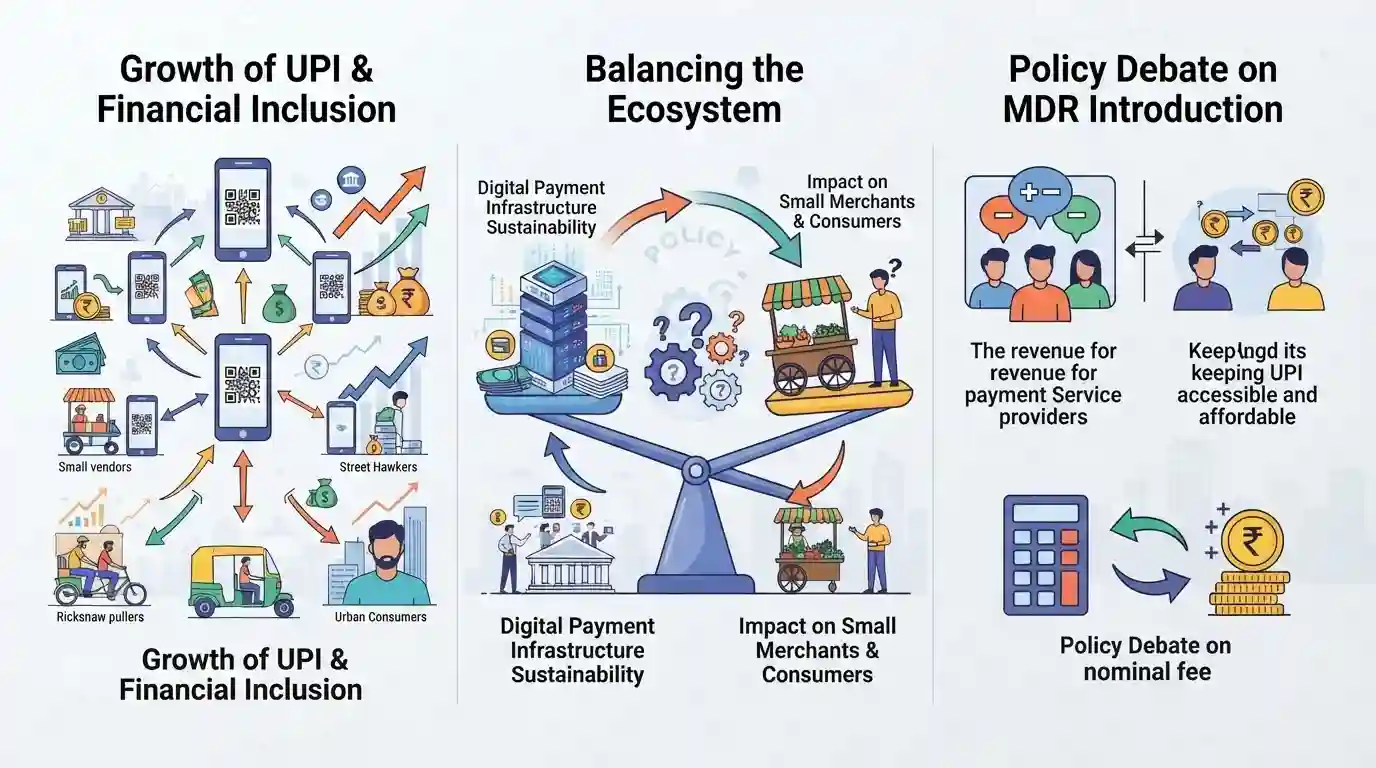
Why It Matters
It deals with the viability of India's flagship digital public infrastructure (UPI) and the ongoing policy debate between zero-cost transactions and long-term economic sustainability for banks and fintech companies.
Summary
An analysis of the policy and economic implications of introducing charges or Merchant Discount Rate (MDR) for Unified Payments Interface (UPI) transactions in India, balancing financial inclusion and digital payment ecosystem sustainability.
Key Points
- The debate over charging for Unified Payments Interface (UPI) transactions centers around the economic viability for fintech companies and banks versus the goal of financial inclusion.
- Zero Merchant Discount Rate (MDR) on UPI has spurred massive adoption but places a heavy financial burden on banks and payment service providers (PSPs).
- Introducing charges or a rationalized MDR could change the transaction math, potentially impacting user adoption volume while ensuring sustainable digital infrastructure.
- Balancing digital public goods (DPGs) growth with market incentives remains a critical regulatory challenge for the RBI.
Important Terms
Unified Payments Interface (UPI)

An instant real-time payment system developed by the National Payments Corporation of India enabling inter-bank transactions through a mobile device using virtual payment addresses.
UPSC context
UPSC GS Paper III (Economy/Digital Payments): Tests understanding of financial inclusion, digital infrastructure, and payment ecosystem evolution in India.
Reserve Bank of India (RBI)
India's central banking institution established under the RBI Act of 1934, responsible for regulating monetary policy, currency issuance, and the banking system.
UPSC context
UPSC GS Paper III (Indian Economy): Essential for questions on monetary policy, banking regulation, inflation control, and financial stability.
National Payments Corporation of India (NPCI)
An umbrella organization for operating retail payments and settlement systems in India, created by the RBI and Indian Banks' Association under the Payment and Settlement Systems Act, 2007.
UPSC context
UPSC GS Paper III (Economy): Tests institutional frameworks governing retail payments infrastructure like UPI, RuPay, and IMPS.
Prelims Trap
Zero-MDR policy applies universally to all UPI transactions without exception across person-to-person and merchant payments.
Aspirants often assume zero-MDR applies uniformly across all UPI transactions. In reality, large-value P2M transactions may attract charges while P2P and small P2M under ₹2,000 remain zero-MDR.
Static Concepts Connected
What is the Merchant Discount Rate (MDR) and how does it function in digital payments?
- Definition: Fee structure paid by a merchant to a bank for accepting digital payments from customers.
- Purpose: Covers infrastructure costs, payment gateway services, and bank processing charges.
- Regulation: Regulated heavily by RBI to ensure digital adoption without harming bank balance sheets.
Cross-Topic Patterns
Digital Public Goods vs. FinTech Viability
The debate over zero-MDR on UPI mirrors controversies around zero-rating data tariffs (net neutrality) and the long-term economic sustainability of Digital Public Goods.

MDR on UPI and digital public goods sustainability is a high-probability UPSC Mains GS3 question in Indian Economy & IT sectors.
Linked PYQs · 2
Linked PYQs · 2
- 2023MainsGS3
What is the status of digitalization in the Indian economy? Examine the problems faced in this regard and suggest improvements.
- 2022MainsGS3
Is inclusive growth possible under market economy ? State the significance of financial inclusion in achieving economic growth in India.
